
An actuator is any device that converts one form of energy into physical, linear force. From a fundamental definition of the word, one could assert that motors are also actuators, but from a practical perspective, the machine world agrees on the linear definition.
The primary source of energy can be pressurized air or liquid, electricity, or another mechanical force. The execution of force may be pushing, pulling, rotating, or clamping, but how that looks varies widely depending on the technology. For this discussion, we’ll ignore mechanical actuators, a method of force transmission that our field is dedicated to replacing.
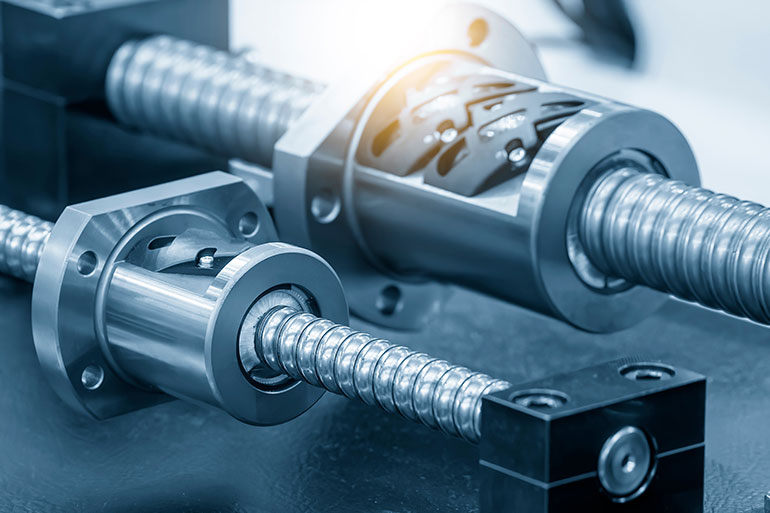
Ball screw actuators are highly efficient, offering well over 90% mechanical efficiency.
Electrical actuators are the most interesting and, oddly enough, seem to have hijacked the term. If you google “actuators” and then click the Shopping tab, the results are entirely electric. They’re interesting in the way that most of their kind require a rotary motor and some sort of ball screw, lead screw, or belt drive. There are “linear motors” that use a bed of permanent magnets and a floating platform capable of insane power and acceleration. However, they are expensive, finicky, and energy-hungry, so we’ll discuss the common ball screw style actuators.
Electric motors are clean, efficient, and versatile, making them popular for actuators when combined with a method to convert rotational force into linear force. Using a helical device, such as a ball screw, the rotational input is converted into an axial output.
Ball screw actuators are highly efficient, offering well over 90% mechanical efficiency. They employ recirculating steel balls (like those in old American car steering racks) that roll continuously with low friction and are great at carrying an inertial load with little power.
Planetary roller screws are also highly efficient, turning at least 85% of their mechanical input into linear force. The reduced efficiency comes from the sheer amount of contact surface, but these actuators take the win when it comes down to extreme thrust potential.
The lead screw is by far the least efficient option for linear actuators, which are lucky to achieve 50% in the best circumstances. Most of the energy is wasted as friction, but that high friction also makes them self-locking. They will hold a load in place with zero power draw and are the only real choice when standby power drops to zero.
Each type of electrical actuator spans a wide range of performance, from the low-powered devices that open your tailgate to the asynchronous drives used in motion control simulators. When selecting a linear actuator, remember that it essentially operates like a gearbox, so you can choose a gear ratio that suits your application. A high-speed, 5:1 “gearbox” will provide a snappy actuator that sacrifices force, while choosing upwards of 60:1 gets you massive thrust at snail-pace speed.

Hydraulic cylinders enjoy nearly 100% volumetric efficiency and have unexplored limits in power density.
Fluid power actuators operate quite differently, accepting a pressurized, flowing fluid to convert into linear mechanical force. Pneumatic cylinders use pressurized air, of course, which requires continuous fulfillment from an air compressor. They are the king of acceleration and high velocity, providing explosive force from a standstill while still achieving over 85% efficiency (not including the compressor). However, their high-pressure force potential is limited by the danger posed by compressed air and the difficulty of compressing it efficiently.
That leads us to the grandfather of linear actuators; the hydraulic cylinder. Are they messy? Sometimes. Do they require expensive accouterments? Certainly. Are they unmatched in power density? Now and always.
Although if you compared the electrons used at the power unit to the actual power output of a hydraulic cylinder, a 50% overall efficiency is a fair ratio to expect. But hydraulic cylinders enjoy nearly 100% volumetric efficiency and have unexplored limits in power density. Where an electric actuator may be “plug and play” compared to the operational requirements of a hydraulic cylinder, there is no way to achieve more linear force in a smaller space than with a hydraulic cylinder. They’re responsive, reliable, and easily customized, to boot.
There’s never been a better time to build machinery, and with so many choices of actuators, there’s not much you can’t achieve within the boundaries of your available energy source. Should you be so creative, nothing is stopping you from using all three on the same machine, taking advantage of the benefits of each.
Filed Under: Components, Cylinders & Actuators, Engineering Basics
