
Thanksgiving is over, and now we’re in that weird pocket of reduced productivity until January, when we’ve finally digested six weeks’ worth of holiday feast. Sure, we get by and look busy, which explains why I get more walk-in cold calls during this period than the rest of the year combined. It’s not that I don’t appreciate the poinsettias and butter cookies, but I’ve got stuff to do before our Christmas shutdown, so maybe read the room and see yourself out after my sixth deadpan response of, “Oh wow … crazy.”
Productivity is essential; we all chase our profitability growth targets to convince corporate stakeholders to keep those Christmas bonuses flowing, and to procrastinate one more year on our artificial intelligence Kaisan event. Indeed, the promise of shorter workweeks resulting from increased productivity has always been the carrot on a stick promised to workers for the adoption of production lines, automation, computers, and now, artificial intelligence.
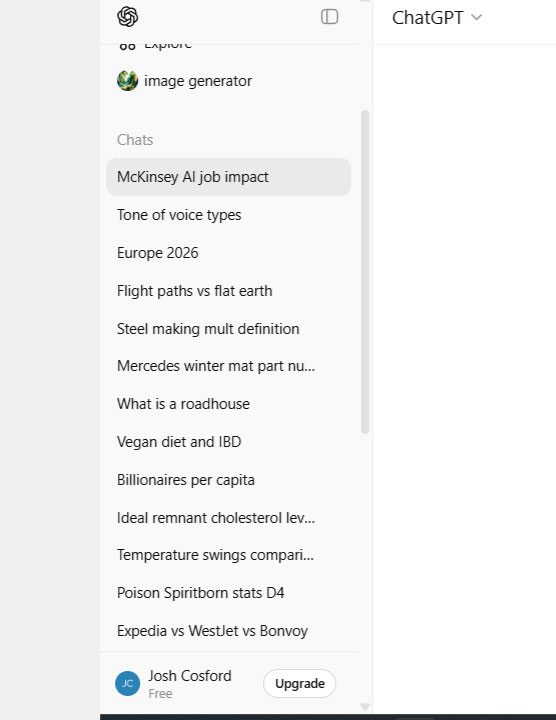
The author’s AI chats show it’s mostly just a replacement for search functions.
I don’t know about you, but I’m writing this in my office on a Friday, and I don’t have the following Monday off. So, is AI really the answer this time or just another broken promise? If you listen to the doomsayers, it appears you’re going to get that extra time off work, but not in the way you hoped. I’m sure you’ve seen or heard some of the modelling data from McKinsey & Company predicting that 30% of all current work could be automated by 2030, with a further 5% of jobs being replaced by AI altogether.
I don’t know about you, but I’m just not buying it. I’ve been around factories, machinery, automation, Industry 4.0, and the talk of the promised land for a long time, and the roadblocks aren’t what you think they are. The technology exists, yes, and some companies are better at adopting automation and AI than others. The problem is that many experts forget that 98% of businesses and corporations are “small,” and that nearly 50% of the workforce receives pay stubs from them.
Small factories, fluid power distributors, hose shops, and service outfits don’t just lack the knowledge to implement AI; they also lack the financial resources to undertake grand projects in which robots build, maintain, and configure flexible workstations or machinery. The time and money redirected from management and operational cash flow would bury the company before any such AI advantage was realized.
Sure, mega-cap companies like Amazon and Apple can afford the entire departments required to implement these cutting-edge technologies, and that’s perfectly fine, because we’re happy to get our protein powder delivered for free on a Sunday through our Prime membership. But when your best customer comes in with a goofy hose and fitting, how will AI help you find that old adapter we had sitting on the test stand that will get said customer out of a jam?
What McKinsey et al forget is how much humans like doing human things. We like face-to-face meetings, solving problems, helping others and feeling valued. When a small business owner is pressed with taking out a $250k business loan so AI and automation can replace one human, it’s not much of a business case unless the ROI is clear. And that’s the problem — it’s not. Just like Big Data, artificial intelligence has, so far, been little more than a party trick to replace your Google search. To prove my point, look at my actual ChatGPT chats above from just the past few days, which I’m not embarrassed to share.
I’m not so short-sighted as to believe AI won’t replace many jobs with information technology or art, which we already know it has. I’m trying to convince my son to ditch his aspirations as a computer animator, and you definitely don’t want to start that paralegal career. But we’ve still got 30 years before an Optimus robot will be good enough to build a hydraulic power unit. So stop doomscrolling, book those Christmas luncheons, and enjoy work and life like you have for the past three decades.
Filed Under: Trending
