
By Ron Marshall
In many industrial plants, the real cost of compressed air isn’t just the air being used on the production floor, it’s the energy consumed when the compressor is running — but not producing useful air. Choosing the wrong operating mode for your compressor can be surprisingly expensive. It’s a bit like sitting at a red light with your car engine revving high. Fuel is being burned, but you’re not going anywhere.
Energy specialists working with compressed air systems regularly see facilities lose thousands of dollars every year simply because the compressor control strategy doesn’t match the plant’s demand profile. Understanding the different operating modes is one of the simplest ways to uncover hidden energy waste.
Let’s take a closer look at the most common compressor control strategies and how they affect efficiency.
Start/stop control
Start/stop control is the simplest method. The compressor starts when system pressure drops below a set point and shuts off completely when the pressure reaches the upper limit.
This approach is very efficient because the motor turns off entirely when air is not needed. However, it’s typically limited to smaller reciprocating compressors with relatively infrequent demand cycles. Large rotary screw compressors generally cannot use this method because repeated motor starts generate heat and cause excessive wear on the equipment.
Load/unload (online/offline)
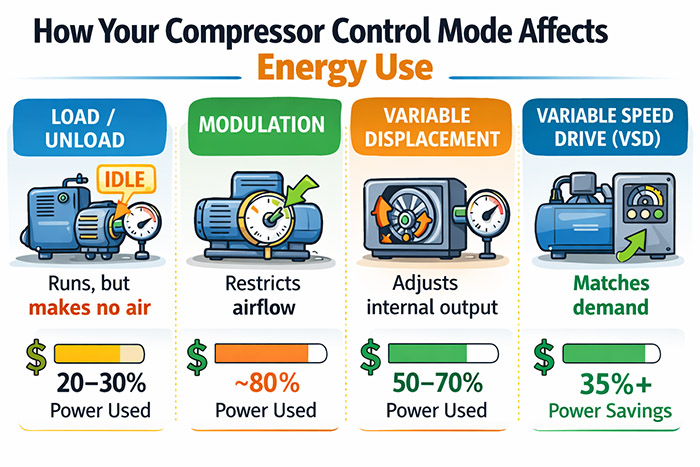
Load/unload control is extremely common in rotary screw compressors. In this mode, the motor continues to run even after system pressure reaches the upper set point, but the compressor stops producing air.
While this avoids repeated motor starts, it introduces a hidden cost. An unloaded compressor can still consume 25–30% of its full-load power while producing zero air. If the system does not have enough receiver tank capacity to stabilize pressure, the compressor can short cycle between load and unload repeatedly. This wastes energy and increases mechanical wear.
Modulation (inlet throttling)
Modulation control adjusts output by restricting the air entering the compressor. The inlet valve partially closes to reduce capacity while the compressor continues to run.
Although this method keeps system pressure very stable, it is one of the least efficient control strategies. A compressor operating at only 50% capacity under modulation can still consume 80% or more of its full-load power. In effect, the machine is working nearly as hard but producing much less air.
Variable displacement control
Some compressors use variable displacement technology to adjust capacity by altering the internal compression process. This allows the compressor to reduce output without fully unloading.
While more efficient than traditional modulation, variable displacement systems still experience efficiency losses at lower loads. They are often used to maintain stable pressure while avoiding frequent load/unload cycling.
Variable speed drive (VSD)
Variable speed drive technology is widely considered the most efficient control method for systems with fluctuating demand. Instead of running at a fixed speed, the motor adjusts its speed to match the plant’s air demand in real time.
This allows the compressor to produce exactly the amount of air required without wasting energy in unloaded operation. In many applications, properly applied VSD compressors can deliver energy savings of 35% or more.
Don’t forget the pressure factor
Beyond control modes, system pressure also plays a major role in energy consumption. The rule of thumb promoted by the Compressed Air Challenge is simple: for every 2-psi reduction in system pressure, energy consumption drops by roughly 1%.
Reducing pressure also lowers artificial demand and leak losses throughout the plant by about 1% for every 1 psi reduced if the demand is unregulated.
The bottom line
If your compressor is running unloaded more than 25% of the time, it may be of benefit to evaluate your control strategy. Proper receiver sizing, better system controls, or upgrading to a more efficient operating mode can dramatically reduce energy waste.
Compressed air is often called the “fourth utility,” but unlike electricity or water, inefficiencies can hide quietly in the background. Taking the time to understand how your compressor operates may reveal that you’re paying for far more air than your plant actually uses.
Filed Under: Air Compressors, Air Preparation, Components, Compressed Air Technologies, Engineering Basics, Pneumatic Tips
