Fluid Power World

  • Home
  • Technologies
    • Hydraulics
      • Cylinders & Actuators
      • Filtration/Contamination Control
      • Fittings, Couplings & Adapters
      • Fluids
      • Fluid Conditioning
      • Hose & Tubing
      • Pumps & Motors
      • Related Technologies
      • Sealing
      • Sensors & Gauges
      • Valves & Manifolds
    • Pneumatics
      • Air Preparation & Regulation
      • Compressed Air Technologies
      • Cylinders & Actuators
      • End Effectors & Grippers
      • Fittings, Couplings & Adapters
      • Hose & Tubing
      • Sensors
      • Vacuum
      • Valves & Manifolds
  • Engineering Basics
  • Trending
  • Resources
    • Digital Issues
    • Pneumatics Tech Toolbox
    • Podcasts
    • Special Reports
    • Subscribe to Fluid Power World Print Magazine
    • Videos
    • Webinars / Digital Events
    • White Papers
  • Women in Engineering
    • Women in Fluid Power
    • Women in Engineering
  • Design Guides
  • Classrooms
    • Hydraulic Filtration
    • Hydraulic System Design
    • Pneumatics Classroom
  • Advertise
  • SUBSCRIBE

Bladder accumulator fundamentals

By Josh Cosford | August 26, 2026

Share

Bladder accumulators are an industry-standard choice, as commonly available as D03 valves or NFPA-style hydraulic cylinders. Your outside sales team is always happy to see them in a factory, because everyone offers an option to either repair or replace them. The big names all make them (or bought companies that make them), but there are also plenty of “off-brand” choices for the smaller hydraulic shops to choose from.

Their popularity did not come by accident — they offer many advantages that were adopted by the U.S. military for aircraft during WWII as backup power should a pump fail or be damaged. The design by French inventor Jean Mercier proved superior, using a poppet valve to protect the bladder from damage when the working pressure dropped to zero.
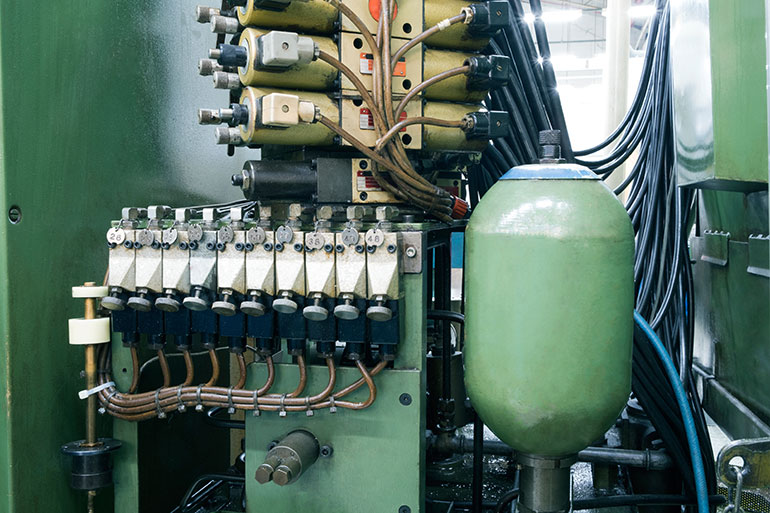
It is best to mount bladder accumulators vertically, as in this system.

It is best to mount bladder accumulators vertically, as in this system.

Post-war, Mercier partnered with Olaer in Europe and Greer in North America to produce bladder accumulators, whose utilization accelerated after the invention of synthetic rubber. It just so happened that this shell made from seamless tube provided the strength to handle thousands of PSI, while the bladder design offered many advantages that, eventually, led to manufacturers copying their design decades later. Today, most bladder accumulators are entirely interchangeable, including their repair kits.

Their popularity is due to their multitude of performance advantages. Everyone loves their fast response time, which is a result of the low mass of the rubber bladder, which, when subjected to thousands of psi, reacts almost instantly. This makes them, when sized correctly, perfect for high-frequency shocks and pulsations, as well as instantaneous surge supply.

Unlike piston accumulators, which rely on sealing the piston against the barrel wall, bladder accumulators allow complete isolation of gas and fluid from one another. There is no chance, except in the event of complete failure, of oil passing to the gas side. That said, a tiny fraction of nitrogen can still pass through the bladder into the oil side, so be sure to monitor precharge pressure.

Bladder accumulators are generally maintenance-free, except when they fail catastrophically, which generally, only occurs past the rubber’s service life. When replaced every 3 to 5 years, you never risk failures that might occur with a decade-old bladder. Also be sure never to exceed a 4:1 compression ratio, which will make short work of the bladder as it folds, creases, and wrinkles rapidly. There are formulas to calculate the ideal precharge pressure, but these accumulators are generally most reliable when precharged to 60-80% of the system’s minimum operating pressure.

Another consideration with bladder accumulators is their relatively limited operational window in extreme climates. The bladder material can soften in extreme heat and, of course, become brittle in the cold. If you’re able to pre-warm the accumulator prior to operation, that certainly helps. But subjecting a sub-zero bladder to instantaneous forces is a recipe for disaster.

Finally, bladder accumulators do have a preference to stand tall and proud. It’s preferred to mount them vertically, with the fluid port facing downward. A horizontal bladder may float to one side, causing friction or uneven wear and stretching. Despite its limitations, the bladder accumulator will remain the most popular design in most markets, thanks to the brilliance of Jean Mercier.

Read more about accumulator safety here.


Filed Under: Accumulators, Components, Engineering Basics


About The Author

Josh Cosford

Current Digital Issue

Fluid-Power-World-October-2026-issue-Cover-feature-image-template-copy

  A note from the editor In our October issue of Fluid Power World, my commentary takes a look at the growing role of automation and sensors in mobile machinery, where OEMs are increasingly focused on automating specific functions and improving machine performance rather than chasing fully autonomous equipment. Josh Cosford gets cheeky comparing the auto…

View Back Issues

Subscribe!

Fluid Power World is written by engineers for engineers engaged in designing machines and or equipment in Off-Highway, Oil & Gas, Mining, Packaging, Industrial Applications, Agriculture, Construction, Forestry, Medical and Material Handling. Fluid Power World covers pneumatics, mobile hydraulics and industrial hydraulics.

Fluid Power Design Guides

fluid
“fpw
EXPAND YOUR KNOWLEDGE AND STAY CONNECTED
Get the latest info on technologies, tools and strategies for Fluid Power Professionals.

RSS feed: Featured White Papers Featured White Papers

  • Moving fluid power forward
  • High-force linear motion: How to convert from hydraulic cylinders to electric actuators and why.
  • A technical comparison: Performance of pneumatic cylinders and electric rod actuators
Fluid Power World
  • Hose Assembly Tips
  • Mobile Hydraulic Tips
  • Pneumatic Tips
  • Sealing & Contamination Control Tips
  • About us
  • Contact Us

Copyright © 2026 Arrowfly LLC. All Rights Reserved. The material on this site may not be reproduced, distributed, transmitted, cached or otherwise used, except with the prior written permission of Arrowfly
Privacy Policy | Advertising | About Us

Search Fluid Power World

  • Home
  • Technologies
    • Hydraulics
      • Cylinders & Actuators
      • Filtration/Contamination Control
      • Fittings, Couplings & Adapters
      • Fluids
      • Fluid Conditioning
      • Hose & Tubing
      • Pumps & Motors
      • Related Technologies
      • Sealing
      • Sensors & Gauges
      • Valves & Manifolds
    • Pneumatics
      • Air Preparation & Regulation
      • Compressed Air Technologies
      • Cylinders & Actuators
      • End Effectors & Grippers
      • Fittings, Couplings & Adapters
      • Hose & Tubing
      • Sensors
      • Vacuum
      • Valves & Manifolds
  • Engineering Basics
  • Trending
  • Resources
    • Digital Issues
    • Pneumatics Tech Toolbox
    • Podcasts
    • Special Reports
    • Subscribe to Fluid Power World Print Magazine
    • Videos
    • Webinars / Digital Events
    • White Papers
  • Women in Engineering
    • Women in Fluid Power
    • Women in Engineering
  • Design Guides
  • Classrooms
    • Hydraulic Filtration
    • Hydraulic System Design
    • Pneumatics Classroom
  • Advertise
  • SUBSCRIBE