
Earlier this year, Bosch Rexroth appointed new leaders of its Compact Hydraulics Business Unit. At CONEXPO/CON-AGG, I had a chance to sit down with the new leadership for Bosch Rexroth’s Compact Hydraulics Business Unit. Learn what Matthias Goebel, President & CEO Bosch Rexroth Compact Hydraulics, and Angelo D’Ammando, VP Sales Compact Hydraulics, say the future holds for the global manufacturer of compact hydraulics motion control solutions.
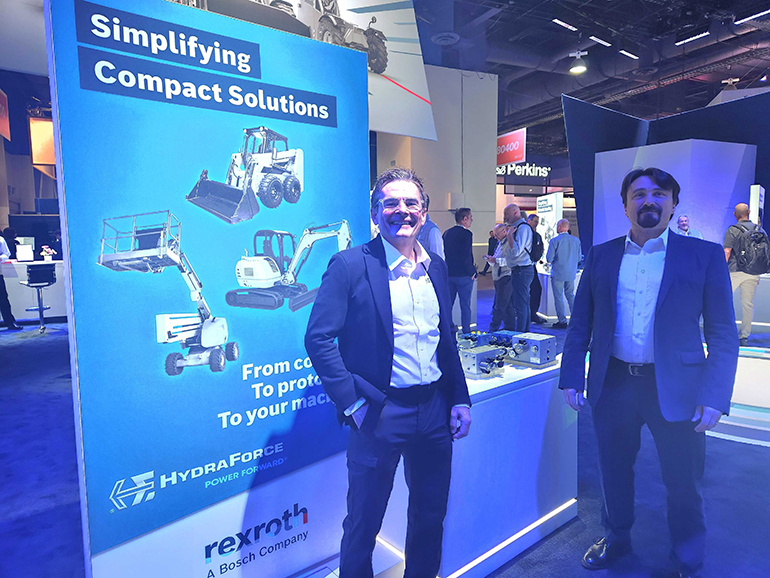
Matthias Goebel, President & CEO Bosch Rexroth Compact Hydraulics, and Angelo D’Ammando, VP Sales Compact Hydraulics at CONEXPO.
Q: What led Bosch Rexroth to create a new leadership structure for Compact Hydraulics?
Goebel: North America is an extremely important market for us, and that’s one of the reasons we made changes to our management board. We’ve invested a lot in the HydraForce brand, which is a strong brand, and we want to build on that.
At the end of the day, it was my decision to bring a team I know well to the U.S. to emphasize the importance of the North American market.
Our board has three members in North America, including myself as CEO, Uwe Czychy, Senior Vice President of Manufacturing, and Angelo D’Ammando, Vice President of Sales. The Management Board also includes two other members, Alessandro Fantini, Vice President of Engineering, who is based in Italy, along with Ugo Caratti, Vice President of Finance and Administration.
Over the past three years, we’ve done a lot of hard work on integration. Now, the product portfolio and production needs to be aligned for worldwide and local production.
As we close our post-merger integration phase, we want to shift to full power in the market, focusing on customers, bringing value and driving growth, which means more investment in the business.
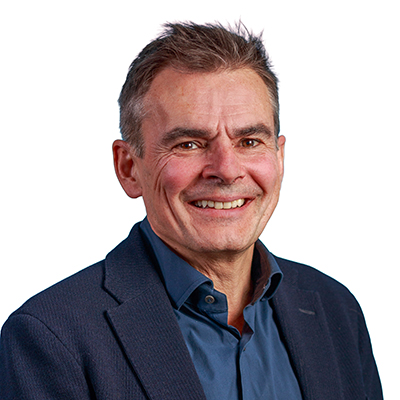
Matthias Goebel, President & CEO Bosch Rexroth Compact Hydraulics
Q: Do you expect to see more manufacturing and product localization in the United States?
Goebel: We’ve already started manufacturing products from our Italian brand, which was formerly Oil Control, here in the U.S. This provides our customers with confidence that we can support them wherever their machines are built.
We’re only profitable if our customers are happy and competitive, therefore we have to find the right tradeoff between optimizing costs, manufacturing technical products and maintaining a very stable supply chain.
Q: How does Bosch Rexroth approach localization more broadly?
D’Ammando: Localization is really a matrix, like a cube with three dimensions. One dimension is the products. For a company like us, no other products are comparable in the market. We have a broad product range, and our localization strategy enables us to supply customers locally through regional assembly, production, and supply chains.
Production is another dimension the industry is facing, especially with the current geopolitical challenges. We are really in a good position there, because we can keep production quality and standards, with the same results and tolerances, anywhere in the world.
The third dimension is the supply chain. As a global organization, we can leverage deep knowledge of suppliers and supply chains across industries. I often describe this approach as a cube, because localization occurs across multiple dimensions at the same time.
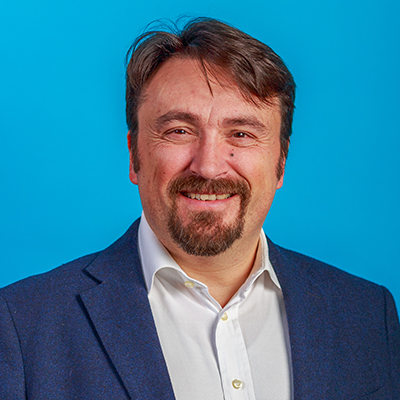
Angelo D’Ammando, VP Sales Compact Hydraulics
Q: What kinds of investments have been made in North America to support this strategy?
Goebel: Over the past three years, we have dedicated substantial effort to integrating the product portfolios of Oil Control in Italy and HydraForce, while also investing in production and logistics capabilities. The next phase is turning this combined portfolio into a fully integrated solution offering. Rather than simply providing individual components, we focus on specific machine types and deliver a complete ecosystem of solutions ranging from Compact Hydraulics offerings to the full suite of products offered by our Mobile Hydraulics division.
Q: Where have those investments been focused?
Goebel: We’ve made substantial investments in technical capacity to ensure we’re ready for the growth ahead. That’s also why Angelo and I decided to move to North America, to help accelerate our sales and application organizations and support customers more closely.
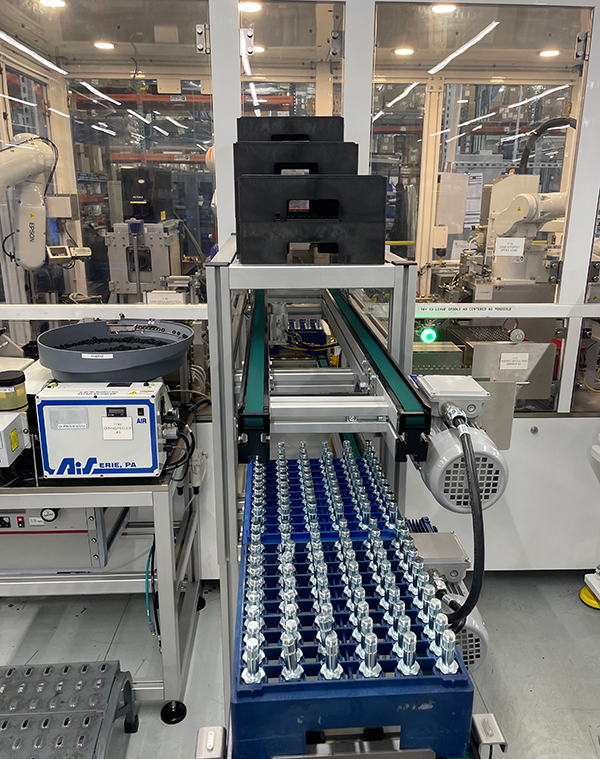
HydraForce has made investments in automation to meet customer demand and to stay competitive in the market and deliver high-quality products for its customers.
Q: How do those investments support customers?
D’Ammando: If you remember the cube I mentioned earlier, these investments touch all three dimensions. So, for Compact Hydraulics, we now have the full production line for Compact Directional Valves and Compact Power Modules/Hydraulic Power Units in Lincolnshire. Second, we’re improving our internal processes and production resources. And third, we’re strengthening our supply chain by working toward more local sourcing.
So, the investment supports the product, manufacturing, and supply-chain side of the business, simultaneously.
Goebel: We’ve made a significant investment in a fully optimized storage and retrieval system, which is just ramping up right now. We’ve also implemented a new ERP system in Lincolnshire, to help reduce costs, improve flexibility and speed. We are here to really to ramp up and support the needs of our customers.
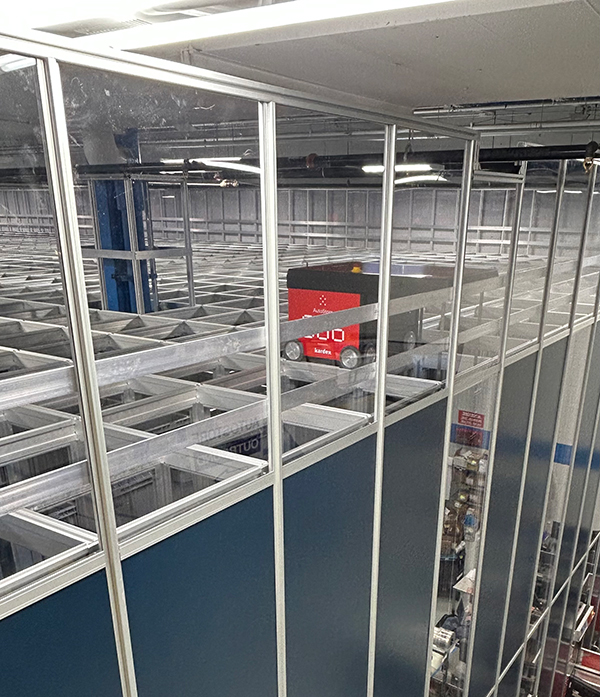
HydraForce has made double-digit million-dollar CapEx investments over the last few years to improve operations, facilities and automation. An example is a multi-million-dollar automated storage and retrieval system (ASRS) in Lincolnshire to improve product availability and responsiveness.
Q: Will the HydraForce brand continue to exist as Bosch Rexroth moves forward?
Goebel: Absolutely. I’ve been in the hydraulics industry for about 30 years, and HydraForce is an iconic name in the market. From a marketing perspective, that’s extremely valuable. As long as I’m responsible for this business, we will promote the HydraForce brand. There is a lot of history behind that name — the people who built the company and the relationships with customers. That kind of heritage has real value.
Q: What comes next after the integration phase?
Goebel: The next step is making our full ecosystem easier for customers to use. Today we have a very comprehensive portfolio for mobile applications, from hydraulics and valves to motors, gearboxes and electronic control systems.
The challenge now is making this portfolio easy to understand and easy to use. We want to make it more digital so engineers can access it easily. We want to help them quickly find solutions, pricing and designs. In the future, digital tools and AI will help make that process even faster.
Our goal is to help engineers and customers quickly find the right solution within our ecosystem and make it easier to work with the full range of products we offer.
Visit hydraforce.com or boschrexroth.com to learn more.
Filed Under: Components, Industry News, News, Valves & Manifolds
