
This guide breaks down budget, midrange, and premium test kits to help technicians quickly pinpoint losses in pressure, flow, and efficiency in hydraulic systems.
Hydraulic troubleshooting requires a fundamental understanding of thermodynamics, experience with various machine types, as well as years of familiarity with various hydraulic schematics. In some ways, it’s like being a doctor — even with a formal education, it takes years of exposure to (hydraulic machine) ailments to develop the knack for diagnosing and troubleshooting.
But just because the best hydraulic troubleshooters have years or decades of experience, doesn’t mean you can’t hit the ground running if you have the proper equipment and tips on how to use it. Whether you’re just a new technician with a budding fluid power career or a veteran looking to upgrade your equipment, I’ve got three tiers of kit you can add to your shopping list to level up your diagnostics.
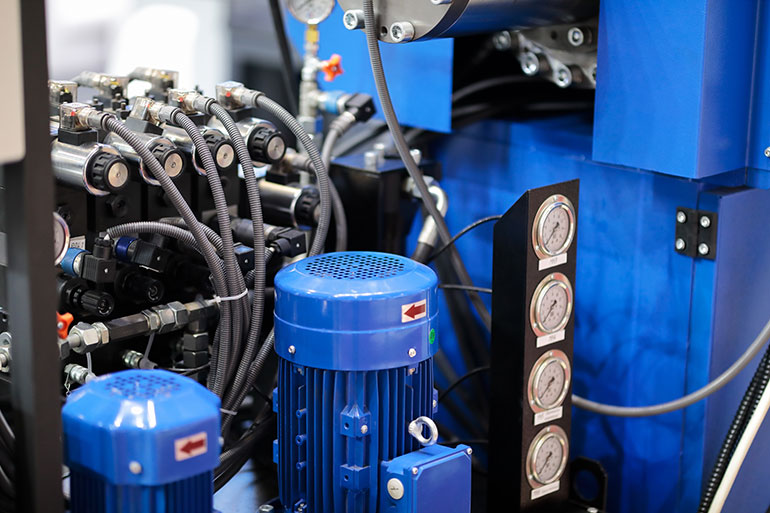
Industrial hydraulic systems require fundamental troubleshooting skills, and access to a variety of measurement tools to gauge system health. Image courtesy AdobeStock
Before we dive into each kit and describe why each piece is necessary, let’s cover the foundations of hydraulic troubleshooting. Ninety percent of mysterious hydraulic failures manifest with symptoms of either reduced force or reduced speed. In either case, we use our testing accoutrement to discover the path hydraulic oil is taking where it shouldn’t. The other 10% are catastrophic mechanical failures, where something breaks and stops working entirely, like a burnt-out solenoid coil or shorn drive coupler. The good news is that our kits can help pinpoint both.
In many cases, machines experience reduced flow or pressure because there aren’t enough oil molecules stuffing themselves into the appropriate location, either because they’re refusing to let the pump push them around or because they’re escaping unnoticed. A worn and bypassing pump, for example, will result in both reduced flow and pressure for every component downstream. By the same token, if many of the oil molecules being stuffed into a hydraulic cylinder are sneaking past the piston seal, both pressure and flow may be reduced.
A key characteristic of hydraulic energy is that anywhere it’s being lost before achieving useful work results in 100% heat generation. Oftentimes, finding that hot spot tells you precisely where to inspect for failure. In the case of the previously mentioned hydraulic cylinder, the fluid passing the piston is generating heat, and measuring heat at the suspected location would likely show an increase over the rest of the system.
Any good kit must also help diagnose the mechanical failures, and I would be so bold as to consider a burnt-out solenoid coil as such. A method to check the electrical components is helpful, so I’ll include tools to help here as well. More sophisticated test equipment, such as test stands for hydrostatic pumps or servo valves, will not be included to keep our kits portable.
Get started with budget kits

The budget kit lets you test most of your hydraulic circuit, though some work will be required. The various fittings and adapters you have lying around the shop can be thrown into one toolbox, but be sure you have plenty of run tees in JIC, NPT, or whatever popular fitting standard you find in your location.
If absolutely nothing is happening hydraulically, and I mean not one function, first check the electric motor is turning, which is as easy as looking at its cooling fan. If the motor is on, then confirm the drive couplers haven’t disintegrated. This first tip applies to test kits, and the most you’ll need here is a screwdriver to remove the protective cover on the bellhousing. Speaking of screwdrivers, they’re great for checking for power at a valve coil by simply touching it to the coil to feel if it’s magnetized — no multimeter required.

Tools as simple as a screwdriver and rags are necessary to most troubleshooting kits.
You’ll need to disconnect the pressure, work, and return lines to install pressure gauges at various spots, using your hydraulic schematic to scout the best locations. You’ll need plenty of ripped-up T-shirt rags, which are quite inexpensive — I wonder if moms realize their old kid’s clothes tossed into those donation bins are eventually soaking up grease and not, in fact, being sold at the thrift store as cute hand-me-downs.
After installing a pressure gauge and flow meter after the pump, safely deadheading a cylinder function should spike system pressure, and if the measurement doesn’t match the schematic, fluid is bypassing somewhere instead of creating full force. The flow meter tells you if the pump is the culprit or if the leakage is downstream. The needle valve can be installed in the primary pressure line to load up the pump if you can’t artificially load it by activating functions. Just be sure the needle valve’s default flow rate is higher than the pump’s flow rate and that it is installed downstream of the relief valve in a fixed-flow circuit.
The laser thermometer is a great tool for pinpointing hot spots to see if bypass is excessive in any one component. Bypass will often be 20-50 degrees higher than what you’ll measure at the reservoir, so check anywhere that could be leaking or simply stuck open,such as relief valves, directional valves, bypass flow controls, cylinder pistons, and tank lines. If any localized area is excessively hot, inspect the component for wear elements, such as seals, valve plates, or spools.
A more comprehensive investment

Onto the midrange kit, which offers similar functionality to the budget kit but with a more professional, comprehensive assortment of components that are easier to use. The pressure test kit includes a custom case with protective foam inserts for your three pressure gauges, test point adapters, run tees, and microbore hoses. You can select the pressure range of the gauges, but 150, 3,000, and 8,000 psi are a good starting point.

Digital pressure gauges are included in the midrange kit, because they can be more accurate and may also have a memory function, allowing you to recall measurements from previous tests. Image courtesy of Noshok
This test kit includes myriad test points with various thread forms, such as ORB, JIC, and NPT, and each form includes a few run tees that can be spliced into plumbing lines — hopefully you have plenty of bushings left from your budget kit to adapt sizes. I’ve included a digital pressure gauge in this kit, some of which have a memory function, allowing you to recall measurements from previous tests. This allows you to easily confirm that your solutions are progressing effectively towards resolution. Because the test points fit universally, you can move the digital gauge around as required and then leave some of the mechanical gauges in strategic places.
The multimeter addition takes the “magnetized screwdriver” test to the next level, and allows you to confirm the actual voltage and amperage seen by the coil, since a simple magnetic field doesn’t always tell the whole story. You can also use it to confirm that control signals from the PLC are functioning, double-check analog outputs, and verify that relays are passing current.
The inline hydraulic tester is a single unit that provides one-stop shopping for the critical data you need, which requires multiple components from the Budget Kit to reproduce. It contains a flow meter, a pressure gauge, a needle valve, and sometimes temperature sensors. It’s installed wherever you want to check pressure, flow, and temperature, such as the primary pump pressure line or actuator work lines. You can use its needle valve to load up a pressure-compensated pump or check for flow and pressure where there should be none.
A test manifold is a neat little block with multiple inlets that feed into a single pressure-reading unit, usually a pressure gauge. They are sometimes a rotary dial that allows you to select the pressure source to measure, but may also be a bar manifold with each inlet isolated with a needle valve. This allows remote pressure monitoring without having to move about the machine.
I think the kitty litter is an obvious tool to help clean up oil spills, which is easier to use and re-use than rags, but some of you may be wondering what the handpump is used for. Sometimes you want gentle, precise control of the flow for testing, such as checking for leakage and bypass in cylinders, pumps, or motors. For example, if a cylinder is suspected of leaking across the piston, installing the handpump on one port and slowly pumping to observe leakage out the opposing port prevents the mess you might see with blasting full pump volume at the cylinder with one port removed.
Answers come quicker with sophisticated tools

The Premium Kit accomplishes much of the same as the Midrange Kit, but adds a level of sophistication and technology that speeds up testing and troubleshooting. We do away with mechanical pressure gauges and run entirely on electronics: pressure transducers, temperature transducers, water-saturation sensors, particle counters, and any other device that can measure a property of hydraulic fluid.

Here is a connection example for analog and CAN sensors. Image courtesy of Stauff
Each transducer feeds into your handheld, touchscreen diagnostic tool, which accepts a multitude of analog or CAN inputs, providing real-time data and memory functions. Instead of observing mechanical or digital pressure gauges, your transducers can measure accurately to within 0.5% or better while logging as finely as 0.1 msec to see how quickly valves are shifting or pumps come on pressure.
Your inline flow meters use highly accurate gears and a Hall-effect sensor, which, as you guessed, can be logged for accurate analysis of proportional valve performance or case drain leakage. You can even compare pressure curves with flow curves to ensure that the actuator’s acceleration and frequency response are in line with expectations.

Hydraulic flow indicators, like these SDMKR from Stauff, provide flow rate measuring of hydraulic media flow.
The thermal imaging camera takes the laser thermometer idea to the next level. You can take snapshots of entire subassemblies, such as the power unit or hydraulic manifold, and then compare heat at various points and during various operations. You can compare such images to previously logged “normal” operations to see if any hot spots provide clues to heat-generating internal bypass.
The high-pressure handpump should be capable of 10,000 psi and will be used for advanced tactics to help improve performance rather than simply diagnose failures. A customer may want increased pressure capacity in a hydraulic cylinder, so, besides explaining to them that increasing pressure reduces the safety factor of a cylinder, the pump can be used for destructive testing on various new high-pressure seals you may prototype.
Then you have your ultimate nerd device — the oscilloscope. These are actually quite inexpensive these days, and much smaller than the suitcase-size units your grandpa used. I only put them in the Premium Kit because it’s not a tool for every skill level. These allow you to check actual voltage waveforms to detect weak or intermittent power to valves, confirm the analog output from transducers when PLCs are having trouble reading them, and data log advanced machine functions to help with diagnostics. It turns the invisible into the visible, and I might even suggest users of the Budget Kit obtain one just to see how the electric bits of your system operate.
Finally, we come to the fluid spill cleanup champs: the oil-absorbing mats. These are available in “socks” to stop the movement of oil across the floor or reservoir top when you know the tidal wave is inevitable. The oil-absorbing flat mats are great to lay down under your work area so that drips and leaks are caught before they hit the floor, avoiding the need to break out the rags or kitty litter. They’re a bit more expensive, but certainly the most effective.
With any of the kits above, you’re already a step ahead of troubleshooting neophytes. You still need to understand the principles of hydraulics, along with some time spent digesting schematics (I recommend using multiple printed copies and colored highlighters). If you can’t afford a whole kit as I’ve recommended, just start building your collection and work your way up. Before you know it, you’ll have built yourself a Premium Kit any hydraulic troubleshooter would envy.
Filed Under: Components, Engineering Basics, Sensors, Sensors & Gauges, Technologies
