
Combining air and oil on modern automation machinery helps to balance force, speed, precision, reliability, and cost.
I know what you’re thinking – “forget it, just use electronic components for automation instead of hydraulics or pneumatics.” Well, you can put the brakes on that idea, fella, because this is Fluid Power World, and I pushed my technical chips all-in nearly two decades ago when I went to school for fluid power. As far as I’m concerned, electronics is just the stuff that powers hydraulic and pneumatic control systems, thank you very much.
Indeed, industrial automation is now a mature discipline, defined more by integration than by a single technology. Before PLCs, we had pneumatics running the automation show with clever use of cam-, roller-, or plunger-operated directional valves. These pneumatic logic systems sequenced a machine through its operation automatically, either in continuous or single-cycle operation. These systems operated nearly a century ago and pioneered familiar jargon such as AND/OR, IF-THEN, while employing timers, one-shots, and shuttle valves.
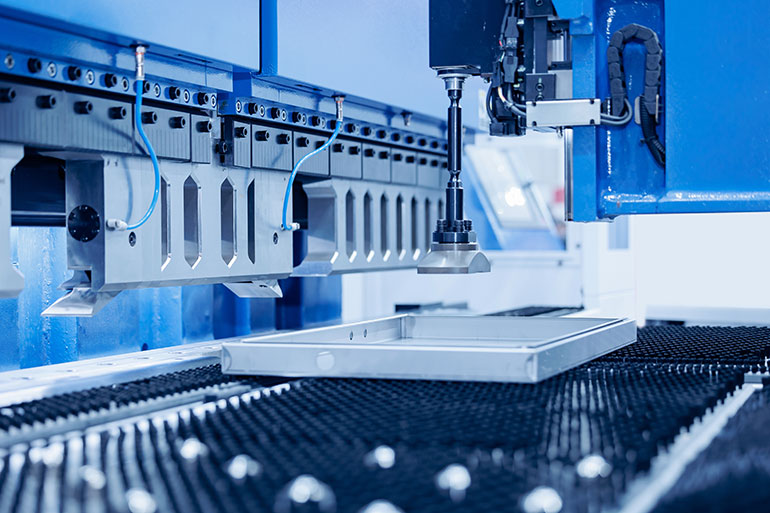
Industrial automation can rely on the power of hydraulics, snappiness of pneumatics, and control of electronics for its many tasks.
And of course, pneumatic logic systems could control hydraulic machinery, and it did. If you’re ever scrolling through an old hydraulic valve datasheet and see the option for pneumatic pilot, you know why. The pneumatic valves handled the logic functions and rapid actuation, while the hydraulics brought two tickets to the gun show. Automated presses come to mind, where the loading, positioning, and clamping could be facilitated quickly pneumatically, while the stamping or pressing function uses the power of hydraulics.
But does it make sense to combine hydraulics and pneumatics on the same machine? After all, you require double the support system with air compressors and hydraulic power units, along with the ancillary components for each arrangement. Pneumatic presses are common, and you could even build them with air-over-hydraulic systems using intensifiers, so why aren’t those more common? And if hydraulic power units are required for a press, why not run the material-handling functions hydraulically as well?
Either option is viable but comes with limitations and sacrifices. For example, a 110-ton hydraulic press can make do with a single 10-in. bore cylinder. Conversely, a pneumatic press would require the equivalent of four 25-in. bore cylinders to achieve the same force at just over 100 psi. And if you want that press to move quickly, your air compressor will nearly dwarf your press. Hydraulics running material-handling processes is common when loads are heavy, but for simple pick-and-place applications, for example, high flow, not high pressure, is required. Hydraulics is often overkill for material handling, such as pick-and-place, unless you’re moving blocks of tungsten.
For modern automation machinery, it’s best to use a combination of air and oil to balance force, speed, precision, reliability, and cost. We choose pneumatic actuators for different reasons than we choose hydraulic ones, and vice versa. Hybrid systems take advantage of the strengths of each form of motivation.
Let’s explore the qualities of both technologies to see why you need to consider automating with a hybrid fluid power system. It’s easy to mistake the purpose of hydraulics as only power while forgetting its superiority in control and precision. If you need positioning with micrometer accuracy, hydraulics is the only choice. Modern sensing technology, such as LDTs (linear transducers), has been combined with ultra-precise proportional and servo valves to deliver high accuracy for automotive welding robots and fine blanking presses, for example.
Conversely, pneumatics are notorious for rapid motion but are also precise with discrete positioning (meaning end-of-stroke each cycle). Using our blanking press example, sheets and blanks are fed into and out of the machine at blinding speed, delivering productivity well beyond hydraulic actuation while providing a level of safety for machine operators who no longer need to reach squishy fingers inside the machine.
This division of labor improves overall system efficiency, reduces energy consumption, and often lowers the total cost of ownership. It also simplifies machine architecture by avoiding oversized hydraulic systems designed to perform tasks better suited to air or oversized air distribution systems for high-volume pneumatics.
Key applications benefit from hybrid fluid power automation
So, other than welding robots or blanking presses, what other technology benefits from automation through hybrid fluid power? Injection molding machines are another classic hybrid application. The clamping cylinders are hydraulic because of the strength required to keep the die shut during injection, and the injection system itself uses a hydraulic motor and cylinder combination, both of which are large.
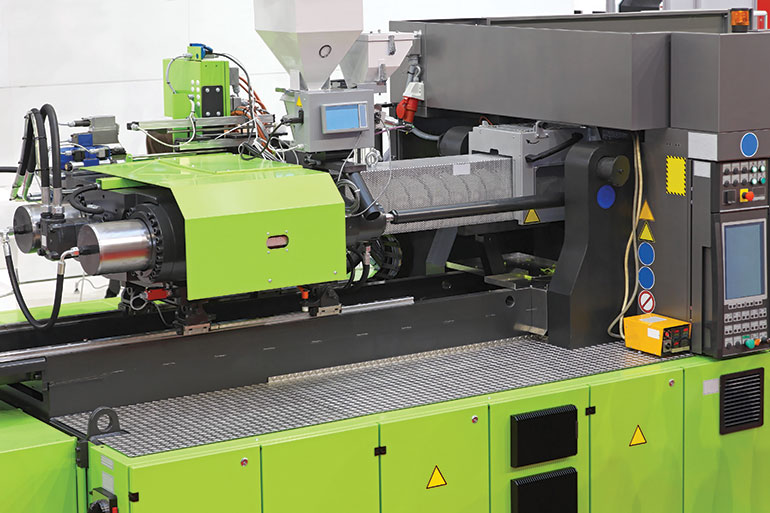
Injection molding uses hydraulics primarily but pneumatic ejection may help remove parts without damage.
The accessory functions on injection molding machines may be fully hydraulic, hybrid, or other, more sophisticated and specialized systems, such as ejectors. The ejection process can be very difficult — especially with complex geometry and undercuts — because the plastic shrinks onto the mold as it rapidly cools. Hydraulic ejectors may be suitable for thick plastics, but pneumatic systems offer a gentler force profile that reduces pin impressions in the plastic.
Additionally, pneumatics are widely used for core pulls, valve gates, robot grippers, and material handling inside and outside of the molding cell. Compressed air is already present in most molding facilities, and pneumatic components integrate easily with automation networks and PLCs. For IMMs manufacturing high-volume commercial components with the same molds for weeks or months, pneumatics have the opportunity to automate post-ejection handling.
Pneumatic actuators can enter the mold space at high speed, where grippers or vacuum cups can orient the part and remove it from the machine. Once placed into racks or nests for cooling, pneumatics can remove the sprue and runners or shear/trim gates, if required. Packaging, automotive, medical, and appliances, just to name a few, are industries that benefit from automated post-ejection handling.
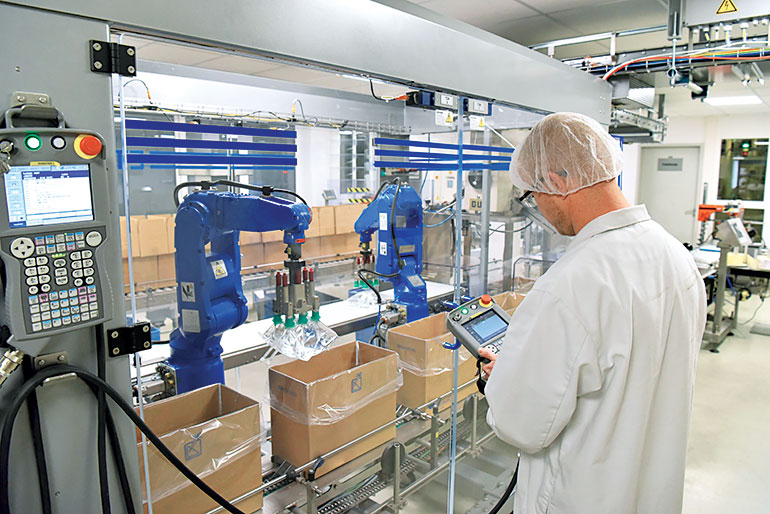
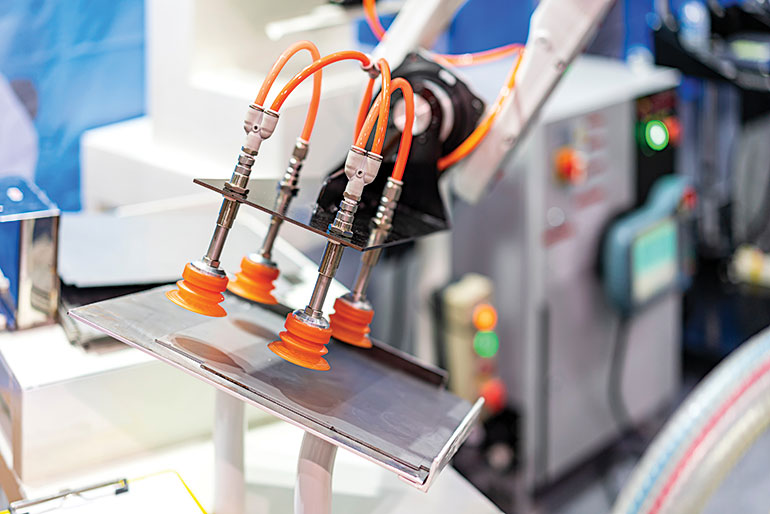
Pneumatics are often required for gentle handling of fragile materials, like plastics, here, and thin materials, below.
High-speed packaging lines sometimes use both technologies on a single machine. Pneumatics dominate in pick-and-place operations, carton folding, labeling, and product transfer due to their speed and low inertia. Short-stroke pneumatic cylinders and air-driven grippers are best for rapid, repetitive motions.
Hydraulics, however, appear where controlled force is required — such as crimping, sealing, compacting, or forming packages. For example, a packaging machine may use pneumatics to position a container and hydraulics to apply a precisely controlled sealing force. Again, these operations could use air-over-oil systems or intensifiers, but limitations with these systems may prevent consistently accurate performance. They are designed to generate pressure, not move much fluid, and you may experience pressure or flow pulsation due to the reciprocating nature of these systems.
With material handling systems, hydraulics are often tasked for lifting, tilting, or positioning heavy loads, such as with automated palletizers, stackers, or transfer carts. Hydraulics provides the necessary force density and durability for continuous operation under heavy loads. Pneumatics complement these systems by handling end-effector tooling and clamps, as well as vacuum cups. Despite this discussion being primarily fluid power, even in facilities dominated by electric robotics, pneumatic actuators remain prevalent because of their simplicity and reliability.
Coexistence does come with challenges
The coexistence of hydraulics and pneumatics in these systems reflects a pragmatic design philosophy: use the right tool for each task. Each is so good at what it does, you’d be silly not to take full advantage of each to increase performance and productivity. There is no other technology with the force potential of hydraulics, and no other technology with the speed-to-cost ratio of pneumatics.
Granted, while hybrid fluid power systems offer clear advantages, they also introduce integration challenges, which we should discuss. Hydraulics and pneumatics have different dynamic characteristics, operating pressures, and control requirements, so coordinating them within a unified automation system requires careful design from a fluid power specialist trained in both. Personally, I know a fair amount about pneumatics, but I’m not a “pneumatics guy.” My specialty is hydraulics, and if I were designing a complex system using both technologies, I’d secure the assistance of a pneumatic specialist colleague to confirm my choices. If you’re a specialist in one rather than both, know your limitations and seek help.
And just because we’re ignoring electric actuators for the purpose of this discussion, no talk about modern automation would be complete without discussing electronic control. Advanced programmable logic controllers (plcs) and industrial networks have largely solved this problem of integrating multiple technologies. Electro-hydraulic valves with proportional or servo control can now be synchronized with pneumatic solenoid valves using the same control architecture. Feedback from pressure sensors, position transducers, and flow meters allows precise coordination between systems.
Energy management is another consideration, because hydraulics typically consumes more power and generates heat, while pneumatics can be inefficient due to air compression losses (although they heat your shop well in the winter). Fluid power designers increasingly incorporate energy-saving features such as VFD- or servo-driven hydraulic pumps and accumulator circuits, for hydraulics, and air-saving valves or pressure zoning, for pneumatics, to reduce waste. Always remember that any pressure lost before achieving useful work is wasted as pure heat.
Both forms of motivation require unique considerations for safety, as well. Hydraulics, of course, is capable of turning vehicles into small cubes, so that kind of power must be respected by machine designers to prevent injury or death. And pneumatic actuators are still plenty powerful enough to remodel extremities, especially when you throw high velocity into the mix. Hybrid systems commissioning must include a pre-start safety review to ensure all the protocols are adhered to, such as press-safety guidelines, appropriate lockout and redundancies, and electronic safeguarding such as light curtains.
A secure future together
As industrial automation continues to evolve, hybrid fluid power systems are not disappearing — they are becoming smarter. Hydraulics and pneumatics just have too much to offer to disappear entirely (or quickly, for that matter).
Electro-hydraulic actuators, intelligent pneumatic manifolds, and IO-Link-enabled components make it easier to integrate fluid power into Industry 4.0 environments. Predictive maintenance, energy monitoring, and digital twins (virtual copies of your machine) are increasingly applied to both hydraulic and pneumatic subsystems. Rather than choosing between hydraulics and pneumatics, machine builders are refining how the two interact within automated systems.
With the proliferation of electronics and digital environments, there’s never been a better time to automate with fluid power, including pneumatics’ golden age of logic systems. Sensors, controllers, busses, HMIs, and other technology are at commodity-level prices and are offered most fluid power manufacturers, not just the big players. I have no problems saying, “forget electric actuators … use hydraulics and pneumatics for automation.”
Filed Under: Components, Compressed Air Technologies, End Effectors & Grippers, Engineering Basics, Pumps & Motors, Technologies, Valves & Valve Manifolds
