
By Josh Cosford, Contributing Editor
This article is about combination valves, which I personally refer to as manifolds, despite being a polysemy with manifolds used to join plumbing. Hydraulic manifolds are the most varied and unique possible valve combinations to suit specific machine needs. But with so many creative ways to execute them, the opportunity for mistakes is as plentiful as the people designing them.
To help me illustrate the common mistakes in manifold design, I employed my friend Lisa DeBenedetto from GS Global Resources. With nearly four decades of fluid power experience, much of it spent directly overseeing manifold design, I couldn’t think of a better person to impart her wisdom.
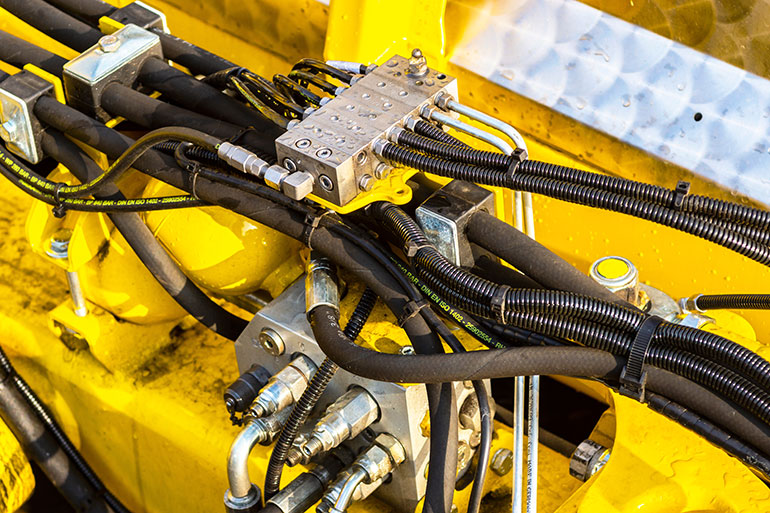
Many of the mistakes she’s observed revolve around the physical constraints of valves and their potential to obstruct one another or nearby ports. For example, limiting access to the valve’s wrench flats could prevent correct installation or servicing. The same goes for manually operated valves or those with knobs, which must be allowed to rotate through their full range of motion without interference from valve coils, valve stems, or even other manual valves.
DeBenedetto makes a good point regarding manual valves requiring 180 degrees of motion, so a 4/3 double-coil valve anywhere within the lever’s arc “… is a problem.” The same goes for a cartridge handpump, which is sometimes installed to provide auxiliary pump capacity in the absence of power. These hand pumps require space to operate, so designers must leave room for the handle, which must be inserted before pumping. DeBenedetto finished off the list of physical errors with, “Gloved hands to turn needle valve knobs — make sure there is clearance for a man’s hands with gloves to be able to grab and turn.”
Of course, spacing errors aren’t always related to the movement of levers, knobs, and screws. No manifold is complete without ports for attaching plumbing; designers must avoid mistakes when installing adapters and hose ends. DeBenedetto points out something that is not always obvious: “If you need a 90-degree elbow, you need to make sure another fitting, port or valve is not in the way. You also need wrench clearance for the fittings.”
“Countersinking valves is sometimes allowed to make better cross-port connections, but then you need to make sure a socket can fit in the counterbore to tighten the valve,” DeBenedetto added regarding the creative use of machining. Indeed, if you can’t get a deep socket over a long valve, how is a technician supposed to install or replace it?
Although not something I would have considered myself, DeBenedetto brings up a great point regarding high velocity fluid. “If you have an unloading cartridge acting as the poor man’s load sense, the velocity and amount of oil that comes out that unloading valve will hit the side of the aluminum manifold and could eventually “worm hole” or eat away at the aluminum. So, wall thickness and whether that oil is expected to make a 90-degree bend out of the unloader need to be considered.” She would prefer to see high-flow manifolds (30 gpm and up), machined in Durabar rather than aluminum.
She continued regarding the best practices of internal porting. “A good rule of thumb when using cartridge solenoid directional valves is that port-1 should always be considered as the tank port whenever possible.” She then added, “Flow forces work against areas, and the nose of the cartridge usually has more area due to the end of the spool. Using port-1 as an inlet on solenoid directional valves could cause premature opening of the valve due to flow forces.”
Regarding the internal design, DeBenedetto expertly added, “Make the port drillings as large as the cavity detail allows. If a drilling into a 10-2 cavity at port-2 is 0.406 in., then make it as close to 0.406 in. as possible where it makes sense. You can also do double drilling into a cavity port to lower pressure drops and add efficiency.”
Sometimes a customer requires just one manifold, while others are shipped thousands. Regardless of quantity, she made a good point regarding mistakes in prototyping. “When designing a prototype, always add test ports for pressure transducers or gauges, and options for orifices as needed. The prototype is always more expensive for the one-off, so why not put all the bells and whistles into it,” she said. “Then, validation testing can remove the items not needed for production to reduce costs … you cannot usually add an orifice or test port after the block is drilled.”
Some of the mistakes in manifold design increase setup and machining cost before the customer ever sees it. “The more sides a designer can use on the manifold for valves, the more efficient the assembly will be,” DeBenedetto pointed out. “If all valves need to be on the top surface, the spaghetti of drillings will decrease efficiency and add pressure drop.”
Finally, DeBenedetto pointed out the errors made during the assembly process. “Over-torquing the long valves into their cavities, and over-torquing coil nuts is the number one problem I have seen with manifold assemblies. Watch the torque specs to avoid these problems. Over-torquing the long valve could cause the valve to bottom out, and the cage can twist, causing the spool inside to bind,” she concluded. “Over-torquing the coil nuts stretches the tubes and causes the pole piece to not move smoothly in the tube assembly.”
I’m humble enough to admit that I was previously unaware of some of these wisdom bombs, so thanks to Lisa DeBenedetto for sharing her vast knowledge on the subject. Indeed, there are many common mistakes in manifold design, so be sure to avoid these in your next application.
Filed Under: Components, Engineering Basics, Mobile Hydraulic Tips, Valves & Manifolds
