
Kidney loop filtration systems are designed to filter fluid from large systems, and are usually made up of a continuous filtration machine on a portable cart that allows users to transport them from machine to machine. But on smaller systems, these portable designs might be overkill.
For smaller hydraulic systems, gear boxes, or diesel fuel systems, a unique and patented design from FluidLoop Technologies LLC of Gig Harbor, Washington draws off small amounts of working fluids and circulates them through a filter to remove particles and/or water. The FL-1000 system can be fixed or portable and moved from equipment to equipment; and can circulate and filter fluid even when machinery is idle or shutdown.
The compact product with carrying case is only about 18 in. long by 8 in. wide, and can pump up to 1 gpm, said Don Brown of FluidLoop.
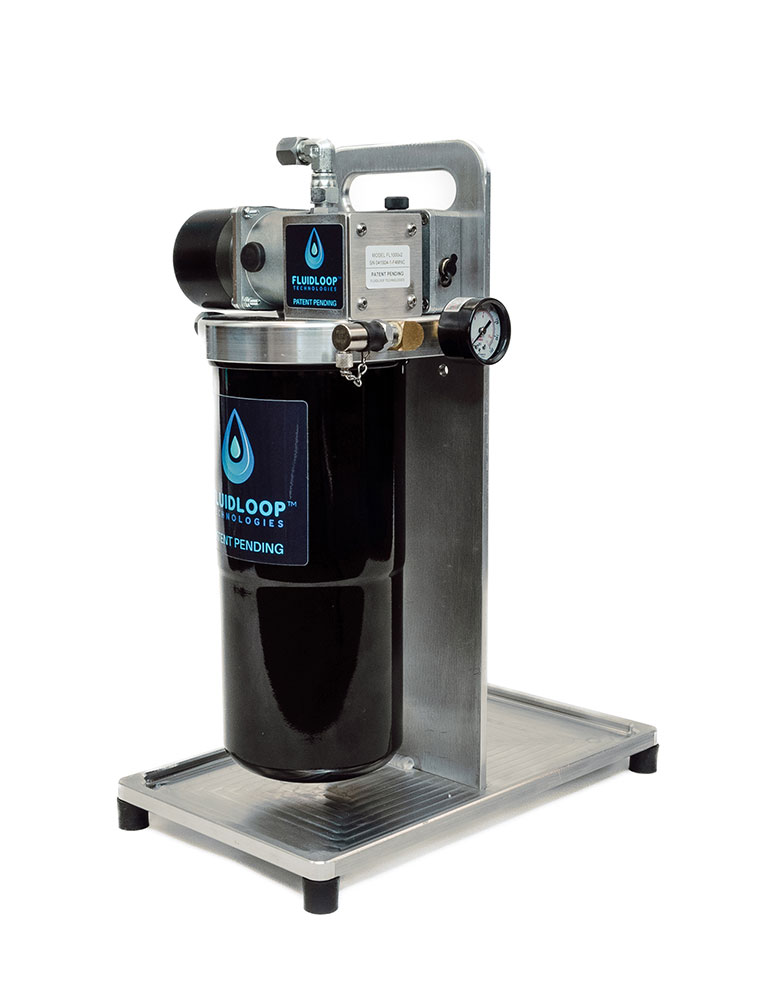
Hand Carry Stand enables FL1000 portability from one machine to the next, here and below.
The patented system uses a specialized miniature dc-powered variable speed pump/motor combination that draws only a fraction of a horsepower. The unit can be tank- or wall-mounted and comes with an optional hand carry stand. It can be run off a standard 120-V outlet with a factory supplied dc converter or a standard dc power supply.
Gearboxes, which are considered some of the most heavily contaminated systems in industrial use, benefit most from low-flow, or offline filtration. Unlike high-flow, in-line filtration systems that must balance flow demand with filtration efficiency, low-flow filtration prioritizes contaminant removal efficiency and continuous oil conditioning. This approach is especially advantageous for gearboxes with relatively small sump volumes and high oil viscosities.
Low flow filtration allows oil to pass through the filter media at reduced velocity, significantly improving particle capture efficiency. This enables the use of fine, high-efficiency media (1–10 µm and below) without causing excessive pressure drop.
“Many gearbox people want to polish up the oil, because they often don’t filter down clean enough. The Fluidloop unit was designed to add on permanently and it can run 24/7,” Brown said.
He also noted that the system can be carried easily from machine to machine as well, as it comes with an aluminum carrying unit bracket.
The variable speed pump allows the FL-1000 to be easily adjusted for use on different viscosity fluids and different tank sizes. The pump/motor is mounted to the filter head, and the system can accommodate a wide range of filters using factory supplied adapters.
The FL1000V2 delivers controlled low flow rates (up to approximately 0.67 gpm depending on viscosity, temperature, and filter selection). It can provide continuous offline filtration without aeration or disturbance of settled contaminants. Its stainless-steel, variable-speed, high-torque pump allows precise adjustment for different oil viscosities and operating temperatures. This is critical for gearboxes using ISO 150–460 oils, where fixed-speed pumps often struggle or generate excessive pressure.
The system supports a variety of high-efficiency spin-on filtration options including 2 and 4-µm synthetic media filters for fine particulate removal, water-removal filters for moisture-sensitive gearbox applications, and 1-µm depth filters for fine particulate and water removal. This flexibility allows users to tailor filtration performance to specific gearbox requirements and contamination risks.
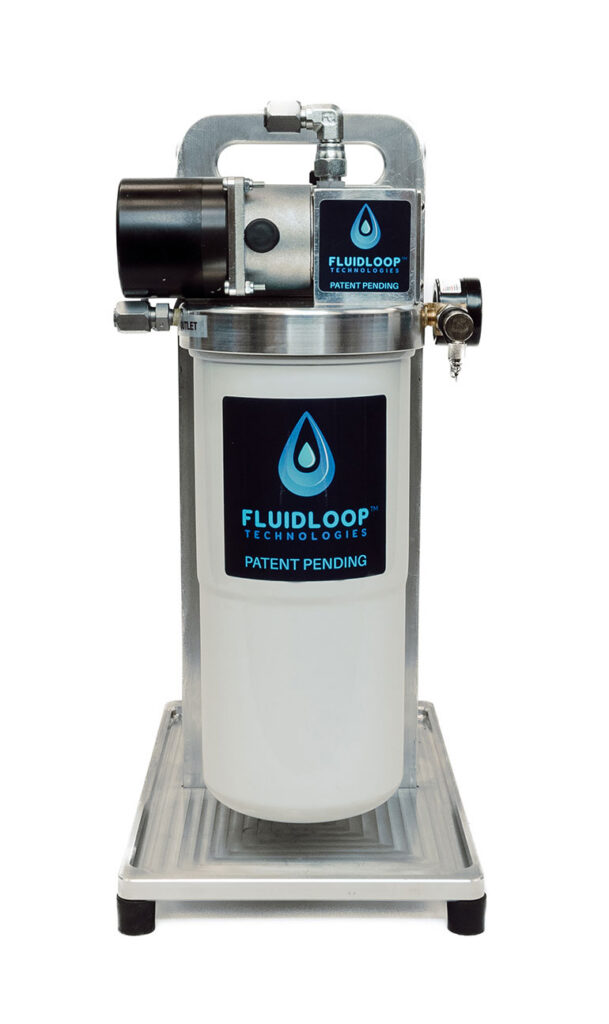
Another example of the hand-carry option of the FluidLoop offline filtration system.
Nick Nesland Sr., who developed the technology, said he started studying sawmill systems that had failed due to contamination. “I got curious about what was controlling the life expectancy, so I started a laboratory to do oil analysis, and I was seeing that the systems that I was designing and installing were typically 10 µm filtration,” Nesland said. “Most of our competitors still use 10 µm as the standard. That’s why I came up with a 1 µm filter in a kidney loop. We would take a small amount of oil, polish it off on the side, and when we did oil analysis again, we saw that the oil was way cleaner.”
Nesland tested it at a sawmill which had previously seen continuous failures. With the 1-µm filtration, they stopped failing and ran optimally. He also tested the machine on the Port of Tacoma, Washington’s hydraulics and its engines, which allowed them to increase time between overhauls from 9000 hours to up to 25,000 hours. They then started using the system on gearbox cranes, which also saw reduced failure times.
Nesland developed a custom spin-on filter head and adapted the variable speed pump motor design to the spin-on filter head. He also created adapters to allow for custom use on the system. This allowed for quick and easy installation that can be done in less than hour, even without shutting down the line, Nesland said.
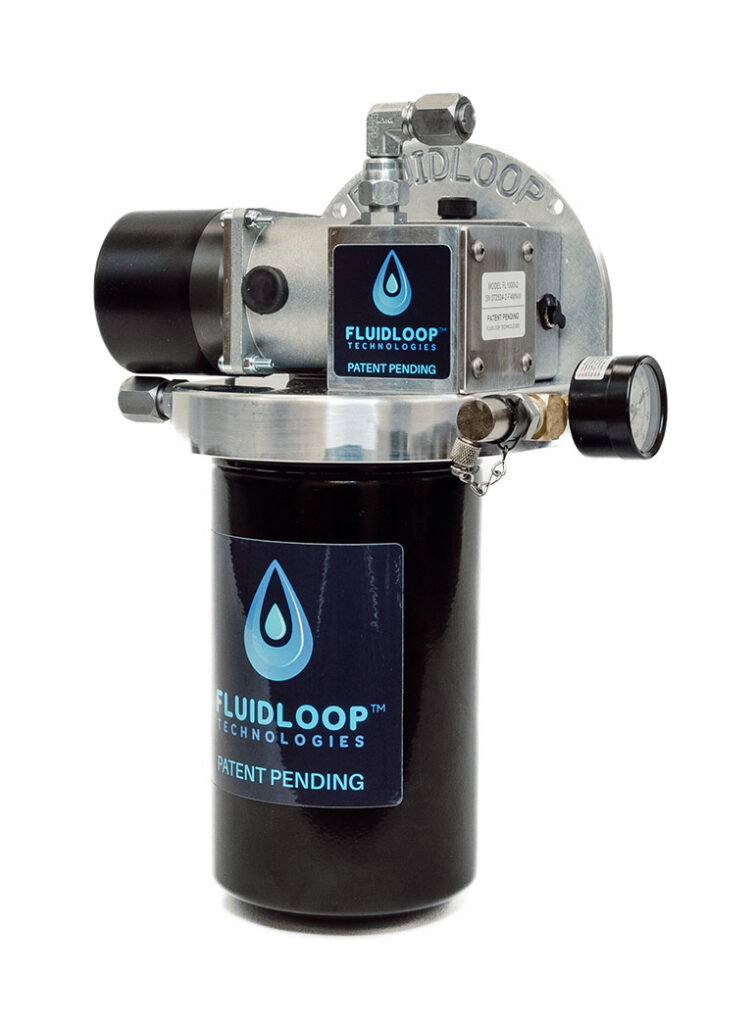
FluidLoop’s FL1000V2-wall mount design
With numerous units in service since introduction, they believe that there are hundreds of thousands of gear box and small hydraulic systems up to about 100-gal reservoirs that can benefit from this low-cost filtration system. Benefits include improvement in equipment life, reduced maintenance and down time, extended fluid drain intervals and reduced fluid disposal costs. Applications could include pulp & paper mills, industrial machinery, agricultural equipment, mining equipment, marine vessels, and wind turbine gear boxes, among others.
For example, Brown said that in one logging veneer plant, contamination was causing catastrophic failures of the high-speed actuators that help peel the logs. Lack of gear oil filtration on high-speed actuator assemblies required frequent rebuilds and mill downtime.
The actuator assembly has a tube with screw and cycles approximately 8,000 times per day when the mill is running. It uses approximately 3 gal of gear oil, with oil temperatures running approximately 110-120°F (43-40°C). It previously had no filtration and required actuator rebuild about every six months.
Prior to filtering, an oil analysis report showed abnormal contamination and fluid condition, with ISO Codes of 25-25-24. They installed a Fluidloop FL1000 Filtration system (on Actuator #1) with a 1µ depth filter designed to remove both dirt particles and water from the gear oil; thereby reducing rebuilds on the actuator and unplanned mill downtime. A second Fluidloop FL1000 was installed on the second #2 Actuator a couple months later.
Installing FluidLoop technology quickly cleaned the units and got them back running. Fluid sampling was done before/at installation, after one week, and after five weeks. Improvements in oil cleanliness were almost immediate. Prior to filtering, ISO Codes were 25-25-24. At one-week the ISO Codes improved to 23-20-15, and at five-weeks, they dropped to 18-16-12.
It is estimated that in a period of 18 months actuator rebuilds will be reduced from six planned to two. This will result in a cost savings of $56,000 – $64,000. Additional savings are estimated by the reduction of unplanned downtime, gear oil replacement, and disposal costs.
FluidLoop Technologies LLC
fluidlooptech.com
Filed Under: Components, Contamination Control, Filtration, Filtration/Contamination Control, Fluid Conditioning, Reservoirs
