Fluid Power World

  • Home
  • Technologies
    • Hydraulics
      • Cylinders & Actuators
      • Filtration/Contamination Control
      • Fittings, Couplings & Adapters
      • Fluids
      • Fluid Conditioning
      • Hose & Tubing
      • Pumps & Motors
      • Related Technologies
      • Sealing
      • Sensors & Gauges
      • Valves & Manifolds
    • Pneumatics
      • Air Preparation & Regulation
      • Compressed Air Technologies
      • Cylinders & Actuators
      • End Effectors & Grippers
      • Fittings, Couplings & Adapters
      • Hose & Tubing
      • Sensors
      • Vacuum
      • Valves & Manifolds
  • Engineering Basics
  • Trending
  • Resources
    • Digital Issues
    • Pneumatics Tech Toolbox
    • Podcasts
    • Special Reports
    • Subscribe to Fluid Power World Print Magazine
    • Videos
    • Webinars / Digital Events
    • White Papers
  • Women in Engineering
    • Women in Fluid Power
    • Women in Engineering
  • Design Guides
  • Classrooms
    • Hydraulic Filtration
    • Hydraulic System Design
    • Pneumatics Classroom
  • Advertisers
    • Advertise
    • PR Submissions
    • Eblast Submissions
  • SUBSCRIBE

Compressed air fail: Look for your numbers

By Paul Heney | September 12, 2026

Share

By Ron Marshall

Mike had walked past his compressors thousands of times. Two rotary screw compressors were installed in the corner of the plant, humming away just as they always had. He knew how to start them, how to stop them, and who to call when something didn’t sound right. Beyond that, the control panel was simply a screen with a lot of numbers — to which he rarely paid much attention.

Then one Tuesday, while waiting for a replacement part to arrive, he decided to do something different.

He grabbed the instruction manual and started exploring the compressor controls.

A few button presses later, he found a screen he never knew existed: Running Hours and Loaded Hours, tracked separately since the day the compressor was commissioned.

Running hours represent the total time the motor had been turning. Loaded hours show how long the compressor had actually been producing compressed air rather than idling unloaded while still consuming electricity. Curious, Mike did some quick math.

His primary compressor had accumulated 18,000 running hours — but had fewer than 9,000 loaded hours.

Half the time the compressor had been running, it wasn’t producing any air at all.
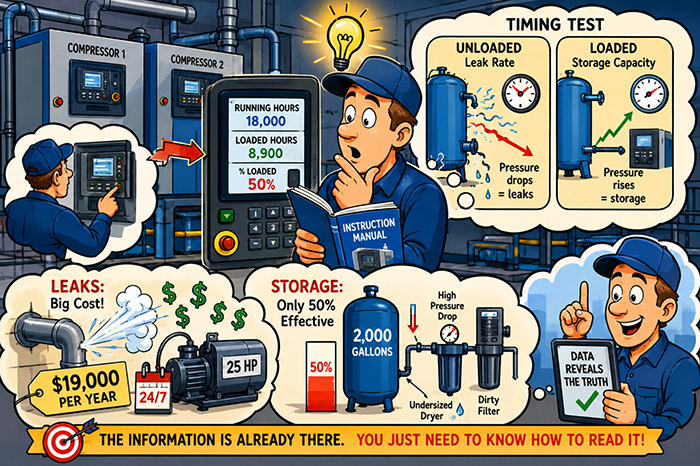
Fig. 1 Your compressor controller can be used to diagnose system problems if you understand what it is trying to tell you.

It had simply been spinning, drawing power, generating heat, and giving everyone the impression that the system was working efficiently.

That discovery bothered him enough to dig deeper. He called one of the instructors he’d met during a Compressed Air Challenge course, who suggested an easy follow-up: perform a compressor timing test.

The test couldn’t be much simpler. During an off-shift or weekend, isolate as much plant air demand as possible and let the compressor cycle normally. Measure how long it spends loaded versus unloaded as it runs in its pressure band. The test is described here.

Timing measurements reveal this about the system:

  • During the unloaded portion of the cycle, any pressure loss is caused almost entirely by air leaks. Measuring how quickly pressure falls allows you to calculate the system’s leakage rate based on the compressor duty cycle.
  • During the loaded portion, the compressor refills the storage volume. Using the receiver size and pressure change, you can estimate the system’s effective storage capacity, the amount of usable compressed air volume available between the load and unload pressures, not just the receiver’s nameplate volume. You should have between 3-5 gal of storage per cfm of your main compressor.

Mike ran his test on a quiet Saturday morning. The results were eye-opening. His leakage rate was high enough to consume the output of a dedicated 25-hp compressor running around the clock just to feed leaks. This was costing him $19,000 per year.

The storage calculation wasn’t much better. Although the system had nearly 2,000 gal of receiver capacity installed, only about half of that volume was being used effectively because of excessive pressure drop across an undersized air dryer and poorly maintained filter. The lack of usable storage explained why his compressor was short-cycling and operating less efficiently than it should.

He realized that the compressor had been quietly recording the clues for years. The information had always been sitting in the control panel, waiting for someone to look.

If no one has explored the diagnostic information on your compressor controls, there’s a good chance your system is telling a story that nobody has read yet. The data is already there. You simply need to know how to interpret the readings.

Want to learn how to perform compressor timing tests, calculate leakage, evaluate storage, and uncover hidden system problems? Check out Compressed Air Challenge’s Compressed Air Systems training.


Filed Under: Air Compressors, Air Preparation, Components, Compressed Air Technologies, Pneumatic Tips


About The Author

Paul Heney

Current Digital Issue

Fluid-Power-World-November-2026-issue-Cover-feature-image-template-copy

A note from the editor This issue takes a look at some of the practical challenges engineers face when designing, maintaining and troubleshooting fluid power systems. Our Design Notes feature explores the particularly harsh environment of tunnel boring machines, where moisture and contamination can quickly become reliability problems. Eaton’s filtration expert weighs in here on…

View Back Issues

Subscribe!

Fluid Power World is written by engineers for engineers engaged in designing machines and or equipment in Off-Highway, Oil & Gas, Mining, Packaging, Industrial Applications, Agriculture, Construction, Forestry, Medical and Material Handling. Fluid Power World covers pneumatics, mobile hydraulics and industrial hydraulics.

Fluid Power Design Guides

fluid
“fpw
EXPAND YOUR KNOWLEDGE AND STAY CONNECTED
Get the latest info on technologies, tools and strategies for Fluid Power Professionals.

RSS feed: Featured White Papers Featured White Papers

  • Moving fluid power forward
  • High-force linear motion: How to convert from hydraulic cylinders to electric actuators and why.
  • A technical comparison: Performance of pneumatic cylinders and electric rod actuators
Fluid Power World
  • Hose Assembly Tips
  • Mobile Hydraulic Tips
  • Pneumatic Tips
  • Sealing & Contamination Control Tips
  • About us
  • Contact Us

Copyright © 2026 Arrowfly LLC. All Rights Reserved. The material on this site may not be reproduced, distributed, transmitted, cached or otherwise used, except with the prior written permission of Arrowfly
Privacy Policy | Advertising | About Us

Search Fluid Power World

  • Home
  • Technologies
    • Hydraulics
      • Cylinders & Actuators
      • Filtration/Contamination Control
      • Fittings, Couplings & Adapters
      • Fluids
      • Fluid Conditioning
      • Hose & Tubing
      • Pumps & Motors
      • Related Technologies
      • Sealing
      • Sensors & Gauges
      • Valves & Manifolds
    • Pneumatics
      • Air Preparation & Regulation
      • Compressed Air Technologies
      • Cylinders & Actuators
      • End Effectors & Grippers
      • Fittings, Couplings & Adapters
      • Hose & Tubing
      • Sensors
      • Vacuum
      • Valves & Manifolds
  • Engineering Basics
  • Trending
  • Resources
    • Digital Issues
    • Pneumatics Tech Toolbox
    • Podcasts
    • Special Reports
    • Subscribe to Fluid Power World Print Magazine
    • Videos
    • Webinars / Digital Events
    • White Papers
  • Women in Engineering
    • Women in Fluid Power
    • Women in Engineering
  • Design Guides
  • Classrooms
    • Hydraulic Filtration
    • Hydraulic System Design
    • Pneumatics Classroom
  • Advertisers
    • Advertise
    • PR Submissions
    • Eblast Submissions
  • SUBSCRIBE