
At this year’s CONEXPO-CON/AGG show in Las Vegas, Lingong Group unveiled an expanded construction equipment portfolio and a new global service platform to better support customers across North America, Europe and other key markets. The group’s core subsidiaries, Shandong Lingong Construction Machinery (SDLG) and Lingong Heavy Machinery (LGMG) introduced new product lines such as loaders, aerial work platforms, and industrial vehicles. There was a focus on new-energy powertrains, intelligent control platforms, and user-centric designs, along with enhanced efficiency and operator control.
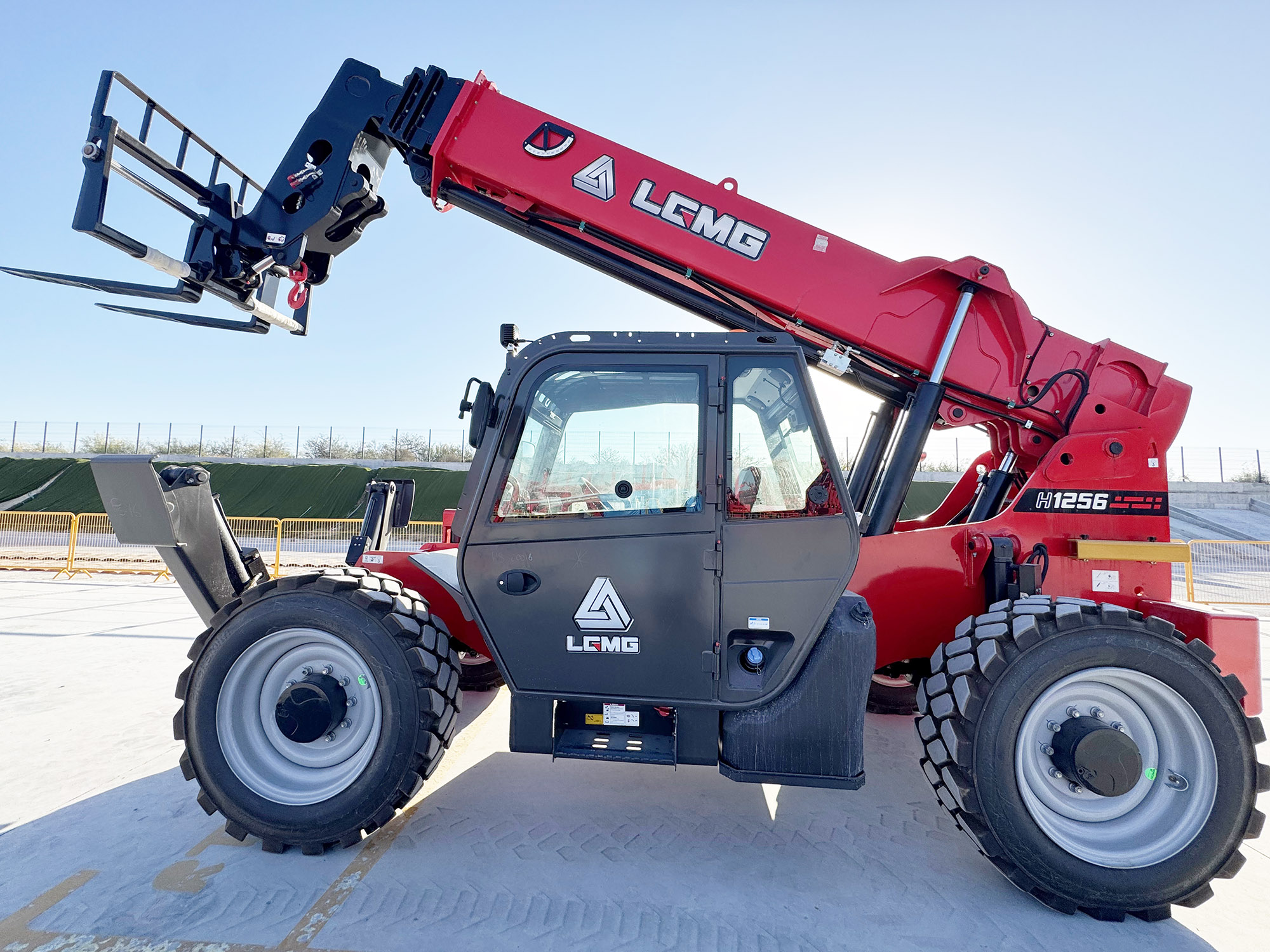
Lingong Group’s H1256 Telescopic Handler.
Lingong, founded in 1972, had 2024 revenues of $5.7 billion and is now in 140 countries and regions, with more than 110 dealers and 60 subsidiaries, along with four R&D centers, and five manufacturing bases. Fluid Power World had an exclusive interview with Feng Chi, SDLG’s Executive General Manager and Chief Engineer about the future of mobile equipment and fluid power’s evolving role.
Focus on efficiency
Chi said that the biggest remaining efficiency gains in hydraulic systems lie within three key areas that he sees as the most promising: optimization of hydraulic system architecture, intelligent control, and electrification.
“Pump and motor mechanical structures have already reached a relatively mature stage. However, reducing throttling losses, overflow losses, and pressure coupling losses during combined operations through improved system architecture remains a key focus for existing conventional products,” he said. “During system control, the load characteristics of actuators can be combined with the efficiency characteristics of pumps and motors to optimize operation in real time, ensuring that pumps and motors remain within their high-efficiency operating range. Electrification of the hydraulic power source also provides a more straightforward way to implement variable-speed and variable-displacement control for hydraulic components.”
He also noted that as intelligent AI self-learning capabilities develop at the machine level, systems will be able to automatically analyze pressure–flow coupling losses during operations — and optimize machine control accordingly.
“This can further reduce losses caused by operator skill differences during combined movements and improve overall system efficiency,” he explained.
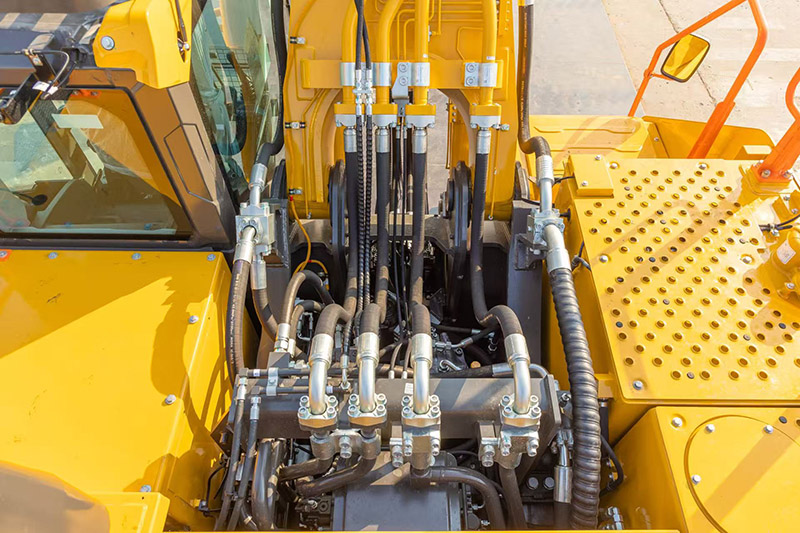
Part of the hydraulic system of Lingong’s SDLG E6505H Excavator.
Energy recovery has been another focus with a lot of manufacturers, especially in high-cycle applications such as excavators or loaders. But how far can energy recovery go?
“Energy recovery in excavators mainly relies on two approaches: swing braking and boom lowering,” Chi said. “Swing braking can typically achieve energy recovery of around 6–10%, while boom lowering can recover about 8–12%. The ongoing electrification of excavators is making energy recovery easier to implement and more effective in practical applications.”
Electrification, electrification, electrification
Compared with the previous CONEXPO held in 2023, Chi said that electrification has become significantly more important in hydraulic systems.
“Pump and valve control is increasingly moving toward full electronic control. At the same time, electrified machine platforms enable optimized variable-speed control of pumps. This allows machine functions to be increasingly defined by software and operating behavior to be customized, helping meet the needs of different application scenarios and operator preferences.”
Chi said that this sort of electrification brings about three major changes:
- Pump selection: There is a greater emphasis on power density and response speed, with electronically controlled variable pumps becoming the mainstream solution.
- Control strategy: Designers shift from hydraulics-dominated control to electrohydraulic coordination, enabling demand-based energy supply and energy recovery.
- Thermal management: The thermal loads of electric drive systems and hydraulic systems become coupled, requiring system-level thermal balance design to improve overall energy efficiency.
He also noted that they indeed seeing electrohydraulic actuators (EHA) gradually replacing traditional hydraulic systems in auxiliary functions such as fan drives and steering assistance, as well as in some medium and low-power systems.
“However, in heavy-duty, high-impact, and high-frequency operating scenarios, traditional high-power hydraulic systems still maintain clear advantages. In the future, we expect electrohydraulic and traditional hydraulic systems to coexist and complement each other,” he said.
Software and smarter systems
Software and control systems are shifting from a supporting role to a leading role, said Chi. In the past, efficiency improvements mainly relied on optimizing mechanical structures. But today, electrohydraulic systems can identify operating conditions in real time and dynamically match pump displacement with load demand to meet the requirements of different working scenarios.
“Many functional requirements are now defined by software, including hydraulic coupling and decoupling control during combined movements, optimization of pressure-flow coupling losses during multi-function operations, and variable-speed and variable-displacement control of pumps and motors based on component efficiency characteristics,” Chi explained.
Beyond that, companies like Lingong Group are designing hydraulic systems for predictive maintenance rather than reactive service.
“By embedding sensors into key hydraulic components, we can monitor parameters such as pressure, temperature, flow rate, and contamination levels in real time,” he said. “Combined with edge computing and cloud-based AI models, this allows us to build a health profile for the equipment. As a result, maintenance can shift from reactive repair to predictive maintenance, improving machine availability and reducing lifecycle operating costs.”
Today and tomorrow
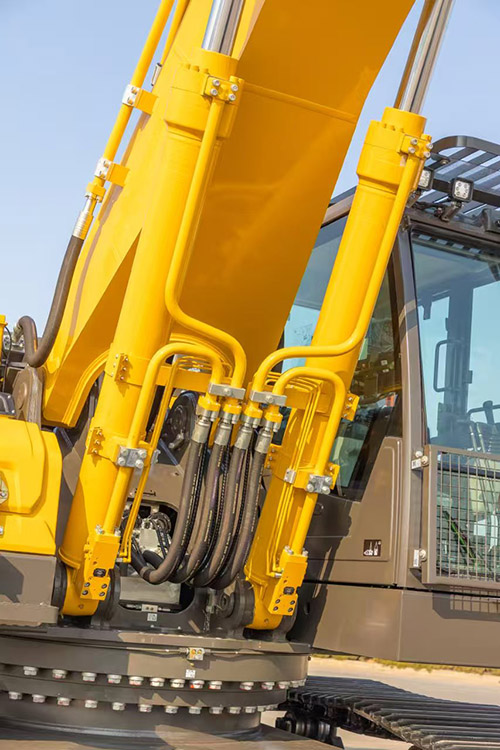
Details of Lingong’s SDLG E6505H Excavator.
Chi had plenty more to offer for design engineers looking at the market today and in the future. Among his other thoughts:
On labor shortages driving efficiency — “Labor shortages are an important driver, but improving productivity remains a core source of competitiveness. These two factors together are accelerating demand for automation. Our automation strategy aims to address both challenges at the same time, making machines smarter and equipment more efficient.”
On preferred power solutions in mining vs construction — “This divergence is already emerging. The mining sector is increasingly favoring electrification and autonomy to reduce cost per ton of material, while the construction sector remains more diversified, adapting to different working conditions and energy infrastructures. This trend places higher requirements on hydraulic systems. We are therefore developing modular, configurable hydraulic platforms that can maintain performance while enabling compatibility across different power platforms.”
On modular hydraulic platforms for diesel, battery-electric, hybrid, or hydrogen powertrains — “This is one of our current key R&D directions. We are developing a scalable and adaptable modular hydraulic platform that can quickly integrate with different powertrains, including diesel, battery-electric, hybrid, and hydrogen. This approach helps shorten development cycles, reduce system complexity, and increase cross-platform component commonality.”
On hydraulics’ role in 2036 — “One widely accepted assumption today is that hydraulic systems are inherently complex and difficult to deeply integrate with electronic control systems. We believe this view will look outdated in ten years. Hydraulic systems will become more intelligent, simpler, and more programmable, evolving into an integrated part of the machine’s digital architecture rather than remaining a ‘black-box’ subsystem.”
On his vision of actuation for an all-new machine in 2040 — “It would likely be a highly integrated, intelligent electrohydraulic system featuring adaptive capabilities.
- Actuators with self-sensing, self-decision, and self-execution capabilities
- Intelligent energy flow management
- AI-driven real-time optimization of control strategies, and
- Seamless integration with the machine’s operating system, supporting cloud-based fleet coordination and management.”
Filed Under: Electrification, Mobile Hydraulic Tips, Trending
