
By Josh Cosford, Contributing Editor
At this just-past CONEXPO show in Las Vegas, which is not in the tourist drought my algorithm is telling me it is, one of my favorite technologies was the mobile hydraulic robots from companies like Bot Crew and Green Climber. These are machines without a seated operator that can function either through wireless or Bluetooth remote control, or entirely automated.
Despite the fact that the member of the team who penned the company name is clearly different from the one who decided on “Gravion,” which sounds more like the missing puzzle piece to complete the Standard Model of Particle Physics, it’s a unique machine. With such a bull-free name like Bot Crew, I was hoping for something hyper-functional like “TaskBot” or “Field Runner.” But that’s neither here nor there, because the Gravion robot is still pretty epic.
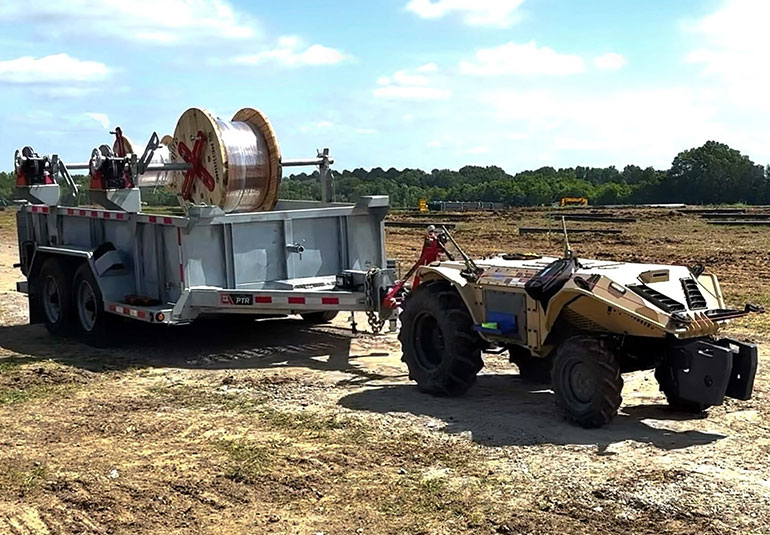
Visually, it looks like an oversized, armored ATV with dirt-drag-racing-sized rear tires and neither a seat nor a steering method. It’s diesel-powered, so it’ll run continuously on the job site without being pulled away for a charge. The Gravion has only 26 hp, which is perfectly suitable considering its primary mission, because it’s definitely not doing any dirt drag racing despite its tires. Plus, that small engine and 23-gallon fuel tank are good for up to two days of continuous operation.
It’s a go-anywhere robot with standard 4WD and a locking differential, so there aren’t many places it can’t go, as long as ground clearance isn’t a factor. 3-point hitch capacity is up to 1,800 lb, and it can pull upwards of 2,000 lb, depending on traction conditions. The standard rear PTO delivers up to 19.5 hp at 540 rpm, while the mid-mounted PTO operates at 2,500 rpm and slightly less horsepower.
It’s available with a dizzying array of attachments: snow blower, forklift, loader, stump grinder, mowers, diggers, backhoe, and many more. It’s able to use both the mechanical PTO and a hydraulic pump, of course, which adds to the versatility, just as you see with modern farm tractors.
The entire machine, including any hydraulic functions, is controlled primarily through remote control. It’s essentially a giant, badass, Swiss Army knife of an RC car. It operates with up to 18 cameras, providing 360-degree vision to spot obstacles when the operator cannot. However, it can also be programmed to operate autonomously when equipped with its optional LiDAR system. Don’t worry, it has a “bumper wire” that shuts the machine down if it runs into something … or someone.
Green Climber specializes in remote-controlled slope mowers but also offers attachments and accessories, including swinging hammers, stump grinders, boom arms, buckets, trenchers, and snow blowers. Slope mowing, its primary directive, is a challenge for manned vehicles because of their top-heavy nature, which makes steep grades uncomfortable for the operator or impossible altogether without rolling the machine. The Green Climber can operate at up to 60° with its hydraulic track extension, adding up to 20 in. more width on some models.
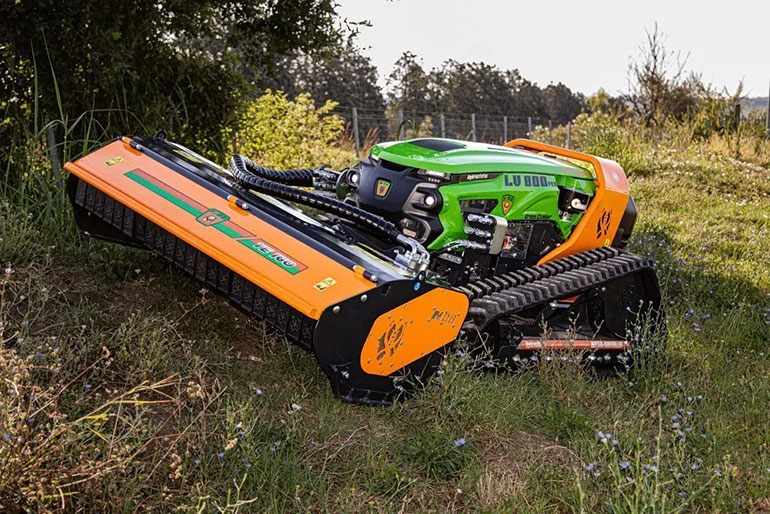
Power comes from gas or diesel engines ranging from 25 to 100 hp, offering more than enough power for their hydraulic systems to make quick work of grass, shrubs, and thick branches alike. The most powerful of which is the LV1000, which has a lifting capacity of up to 2,866 lb with the appropriate attachment. All functions are hydraulic, as their engines power the hydraulic pump, which in turn distributes its energy to the rest of the actuators, including the drive motors. Their large models come standard with a recovery winch, making them the perfect first responder when your rig gets stuck while hauling one.
All machines are available with Autec or IMET radio remote control systems, typically in the form of a belly box (larger models include a digital display). With up to 500 ft of range, one could clear an entire hillside from the comfort of his or her Muskoka chair (not included). Typical operation is with a single joystick on the remote, rather than dual levers like old skid steers, which allows simultaneous operation of hydraulic functions with the opposing hand. Despite the reliability of today’s electronics, Green Climbers are offered with manual levers in case a problem occurs with the remote or receiver.
Although the Green Climber machines are not currently offered in autonomous versions, their range has expanded to include remote-control buckets and forklifts, which are a natural evolution for hazardous worksites. With a lifting capacity up to 4,000 lb, these units are the perfect companion for remote worksites on difficult terrain. Their Pocket Lift Plus folds down to only 31 in. for easy transportation and storage, which I imagine will soon start replacing the bulky forklifts you see hanging off the back of flatbed delivery trucks.
I wasn’t surprised by the level of electrification I saw at the 2026 CONEXPO, but I certainly didn’t predict the proliferation of hydraulic-powered robots. Such solutions provide all the benefits of electronic and hydraulic technology in one powerful package, so shame on me for not seeing it coming sooner. My bold prediction for the 2029 CONEXPO will be widespread adoption of automated mobile hydraulics.
Filed Under: Mobile Hydraulic Tips
