
Contitech is poised for growth with independence, plant expansions, and a stable manufacturing base.
Continental is undergoing one of the most significant transformations in its history — the spin-off of its ContiTech group. For the Americas region, that change means sharper focus on core markets, a stronger distributor base, and new opportunities in energy, mining, agriculture, and beyond.
FPW sat down with Andreas Gerstenberger, CEO of ContiTech USA and Head of Business Area Industrial Solutions Americas (IAM), to discuss what the restructuring means for customers, how tariffs and onshoring are shaping strategy, and where the company sees its next phase of growth.

Andreas Gerstenberger, CEO of ContiTech USA and Head of Business Area Industrial Solutions Americas (IAM), sat down with Fluid Power World to discuss the changes the company is going through and its outlook for the future.
FPW: Let’s start with the biggest news — the spin-off that’s going to happen eventually here of the ContiTech group from Continental. Is the goal to have that all done by the end of this year?
Gerstenberger: What we can say is that if you look at the history of Conti, this is one of the most fundamental changes the group is going through.
(For example, more than 20 years ago, Continental made several major acquisitions, culminating with Siemens VDO, which included several different divisions to basically build a new automotive supplier giant at that time.) It was the dream then to continue to grow and diversify, which led to further acquisitions and moves of different businesses under the roof of Continental. That gave a very good run for the company, for its customers, and its people. And now, in the last couple of years, I would say the change here in America, and also globally — not only in the automotive industry — is requiring different organizational setups and more focus. Instead of being so diversified that sometimes you don’t know what’s on the left or right side, that’s what’s driving it. And that’s why Conti as a group — declared fittingly on the Fourth of July — independence for the three sectors, as we call them today.
So what we are doing in ContiTech, and what that means for us here in the Americas, is that we see it as an opportunity to be more focused on our customers. And if you take out the automotive side for GM, Chrysler, and so on and so forth … we do not have too many customers together with tires or with automotive that we share. We do have, for example, customers like John Deere or Caterpillar, where we provide products like tires or automotive brakes. But if I look at our distributor base — and more than half of our business here in America is distributor-based — we have a different customer base to focus on.
FPW: How has the distribution base reaction been?
Gerstenberger: We have a customer council on the distributor side, and we met with our end users. They have said, “We ask you to continue to do what you’re doing, and focus on us customers, and then we will stay with you, as we did before.” We have a very strong base.
FPW: You’re poised for growth, with a lot of opportunity to hone in on the industrial market. And like you said, 50% of your business is distributors. Is that where you want to keep going? Or do you think that with this change, you might move more toward a different side of the business?
Gerstenberger: Here in this region, we do most of our business in five countries — Canada, the U.S. (by far the biggest), Mexico, Brazil, and Chile. And if you look at the GDP of those different countries and compare them and the growth predictions you have for Canada, the United States, Mexico, and Brazil, compared to other GDPs globally where my colleagues in Asia Pacific or in Europe are active, then we are in a very blessed region. The Americas overall is one of the biggest growth regions in the world.

ContiTech recently hosted its Total Conveyance Event in celebration of the expansion of its conveyor belt manufacturing facility in Ponta Grossa, Paraná, Brazil. Total Conveyance provides customers with an integrated approach that combines products, services and digital technologies to support material handling across mining, agriculture, construction and logistics.
We are in energy. We are in oil and gas. We are in hydrogen. We are mid, up, and downstream — active along the energy value chain in the region and also globally. Mining, e.g. copper which is not only strong in the United States, but also in Brazil and Chile which is important in the energy transition, including building data centers and the required batteries to support them. We are active in food and beverage. North America is very independent of food imports. We have a very strong agricultural sector here in the country, with plants in Nebraska and Iowa.
We see a chance with onshoring. Companies coming back and expanding what they have — because we are in construction design, in material, and in hydraulic solutions, which are helping those companies to build or rebuild their facilities. So overall, we are quite optimistic.
We want to go more into systems. For example, we are working in our conveyor belt business — which we call Total Conveyance. This is our largest business in the region in terms of sales. What does that mean? If you operate a mine, the major concern of a mine operator is not if the conveyor belt is working. The major concern is, how many tons of whatever they are mining do I get out every day, and send for production. The conveyor belt is just the means of getting it there.
So what we are trying to do is take care of the entire system for the miner, which is far more than the conveyor belt. It has to do with digitalization, with predictive maintenance, with engineering know-how, and with people directly on the front line, working for the customer, on the ground with the customer, with our products and other products. That will be a new approach if you look at the value chain, rather than being just a component supplier.
We are pretty bullish when we look at the region. If you look at the economic data, we have challenges like every other company, but also many opportunities related to that.
FPW: How are tariffs affecting this growth plan?
Gerstenberger: I think the biggest challenge to any change is the uncertainty that comes with it. And I think companies like ContiTech are used to change. We are also used to managing uncertainty. The question is, how long can we live with this uncertainty? Because when you have uncertainty, regardless of who you are and where you are, most companies and human beings first hold back and wait. And waiting as an entrepreneur means I’m not investing as much as I wanted to, I’m not doing the next thing because I will wait. I think that’s a little bit of the concern right now related to tariffs. We will do the best with the situation thanks to our footprint. Would we be impacted if certain tariffs stay or are increased for certain products? Yes. But the impact for us is manageable, and with a new plant in Mexico, and our plant in Canada, and the rest here in the United States, we have more than 90% of what we use here in the region.
FPW: You’re already manufacturing where you’re selling. And you are sourcing more locally where you can?
Gerstenberger: Yes. Long before this tariff discussion, we had a philosophy in the Conti group called, “in the region, for the region” — so in the country, for the country. If you are more in the Americas, it doesn’t make sense, as it maybe did 20 years ago, to produce everything in Southeast Asia. For us, a big wake-up call in that direction was COVID. When COVID happened, we started to proactively look for finished products and also raw materials or compounds as close as we can to our origin of production and sale. And the vast majority of our sales in the region are in the United States. So that’s where most of our plants are. We still source certain raw materials from other regions, and we are working with purchasing and R&D to minimize it as much as we can.
FPW: Size-wise, how big is the Norfolk hydraulics business compared to others in the region or world?
Gerstenberger: If you look at our hydraulic capacities globally, and our expertise in hydraulics globally, the vast majority of the origin of the hydraulic expertise comes from Norfolk, Nebraska. That was then exported and shared to other facilities in Asia and in Europe many years ago. And now, with the plant in Aguascalientes, Mexico, Norfolk is the mother plant, helping to build up this brand-new facility in terms of capacity. If you look at the new plant and then Norfolk, the new plant would be significantly bigger than Norfolk. But Norfolk is not only doing hydraulics — they’re also doing other things, and I think that’s the strength they have.
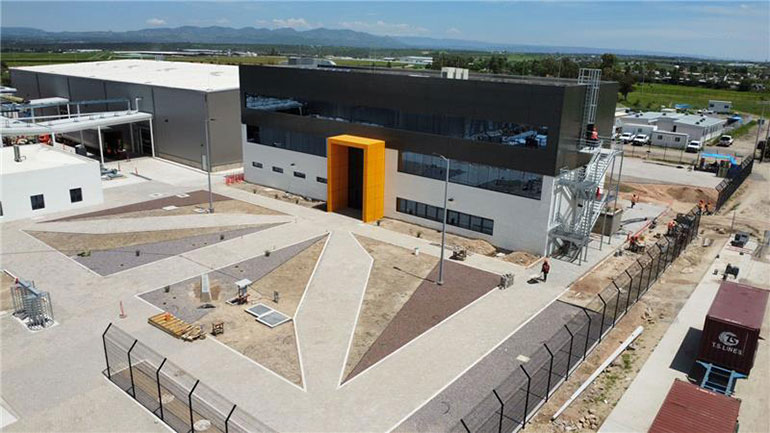
With the opening of its plant in Aguascalientes, Mexico, Gerstenberger said that ContiTech continues to expand its “in the region for the region” mission, as it is poised to better serve the North and South American markets.
FPW: Let’s talk a little bit about the Mexico plant and its grand opening.
Gerstenberger: We officially opened on the 25th of August. It is our biggest plant in hydraulics in the region, and it was a pretty fast process. We had the groundbreaking at the beginning of last year. The official opening will be coming this November. It will be a plant working in phases. So if we’re doing well in the first phase, then we go to the second and then the third phase. The capacity can be used almost like a butterfly — you have a center line and then you can double, then triple each line.
FPW: In the past year, you have been doing many product developments and releases in the hose field, not just hydraulics, even with data cooling and food hose. Let’s talk about your plan for future product growth.
Gerstenberger: If you look at our portfolio today, we have four major product groups — conveyor belts, fluid power/hoses, power transmission belts, and air springs. We consider ourselves to have opportunities in terms of hydraulics, and that’s why we are investing. This is also an area where acquisitions could make sense, on a regional but also on a global basis.

In the past year, ContiTech has launched several new hose lines, including the X-Life XCP5 hydraulic hose with braided construction for high-pressure applications in agriculture, mining, manufacturing, construction and energy industries. Additionally, the company has expanded with hoses for food service, data centers, and marine applications.
For conveyors, we consider ourselves already pretty well-positioned here in the region. We have various plants in Marysville, Ohio, and Lincoln, Nebraska. And we are also in South America. With the latest expansion, which we just opened in Ponta Grossa — a $30 million expansion — we see more opportunity. On the air spring side, we are very well positioned with certain OEM customers who build trucks or trailers.
And then there are other areas where we are trying to excel more, and that is this total conveyance, or service mindset. That’s why we also looked into data cooling hoses, which is a huge change in the entire region. If you talk to companies, North America is probably one of the leading regions pushing this more than Europe at this point in time. We had been approached some years ago by some of our really close customers if we wanted to be development partners. And that’s exactly what happened, and that’s what we then launched at the last NAHAD in San Diego to the market.
I think this data center business is going to keep going well. All those data centers need energy. But if I can say, together with my colleagues, we make sure that our data center solutions support your AI solutions.
We have to think and communicate more in value chains, and not only products. We want to be strong in our classics, but we also want to set innovation highlights here and there. And that’s true for all products we have in our portfolio.
FPW: With some of your preventive maintenance technology in conveyance, will you take that technology to your other groups?
Gerstenberger: If you consider tire pressure monitoring, which today is normal, that’s progress toward a smart tire. And I would say that’s also true for hoses. We have tested various potential solutions for measuring pressure in a hose.
If you have highly technical, demanding solutions — like in high-pressure hydraulic operations, or in conveyor operations — predictive maintenance related to safety would be very helpful, and customers would appreciate it. There’s not one answer for the total market. I would differentiate a little bit by channel, absolutely, and by application — it makes total sense.
FPW: How are industry regulations impacting your sustainability initiatives in terms of rubber development?
Gerstenberger: The meaning of sustainability in the region really differs by country. And if you then look globally, it differs even more by region. For us as a corporation in the current structure, Conti decided for its corporate goals to include sustainability with sub-objectives. That’s true for Automotive, for Tires, and for Tech.
For example, here in America, in Mount Pleasant, Iowa, we developed for garden hose a solution that, in the end state, contained more than 90% recycled material. We launched that product to the market, but the demand here was very limited. On the other side, if you talk to conveyor belt customers in Canada, for example, they want to know: how can you help me recycle?
We are trying, also on the component side and on the mixing side — which starts with product and design — to use materials that are more environmentally sustainable, and to exchange certain sources that are no longer compliant, which is driven by purchasing. In general, we are adapting because of regulations and customer requirements.
I think some of the key questions that companies and customers should ask are: why is it good for me to be part of a circular economy? What does it cost me? What does it bring me? Can I use that to help convince my eventual end-users? It will remain, it will be here, but it must be differentiated.
Filed Under: Components, Hose & Tubing, Industry News, News, Trending
