
As it wrapped up the initial project testing phase, Danfoss Scotland, part of Danfoss Power Solutions, announced the results of its Dextreme Max system validation in a 30-ton battery-electric excavator. Undertaken with a £4.29 million grant from the UK Government, Danfoss demonstrated that its Dextreme digital hydraulic architecture reduced excavator power consumption by 35% across a representative duty cycle mix, corresponding to 53% longer runtime on a single charge. The results confirm the potential of the Dextreme Max system to significantly increase energy efficiency and accelerate the electrification of large excavators.

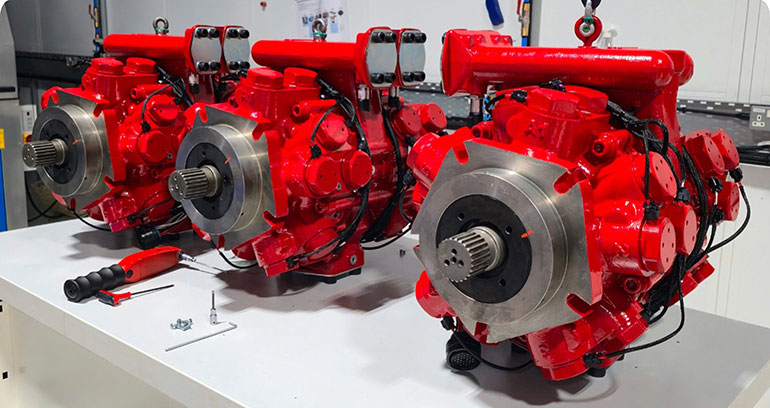
Danfoss’ Dextreme Max system aims to cut excavator energy consumption by up to 50% by reducing energy losses and recovering energy that would otherwise be wasted. The system’s integral component is the DDP1X0D, a Digital Displacement hydraulic pump/motor with multiple independently controlled outlets. The Dextreme Max system provides independent actuator supply, eliminates flow-sharing losses, and enables energy recovery from excavator motions such as boom lowering.
When asked what’s next for the project, Matteo Pellegri, Senior Manager, Engineering, Digital Displacement Systems, said that the next phase is already taking shape.
“This project taught us a great deal: the system’s shortcomings, areas for improvement, and the broader potential we can now pursue with a clearer focus on productization and simplification. We’re not going back to the drawing board. The technology is mature and requires refinement rather than a fresh start. The pump hardware is nearly perfect — it’s incredibly efficient — so optimization will focus on software control and the system that surrounds the pump,” Pellegri. “Digital Displacement is at the forefront of fluid power, and that remains our focus. Some elements of the system came from our existing portfolio outside of excavator-specific applications, and they performed impressively from day one. That speaks to the quality and versatility of what we bring to non-standard applications. There is always room to push further, and we intend to.”
In 2023, Danfoss received a grant from the Red Diesel Replacement Phase 2 Competition, a program funded through the Department for Energy Security & Net Zero’s £1 billion Net Zero Innovation Portfolio, to develop and validate the Dextreme Max system. The program provided funding for projects developing low-carbon alternatives to red diesel for the construction, mining, and quarrying sectors. Danfoss used the funding to procure a battery-electric excavator and integrate its Dextreme Max system into the machine. The grant represented approximately 65% of the eligible project costs, with Danfoss funding the remaining portion.
Danfoss selected a Develon DX300LC‑7 crawler excavator for the project. Originally diesel powered, the excavator was supplied in an electric configuration by Staad B.V., which replaced the engine with an electric drivetrain consisting of a Danfoss Editron EM-PMI375 permanent magnet synchronous motor, EC-C1200 inverter, and MC050 motor controller, plus three 140-kWh batteries.
Danfoss engineers replaced the excavator’s conventional swashplate hydraulic pump with the DDP180D pump/motor. The excavator’s four primary services — boom, arm, bucket, and swing — are supplied through ten individually controllable outlets on the pump. These outlets are dynamically grouped through a ganging block, a digital distributor that reallocates capacity to the service requiring it. A dedicated valve operating as a hydraulic H-bridge was developed and applied to the boom function to allow independent metering, providing anti-cavitation, pressure amplification, and energy recovery during overrunning motions. Finally, the control system architecture was developed to provide real-time control of the hydraulic system, electric powertrain, and auxiliary subsystems.

Pellegri said that Danfoss’ primary interest is in collaborating with OEMs. “They know their machines better than we do, and reaching a true technical optimum requires that partnership. We’re not actively pursuing additional funding, but I wouldn’t rule it out,” he said. “Advanced technology often has to navigate a push-pull dynamic; customers recognize the need for new solutions but can be hesitant to commit. At the same time, regulators have a strong interest in seeing these technologies succeed, as their own policy goals depend on it. The Red Diesel Replacement Programme is a good example of that alignment. Funding mechanisms can play a role in bridging that gap.”
Pellegri added that the baseline machine is the most expensive component of the system, but more importantly, adapting a new machine from scratch is the most time-consuming part of the work, which involves reverse engineering, integration, interfacing with existing systems, securing support from the OEM or dealer. “That investment is significant. In an OEM collaboration, that process becomes more streamlined, but our plan is to continue working on the machine we already know and own. Building on established groundwork is simply the smarter path to faster, better results,” he concluded.
To compare system performance before and after conversion, multiple tests were carried out, including JCMAS air grading and JCMAS air dig and dump (equivalent to ISO/AWI TS 11152-2). Compared to the baseline electric excavator, the Dextreme Max system reduced battery energy use by 49.2% in air grading and 31% in air dig and dump, with negligible impact on cycle time. Assuming a duty cycle of 30% grading and 70% digging, Dextreme Max would reduce battery power consumption by 35% without significantly impacting work rate. This would result in 53% longer operating hours with the same battery capacity as the baseline machine, or similar runtime as the baseline with two battery packs instead of three.
“The results of this testing highlight the potential of digital hydraulic architectures to overcome the obstacles in heavy-duty machinery electrification. Electric excavators offer excellent responsiveness, smooth control, a quiet cab environment, and zero-emission operation. With Dextreme Max, they can also deliver the runtime, productivity, and total cost of ownership advantages required for wider adoption, thereby accelerating the decarbonization of heavy-duty machinery,” said Alasdair Robertson, Senior Director, Digital Displacement, Danfoss Power Solutions. “We are extremely encouraged by these results, but there is more work to do. Further gains are possible, and we will continue optimizing the system to maximize the energy savings and value for our customers.”
Danfoss Dextreme systems offer an incremental approach to implementation through three levels: Swap, Flex, and Max. Dextreme Swap involves a simple pump replacement, offering improved system control and more efficient operation. Dextreme Flex introduces flexible allocation of the Digital Displacement pump outlets, reducing flow distribution losses and further improving efficiency. The Dextreme Swap and Flex systems are commercially available, and this project has advanced the path to commercialization for Dextreme Max.
Danfoss Power Solutions
www.danfoss.com
Filed Under: Components, Electrification, EV Engineering, Featured, Mobile Hydraulic Tips, pumps, Pumps & Motors, Trending
