
By Josh Cosford, Contributing Editor
Let’s be honest, there hasn’t been much change in the fundamental nature of hydraulics in the past couple of decades. Discoveries regarding how we control or operate hydraulics are few and far between. We’re unlikely to see another breakthrough like post-pressure compensation or horsepower control, because it’s just so much easier to corral oil molecules with pumps, valves, and actuators operated with electrons.
Hydraulic control of hydraulics will continue to decline, because those complex circuits are now so easy to replace with electronics. Linear position sensors, pressure transducers, and flow sensors are commonly available and at economical prices. Even if the goal is performance rather than cost, modern proportional valves with onboard electronics perform at near-servo valve levels. Simply switching to electrification has reduced the complexity of hydraulic circuits, but recent trends are pushing the limits further.
Electrification requires, well, electrical wires. Depending on the type of sensor or transducer, you may require anywhere from two to twelve or more wires. Some devices include traditional inputs and outputs with switches and relays, requiring even more wires for a fully functional integrated display unit.
And then there are the valves directing traffic. Many bang-bang valves require only two or three wires, but remember that’s per coil. Plus, in some cases, proportional and servo valves require up to six wires each. All it takes is to open the fuse box on a modern excavator to see just how many wires it takes to direct traffic to and from all of its electrical devices.
All this wiring is expensive to purchase, complicated to install, and adds a surprising amount of mass to any machine it’s used on. Manufacturers are realizing that digital, smart electronics, combined with fieldbus networks, create a more self-sufficient package that reduces wiring while improving functionality. In this case, “digital” just means computer, and shouldn’t be confused with electronics simply equipped with circuit boards. Each device we discuss from here on is a self-contained, computer-operated unit.
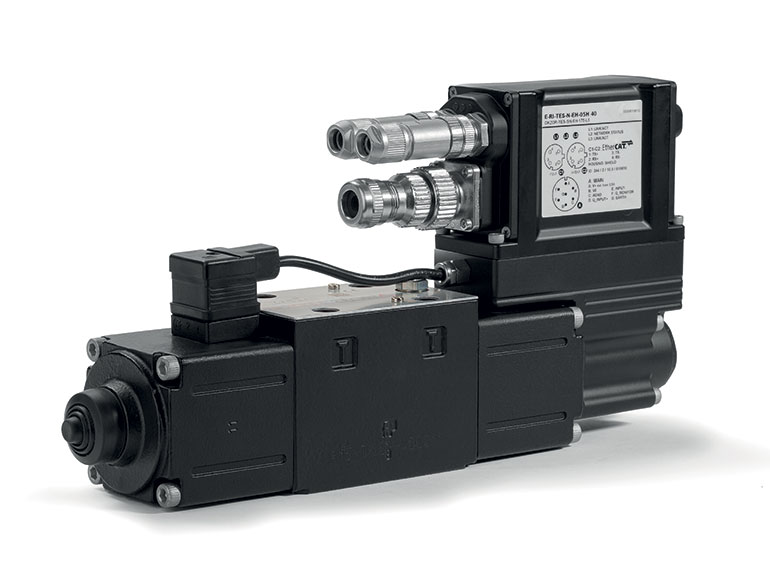
The smart electrohydraulics from Atos, for example, offers an entirely digital package with IO-Link (or other fieldbus options) compatibility that reduces wiring complexity while improving performance and reliability. They also reduce maintenance costs because of their onboard predictive maintenance data. All Atos smart electrohydraulics are Bluetooth-compatible, enabling easy configuration changes while providing advanced diagnostics and troubleshooting capabilities.
Electrohydraulics will be commonly used in mobile pumping technology, such as the RSE pump from PMP. They’ve developed a concrete mixer-specific application, for example, that piggybacks on the RSE’s digital controller. Their DigiMix app can access details from the entire hydraulic circuit via Bluetooth, providing automatic maintenance notifications, recording data onboard and in the cloud, offering predictive maintenance, and integrating with the truck’s native vehicle electronics.
The need for digital technology to bring us into the future isn’t lost on the manufacturers providing the platforms for machinery, especially in the on-highway realm. Ford has created an entire business network called Ford Pro, which, amongst other things like EV charging and financial management, offers solutions to ease the integration of mobile hydraulics on its heavy-duty truck platforms. Users or approved upfitters can tap into Ford’s vehicle integration system to manage the control of hydraulics, such as increasing the idle speed for PTO pump use, or adding lockouts that prevent shifting out of park during hydraulic valve operation.
The entire Ford Pro Vehicle Integration System is user-configurable, integrates with available screens and displays to provide visual data, and offers touchscreen capability right out of the box. The system can piggyback on the vehicle’s GPS to provide geofencing for snowplows, fuel monitoring for the fleet managers, and machine productivity metrics live to the management team, accessible anywhere a mobile device has a connection.
The benefits of digital technology exceed simply the operational end to help reduce costs. Most fieldbus systems use two or four wires, and these digital valves, pumps, or servoactuators only require power alongside their computer signals. All nodes in a digital system require only one or two sets of wires daisy-chained to the next component. Rather than a hundred wires feeding twenty-five electrical devices, one or two cables run through the entire chassis.
Although 4-wire cables can provide power, ground, D+, and D- (the control signals) with a single wire, mobile machinery tends to use 2-wire systems such as CANopen or SAE J1939 to avoid noise caused by running power wires in the same jacket. Regardless, consider the weight savings and complexity reduction simply with wiring alone.
The next step is predictable: battery-powered hydraulic components. Why run any wires at all when Wi-Fi and Bluetooth dominate every corner of the consumer goods market? It just makes plain sense for the evolution of hydraulics. Battery technology has come a long way, and lithium-ion batteries can last for weeks or months when used correctly.
Imagine installing a tank level/temperature sensor that requires just a Bluetooth connection to a J1939 controller, or a sectional proportional valve with a 10 kWh battery that controls your stone slinger functions for months without recharging. Wireless components open up a world of configurable and modular hydraulics that allow customization at the time of machine manufacture, and also for the end user, who can add functions as easily as a new pair of AirPods. Yes, my friends, the future is wireless.
Filed Under: Components, EV Engineering, Featured, Mobile Hydraulic Tips, Trending, Valves & Manifolds
