Fluid Power World

  • Home
  • Technologies
    • Hydraulics
      • Cylinders & Actuators
      • Filtration/Contamination Control
      • Fittings, Couplings & Adapters
      • Fluids
      • Fluid Conditioning
      • Hose & Tubing
      • Pumps & Motors
      • Related Technologies
      • Sealing
      • Sensors & Gauges
      • Valves & Manifolds
    • Pneumatics
      • Air Preparation & Regulation
      • Compressed Air Technologies
      • Cylinders & Actuators
      • End Effectors & Grippers
      • Fittings, Couplings & Adapters
      • Hose & Tubing
      • Sensors
      • Vacuum
      • Valves & Manifolds
  • Engineering Basics
  • Trending
  • Resources
    • Digital Issues
    • Pneumatics Tech Toolbox
    • Podcasts
    • Special Reports
    • Subscribe to Fluid Power World Print Magazine
    • Videos
    • Webinars / Digital Events
    • White Papers
  • Women in Engineering
    • Women in Fluid Power
    • Women in Engineering
  • Design Guides
  • Classrooms
    • Hydraulic Filtration
    • Hydraulic System Design
    • Pneumatics Classroom
  • Advertisers
    • Advertise
    • PR Submissions
    • Eblast Submissions
  • SUBSCRIBE

Festo extends fieldbus connectivity into hazardous locations

By Puja Mitra | September 12, 2026

Share

In Class I, Division 2 hazardous locations, pneumatic actuators have typically been controlled from cabinets located in safe areas. Long wiring runs can increase installation and commissioning time, make maintenance and troubleshooting more difficult, and limit future system expansion.
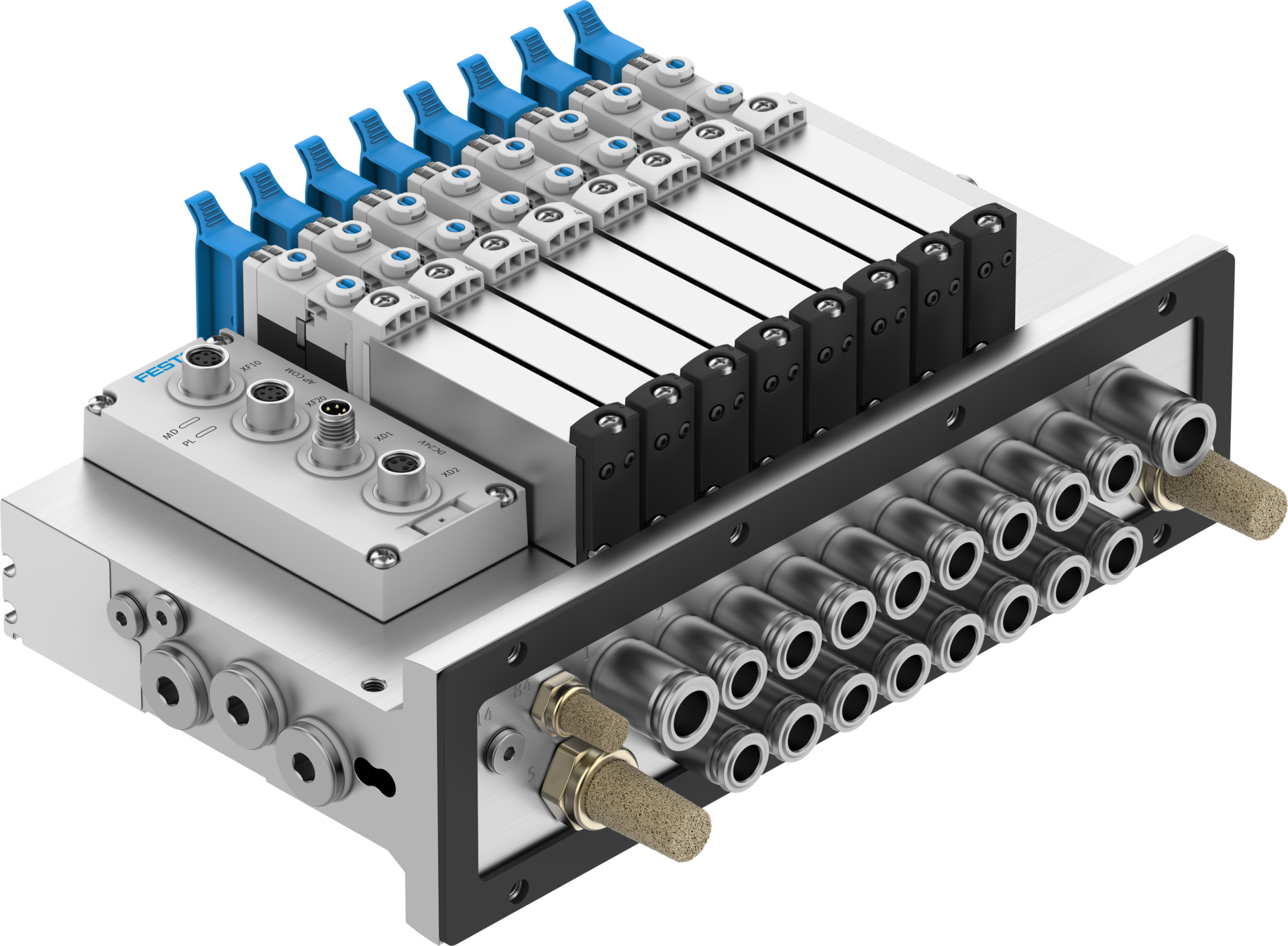
Festo’s VTUG-EX valve terminal provides fieldbus connectivity for use in Class I, Division 2 areas. Ethernet-based fieldbus communication connects the terminal directly to a PLC, reducing the need for individual actuator wiring over long distances.

The VTUG-EX supports EtherNet/IP, PROFINET, and PROFIBUS communication through interchangeable bus nodes. It can also connect directly to an IO-Link master. The terminal supports up to 24 valve stations, or 48 solenoid coils, and flow rates of up to 630 l/min (22 CFM). Hot-swap valve replacement, multiple pressure zones, and panel-mounted installation support maintenance and system configuration. Certifications, including UL Class I, Division 2 and IECEx, allow the VTUG-EX to be used in hazardous locations in multiple regions.

Festo builds control cabinets for hazardous locations

Automation systems in hazardous locations also require control cabinets designed to distribute power, communication, and control signals safely. These cabinets must meet the certification requirements for the environments in which they are installed.

Festo designs, builds, assembles, tests, and certifies control cabinets for hazardous and non-hazardous areas. The completed cabinets are delivered ready for installation. Festo also manufactures many of the automation components used in these cabinets, including valve terminals, air-preparation equipment, emergency-shutdown systems, and I/O products. This allows the cabinet and its components to be specified and integrated through a single supplier.

Festo
www.festo.com


Filed Under: Components, Featured, Industry News, Pneumatic Tips, Technologies, Valves & Valve Manifolds
Tagged With: festo
 

Current Digital Issue

Fluid-Power-World-November-2026-issue-Cover-feature-image-template-copy

A note from the editor This issue takes a look at some of the practical challenges engineers face when designing, maintaining and troubleshooting fluid power systems. Our Design Notes feature explores the particularly harsh environment of tunnel boring machines, where moisture and contamination can quickly become reliability problems. Eaton’s filtration expert weighs in here on…

View Back Issues

Subscribe!

Fluid Power World is written by engineers for engineers engaged in designing machines and or equipment in Off-Highway, Oil & Gas, Mining, Packaging, Industrial Applications, Agriculture, Construction, Forestry, Medical and Material Handling. Fluid Power World covers pneumatics, mobile hydraulics and industrial hydraulics.

Fluid Power Design Guides

fluid
“fpw
EXPAND YOUR KNOWLEDGE AND STAY CONNECTED
Get the latest info on technologies, tools and strategies for Fluid Power Professionals.

RSS feed: Featured White Papers Featured White Papers

  • Moving fluid power forward
  • High-force linear motion: How to convert from hydraulic cylinders to electric actuators and why.
  • A technical comparison: Performance of pneumatic cylinders and electric rod actuators
Fluid Power World
  • Hose Assembly Tips
  • Mobile Hydraulic Tips
  • Pneumatic Tips
  • Sealing & Contamination Control Tips
  • About us
  • Contact Us

Copyright © 2026 Arrowfly LLC. All Rights Reserved. The material on this site may not be reproduced, distributed, transmitted, cached or otherwise used, except with the prior written permission of Arrowfly
Privacy Policy | Advertising | About Us

Search Fluid Power World

  • Home
  • Technologies
    • Hydraulics
      • Cylinders & Actuators
      • Filtration/Contamination Control
      • Fittings, Couplings & Adapters
      • Fluids
      • Fluid Conditioning
      • Hose & Tubing
      • Pumps & Motors
      • Related Technologies
      • Sealing
      • Sensors & Gauges
      • Valves & Manifolds
    • Pneumatics
      • Air Preparation & Regulation
      • Compressed Air Technologies
      • Cylinders & Actuators
      • End Effectors & Grippers
      • Fittings, Couplings & Adapters
      • Hose & Tubing
      • Sensors
      • Vacuum
      • Valves & Manifolds
  • Engineering Basics
  • Trending
  • Resources
    • Digital Issues
    • Pneumatics Tech Toolbox
    • Podcasts
    • Special Reports
    • Subscribe to Fluid Power World Print Magazine
    • Videos
    • Webinars / Digital Events
    • White Papers
  • Women in Engineering
    • Women in Fluid Power
    • Women in Engineering
  • Design Guides
  • Classrooms
    • Hydraulic Filtration
    • Hydraulic System Design
    • Pneumatics Classroom
  • Advertisers
    • Advertise
    • PR Submissions
    • Eblast Submissions
  • SUBSCRIBE