Fluid Power World

  • Home
  • Technologies
    • Hydraulics
      • Cylinders & Actuators
      • Filtration/Contamination Control
      • Fittings, Couplings & Adapters
      • Fluids
      • Fluid Conditioning
      • Hose & Tubing
      • Pumps & Motors
      • Related Technologies
      • Sealing
      • Sensors & Gauges
      • Valves & Manifolds
    • Pneumatics
      • Air Preparation & Regulation
      • Compressed Air Technologies
      • Cylinders & Actuators
      • End Effectors & Grippers
      • Fittings, Couplings & Adapters
      • Hose & Tubing
      • Sensors
      • Vacuum
      • Valves & Manifolds
  • Engineering Basics
  • Trending
  • Resources
    • Digital Issues
    • Pneumatics Tech Toolbox
    • Podcasts
    • Special Reports
    • Subscribe to Fluid Power World Print Magazine
    • Videos
    • Webinars / Digital Events
    • White Papers
  • Women in Engineering
    • Women in Fluid Power
    • Women in Engineering
  • Design Guides
  • Classrooms
    • Hydraulic Filtration
    • Hydraulic System Design
    • Pneumatics Classroom
  • Advertise
  • SUBSCRIBE

Festo simplifies decentralized I/O design with configurable digital I/O module

By Mary Gannon | August 21, 2026

Share

As automated machines become more capable, increasing amounts of decentralized I/O are needed. Conventional approaches often rely on multiple dedicated input and output modules, increasing hardware, commissioning, and additional components that machine builders and system integrators must engineer, stock, and support.

Festo addresses this challenge with a new configurable digital I/O module for the CPX-AP-I decentralized I/O platform. Instead of forcing machine builders to work around fixed I/O configurations, this new module adapts to the application, enabling more efficient use of decentralized I/O across a machine.
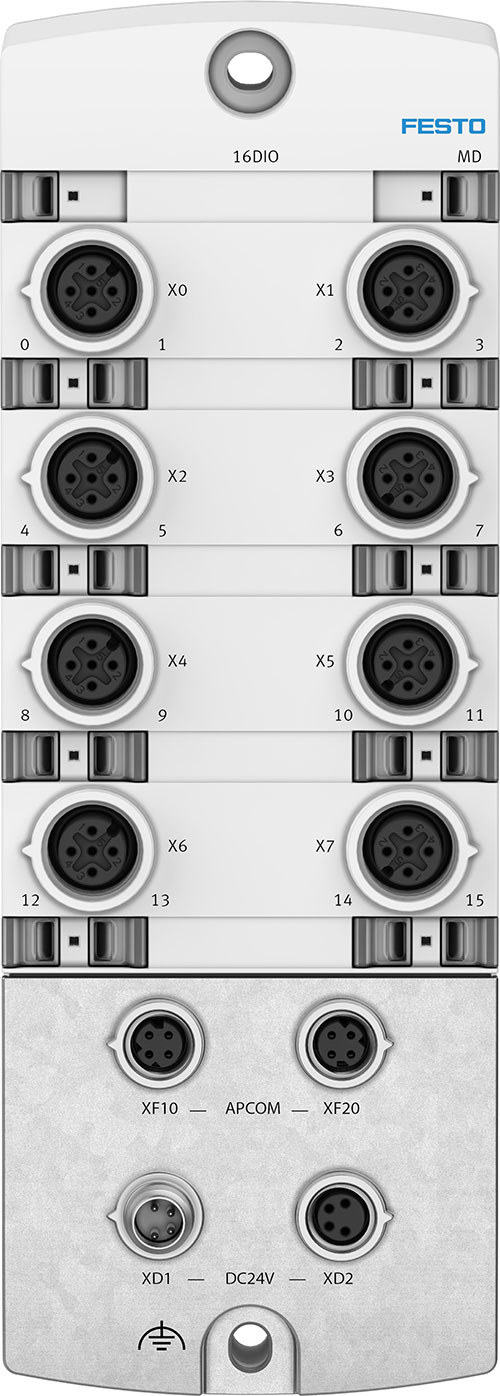
Festo-CPX-AP-I-16DIO-M12
The configurable digital I/O module gives machine builders greater freedom to design around the needs of the application instead of the limitations of fixed I/O modules.

The new CPX-AP-I configurable digital I/O module provides 16 channels that can each be configured as a digital input or digital output to match application requirements. Users can configure the module channel by channel, divide it into eight inputs and eight outputs, or dedicate all 16 channels to output functions. Selected output channels provide up to 500 mA for high-current devices.

The module ships with a default 16-input configuration for immediate installation, while output functions are enabled through software parameterization. Individual LED indicators on each channel simplify commissioning and troubleshooting by providing clear operating and diagnostic status. The M12 version is available now.

The configurable digital I/O module gives machine builders greater freedom to design around the needs of the application instead of the limitations of fixed I/O modules. A single module can support a wider range of machine configurations, reducing the number of module variants that must be specified, stocked, and maintained over the life of a machine.

The new module is part of Festo’s CPX-AP-I decentralized I/O platform, a high-performance system that distributes I/O, valve terminals, and IO-Link devices throughout a machine. Supporting up to 80 modules over distances of up to 164 ft (50 m) between modules, the platform reduces wiring, simplifies modular machine architectures, and allows machine builders to expand or reconfigure systems without redesigning the entire control architecture.

Festo has also introduced a new CPX-AP-I bus node supporting CC-Link IE Field Basic, expanding the platform’s connectivity for Mitsubishi Electric Automation’s environments.

Festo has also introduced a new CPX-AP-I bus node supporting CC-Link IE Field Basic, expanding the platform’s connectivity for Mitsubishi Electric Automation’s environments.

Festo has also introduced a new CPX-AP-I bus node supporting CC-Link IE Field Basic, expanding the platform’s connectivity for Mitsubishi Electric Automation’s environments. Widely used throughout Asia, the industrial Ethernet protocol enables machine builders to integrate CPX-AP-I decentralized I/O into Mitsubishi PLC architecture without additional gateways or custom engineering.

The new bus node allows machine builders to retain the same CPX-AP-I decentralized I/O architecture while changing only the network interface for Mitsubishi Electric systems. The result is less engineering, faster machine adaptation for regional markets, and a common automation platform that supports multiple industrial Ethernet protocols, including EtherNet/IP, PROFINET, EtherCAT, Modbus TCP, and now CC-Link IE Field Basic.

Festo 
festo.com


Filed Under: Components, Components, Pneumatic Tips
Tagged With: festo
 

About The Author

Mary Gannon

Mary Gannon is editor of Fluid Power World. She has been a technical writer and editor for more than 13 years, having covered fluid power, motion control and interconnect technologies.

Current Digital Issue

Fluid-Power-World-September-2026-issue-Cover-feature-image-template-copy

A note from the editor In our September issue of Fluid Power World, we concentrate on how digital technology, connectivity, electrification and smarter controls are being integrated into systems. Our cover story from Bosch Rexroth looks at how construction machinery is embracing connected systems, while our Design Notes feature explores HeavyTech’s ground-up approach to hybrid…

View Back Issues

Subscribe!

Fluid Power World is written by engineers for engineers engaged in designing machines and or equipment in Off-Highway, Oil & Gas, Mining, Packaging, Industrial Applications, Agriculture, Construction, Forestry, Medical and Material Handling. Fluid Power World covers pneumatics, mobile hydraulics and industrial hydraulics.

Fluid Power Design Guides

fluid
“fpw
EXPAND YOUR KNOWLEDGE AND STAY CONNECTED
Get the latest info on technologies, tools and strategies for Fluid Power Professionals.

RSS feed: Featured White Papers Featured White Papers

  • Moving fluid power forward
  • High-force linear motion: How to convert from hydraulic cylinders to electric actuators and why.
  • A technical comparison: Performance of pneumatic cylinders and electric rod actuators
Fluid Power World
  • Hose Assembly Tips
  • Mobile Hydraulic Tips
  • Pneumatic Tips
  • Sealing & Contamination Control Tips
  • About us
  • Contact Us

Copyright © 2026 Arrowfly LLC. All Rights Reserved. The material on this site may not be reproduced, distributed, transmitted, cached or otherwise used, except with the prior written permission of Arrowfly
Privacy Policy | Advertising | About Us

Search Fluid Power World

  • Home
  • Technologies
    • Hydraulics
      • Cylinders & Actuators
      • Filtration/Contamination Control
      • Fittings, Couplings & Adapters
      • Fluids
      • Fluid Conditioning
      • Hose & Tubing
      • Pumps & Motors
      • Related Technologies
      • Sealing
      • Sensors & Gauges
      • Valves & Manifolds
    • Pneumatics
      • Air Preparation & Regulation
      • Compressed Air Technologies
      • Cylinders & Actuators
      • End Effectors & Grippers
      • Fittings, Couplings & Adapters
      • Hose & Tubing
      • Sensors
      • Vacuum
      • Valves & Manifolds
  • Engineering Basics
  • Trending
  • Resources
    • Digital Issues
    • Pneumatics Tech Toolbox
    • Podcasts
    • Special Reports
    • Subscribe to Fluid Power World Print Magazine
    • Videos
    • Webinars / Digital Events
    • White Papers
  • Women in Engineering
    • Women in Fluid Power
    • Women in Engineering
  • Design Guides
  • Classrooms
    • Hydraulic Filtration
    • Hydraulic System Design
    • Pneumatics Classroom
  • Advertise
  • SUBSCRIBE