Fluid Power World

  • Home
  • Technologies
    • Hydraulics
      • Cylinders & Actuators
      • Filtration/Contamination Control
      • Fittings, Couplings & Adapters
      • Fluids
      • Fluid Conditioning
      • Hose & Tubing
      • Pumps & Motors
      • Related Technologies
      • Sealing
      • Sensors & Gauges
      • Valves & Manifolds
    • Pneumatics
      • Air Preparation & Regulation
      • Compressed Air Technologies
      • Cylinders & Actuators
      • End Effectors & Grippers
      • Fittings, Couplings & Adapters
      • Hose & Tubing
      • Sensors
      • Vacuum
      • Valves & Manifolds
  • Engineering Basics
  • Trending
  • Resources
    • Digital Issues
    • Pneumatics Tech Toolbox
    • Podcasts
    • Special Reports
    • Subscribe to Fluid Power World Print Magazine
    • Videos
    • Webinars / Digital Events
    • White Papers
  • Women in Engineering
    • Women in Fluid Power
    • Women in Engineering
  • Design Guides
  • Classrooms
    • Hydraulic Filtration
    • Hydraulic System Design
    • Pneumatics Classroom
  • Advertise
  • SUBSCRIBE

Festo VTOC valve terminal enhances valve control in semiconductor fabrication

By Mary Gannon | June 8, 2026

Share

As semiconductor gas box designs incorporate more process lines and control points, the number of pilot valves required to manage critical gases increases. Typical valve terminals with limited capacity force OEMs to use multiple units, increasing panel space, wiring complexity, build time, and system cost.

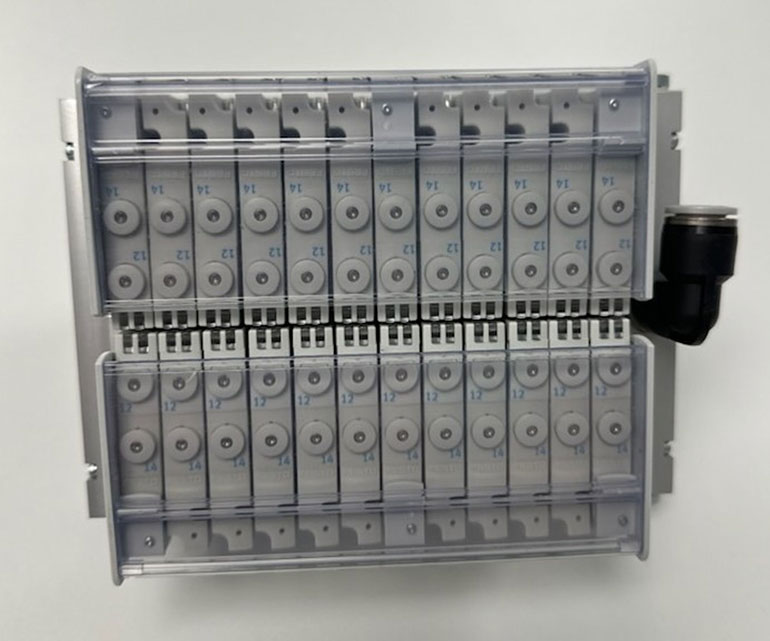
Festo offers the VTOC valve terminal designed for high-density semiconductor applications. The VTOC features 48 valve stations – twice the standard VTOC capacity – within a single compact footprint unit. Each valve slice controls two processes, enabling up to 96 process control points per unit.
Festo-VTOC-for-semiconductor-applications-IMG_4606

Rather than extending the terminal lengthwise to increase valve count, Festo redesigned the VTOC terminal to integrate two compact rows of valves, allowing the terminal to deliver higher control capacity while maintaining a compact form factor ideal for conserving control panel space.

The VTOC uses swappable interface modules to support Ethernet/IP, PROFIBUS, EtherCAT, Modbus TCP, and CC-Link, allowing the same valve terminal to be used across control environments. This design supports consistency across builds, reduces engineering overhead, lowers inventory, and promotes efficiency through familiarity with a standard component.

With each valve rated for up to 40 million operations, the VTOC delivers a long service life in high-duty environments. The modular valve design enables fast identification and replacement of individual valves, reducing maintenance time and minimizing disruption to critical processes.

Festo
festo.com


Filed Under: Components, Components, Pneumatic Tips, Valves & Valve Manifolds
Tagged With: festo
 

About The Author

Mary Gannon

Mary Gannon is editor of Fluid Power World. She has been a technical writer and editor for more than 13 years, having covered fluid power, motion control and interconnect technologies.

Current Digital Issue

Fluid-Power-World-October-2026-issue-Cover-feature-image-template-copy

  A note from the editor In our October issue of Fluid Power World, my commentary takes a look at the growing role of automation and sensors in mobile machinery, where OEMs are increasingly focused on automating specific functions and improving machine performance rather than chasing fully autonomous equipment. Josh Cosford gets cheeky comparing the auto…

View Back Issues

Subscribe!

Fluid Power World is written by engineers for engineers engaged in designing machines and or equipment in Off-Highway, Oil & Gas, Mining, Packaging, Industrial Applications, Agriculture, Construction, Forestry, Medical and Material Handling. Fluid Power World covers pneumatics, mobile hydraulics and industrial hydraulics.

Fluid Power Design Guides

fluid
“fpw
EXPAND YOUR KNOWLEDGE AND STAY CONNECTED
Get the latest info on technologies, tools and strategies for Fluid Power Professionals.

RSS feed: Featured White Papers Featured White Papers

  • Moving fluid power forward
  • High-force linear motion: How to convert from hydraulic cylinders to electric actuators and why.
  • A technical comparison: Performance of pneumatic cylinders and electric rod actuators
Fluid Power World
  • Hose Assembly Tips
  • Mobile Hydraulic Tips
  • Pneumatic Tips
  • Sealing & Contamination Control Tips
  • About us
  • Contact Us

Copyright © 2026 Arrowfly LLC. All Rights Reserved. The material on this site may not be reproduced, distributed, transmitted, cached or otherwise used, except with the prior written permission of Arrowfly
Privacy Policy | Advertising | About Us

Search Fluid Power World

  • Home
  • Technologies
    • Hydraulics
      • Cylinders & Actuators
      • Filtration/Contamination Control
      • Fittings, Couplings & Adapters
      • Fluids
      • Fluid Conditioning
      • Hose & Tubing
      • Pumps & Motors
      • Related Technologies
      • Sealing
      • Sensors & Gauges
      • Valves & Manifolds
    • Pneumatics
      • Air Preparation & Regulation
      • Compressed Air Technologies
      • Cylinders & Actuators
      • End Effectors & Grippers
      • Fittings, Couplings & Adapters
      • Hose & Tubing
      • Sensors
      • Vacuum
      • Valves & Manifolds
  • Engineering Basics
  • Trending
  • Resources
    • Digital Issues
    • Pneumatics Tech Toolbox
    • Podcasts
    • Special Reports
    • Subscribe to Fluid Power World Print Magazine
    • Videos
    • Webinars / Digital Events
    • White Papers
  • Women in Engineering
    • Women in Fluid Power
    • Women in Engineering
  • Design Guides
  • Classrooms
    • Hydraulic Filtration
    • Hydraulic System Design
    • Pneumatics Classroom
  • Advertise
  • SUBSCRIBE