
Without the power of hydraulics or the snappy precision of pneumatics, much of the fun in theater and amusements parks wouldn’t be possible.
By Josh Cosford, Contributing Editor
There are few industries entirely devoid of fluid power actuation, but some could have never existed without it. Even if some other technologies, such as mechanical transmission, could have created a similar result, the power, reliability and smoothness of fluid power have provided the top solution for entertainment machines for nearly a century.
Although lights, cameras, and special effects get all the awards from awing crowds who attend movies, stage shows, theme parks, and even rock concerts, hydraulic and pneumatic technology is a critical component of the spectacle. From the rapid actuation of pneumatics to the powerful and precise control of hydraulics, you can expect to experience the hidden magic provided by fluid power when you’re dazzled by entertainment.
Fluid power offers up advantages making it ideal for high loads, repeating movements and dynamic actuation. Hydraulics, in particular, excels where compact, high-force cylinders and motors are tasked to move entire stage platforms, massive animatronics and amusement park safety systems. While not as force-dense, pneumatics provide speed, simplicity and economical options for everything from animated movie beasts to lifting systems on aerial carousels.
Bringing the power and rotation to Kà
To fully understand how fluid power aids the entertainment industry, it’s best to talk about some choice applications that our industry best serves. The Cirque Du Soleil Kà show, which previously ran at the MGM Grand in Las Vegas, is a tour de force of hydraulic technology. Its signature 25×50 ft deck tips the scales at over 50 tons and stands 75 feet from the basement floor. The platform rotates 360° while tilting up to 100°, where performers appear to walk unaided up its vertical surface.

Although designed and built over 20 years ago, the Kà production used the most advanced hydraulic and control systems available at the time. It used four 12 in. bore x 52-ft stroke cylinders rated for 4,000 psi and fed by (now discontinued) Parker PE series axial piston pumps. Ten of these 145-cc bad boys were driven by 1,250 horsepower, and with the help of 34 50-gal accumulators, offered up 2,200 gpm to the platform lifting system.
Although an electric motor handles the rotating function, designers chose four 12 in. bore by 110-in. stroke cylinders for the stage tilting function, which can cycle from completely horizontal to over-center at 100°. The combination of lift, tilt, and rotate functions with sophisticated control systems allows for over a hundred axes of motion and requires highly advanced valves to achieve the task. Parker D3FH high response, proportional servovalves combined with Atos slip-in proportional valves control lift functions, while D81HF zero-overlap proportional valves control the slant angle.
As you’d expect, such a complex set of high-performance components isn’t controlled by push buttons and toggle switches. Delta motion controllers employed PID programming to ensure the entire array of valves and actuators performed smoothly and accurately. PID stands for proportional, integral and derivative. Using various sensors, it essentially controls the various axes of motion with a correction profile that looks at how far off in position the actuators are (proportional), how long they’ve been out of position (integral) and smoothness correction if things are changing too fast (derivative).
Of course, not all fluid power applications in the entertainment industry are so sophisticated and expensive. Amusement parks use an array of hydraulic and pneumatic technology, from the hydraulic catapults that previously powered the Top Thrill Dragster at Cedar Point to simple pneumatic locks for restraint systems. Although many rides use a ratcheting lock system for their lap or shoulder bar, these older systems require park employees to release the pins manually car by car, so now many parks prefer fluid power activation, which is infinitely adjustable and semi-automatic.
Keeping riders safe
Rather than manual release, the evolved cars were installed with levers attached to the pin release that was actuated by a long bar under the coaster, itself powered by pneumatic cylinders. This allowed the control operator to simultaneously release the spring-loaded bars, which sped up the rider changeover process. However, the system still used a ratcheting system with discrete positions that were not suitable for every body type. The hydraulic restraint system would improve the experience even further.
Perhaps I should add the caveat regarding hydraulic locking systems since these are not traditionally powered actuators. Hydropneumatic accumulators provide the stored energy to operate the restraint cylinders in a simple circuit that also includes a 2/2 solenoid poppet valve, for example. The lap or shoulder bar can be pulled into place while fluid exits the cylinder’s cap port, passes through the poppet valve and into the rod port, kind of like a float function. Excess volume is directed to the accumulator.

Hydraulic restraint systems are built to a near-aerospace level of quality and safety, especially as the coaster speed and G-forces rise. Two actuators on each seat provide redundant protection should one fail. Image AdobeStock
Once adjusted to a snug yet comfortable position, the restraint cylinder is locked in place because fluid cannot move backward through the poppet valve. The poppet prevents the backward motion of fluid from the rod port of the cylinder, keeping the restraint locked and firm until the ride ends.
When the car is stopped on the power rail (essentially a brush contact), power and control are provided to the solenoid valve, which opens when all the safety criteria are met. It’s quite a simple hydraulic circuit that essentially allows the restraint to move freely or to lock, aided by the accumulator.
Hydraulic restraint systems are built to a near-aerospace level of quality and safety, especially as the coaster speed and G-forces rise. The above combination of cylinder, accumulator and valves is a single assembly with no external plumbing, ensuring no tube or hose could leak or fail. Combining two actuators per seat provides redundant protection should one fail, which is a testament to the commitment parks take to safety.
Simple pneumatics are everywhere
Across the world, there are myriad older theme parks with rides and attractions that remain very close to their original design and configuration, making them popular for theme park fans looking for a legendary thrill. Besides the applications already mentioned, pneumatic cylinders were a common solution for powering safety gates and slow-speed motion effects, for example, due to their simplicity and low cost. For safety gates — such as those at ride entrances, exits, or loading platforms — small-bore double-acting cylinders (typically 1 to 1.5 in. bore, 4 to 8 in. stroke) were mounted to hinged gates to control their opening and closing. These cylinders were often tied to basic solenoid valves triggered by operator controls or proximity switches, ensuring gates only moved when conditions were safe.
For slow-speed motion effects in themed dark rides or gentle attractions, pneumatic cylinders were used to animate lightweight props, such as rocking animals, swaying lanterns, or slowly rising figures. In these applications, speed control was handled by needle valves or inline flow restrictors, and cylinders operated at low pressures (40–60 psi) to reduce wear and maintain smooth motion.
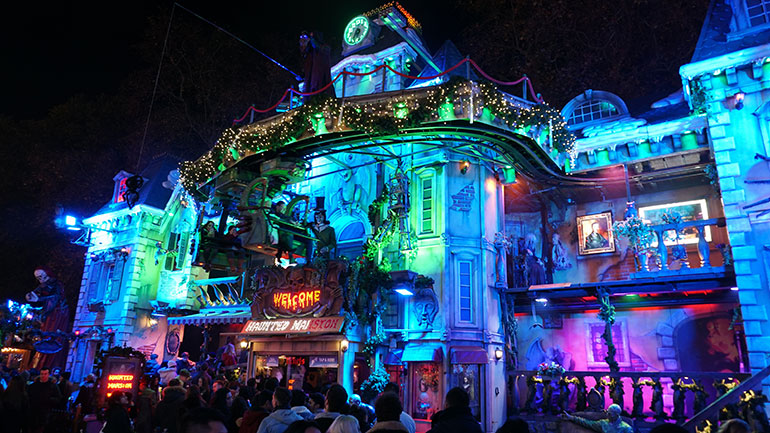
Compact pneumatic cylinders are often used for simple motions on animatronic figures in amusement parks, such as rocking animals, swaying lanterns, or slowly rising figures. Image AdobeStock
If you’ve ever ridden through a haunted house for example, you’ve likely heard the unmistakable sound of air hissing upon release, which indicates that a skeleton or other similar character has just jumped at you, made possible by pneumatic cylinders.
You can expect to see the compact stainless cylinders made famous by manufacturers such as Bimba and Norgren, who supplied many of these rugged, interchangeable components. Though limited in precision due to air compressibility, these pneumatic systems were reliable, easy to maintain, and inexpensive to replace — making them ideal for non-critical functions in long-running park attractions still in use today.
Pneumatics are still used on many attractions’ braking systems, as can be seen at Ohio’s Cedar Point.
Riding into the movies
If you’re the kind of person who loves movies and theme parks, then it’s likely you’ve already had the pleasure of experiencing the immersive attractions such as the Ratatouille ride at Disney or the Transformers: The Ride 3-D at Universal Studios. The latter is a stunning and immersive experience using hydraulic motion control, 3D projections and track-mounted cars for up to twelve passengers.
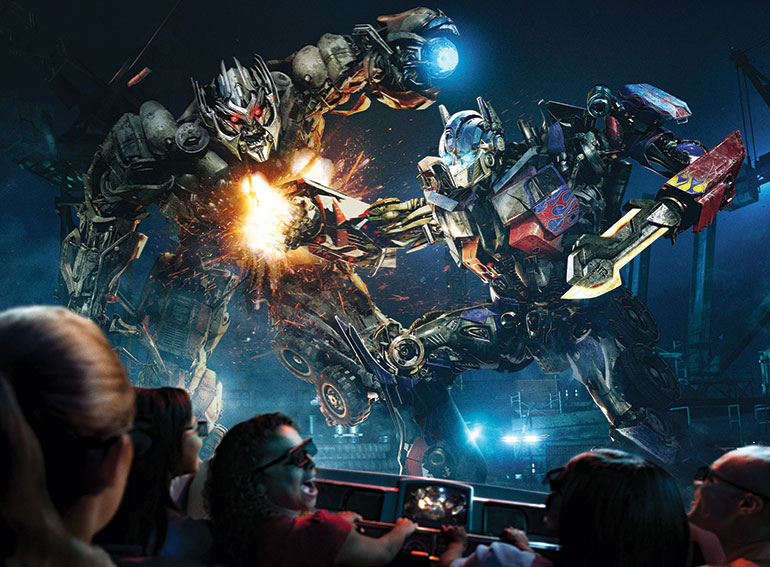
Transformers: The Ride – 3D is based on the popular Transformers films and created along with the award-winning director of the film series, Michael Bay. It features hydraulic motion control, 3D projections and track-mounted cars for up to twelve passengers.
The story has riders escaping Decepticons while riding an EVAC (short for evacuation) and aided by Autobots. Each of these EVAC hexapod cars tips the scale at up to 12,000 lb when fully loaded and is controlled by an onboard 6-DOF motion control system. 6-DOF stands for 6 degrees of freedom and describes the movement axes possible using six hydraulic cylinders.
A 6-DOF system is able to produce linear (translational) movement, which is described as surge, sway, and heave. These directions translate to forward/backward on the X-axis (Surge), left/right on the Y-axis (Sway) and up/down on the Z-axis (Heave). The next three movements are the more familiar pitch, roll and yaw, each of which centers around one of the above translational axes. Pitch tilts forward or backward about the Y-axis, roll tilts side to side about the X-axis, and yaw rotates clockwise or counterclockwise around the Z-axis.
The 6-DOF system uses six sophisticated hydraulic cylinders with low breakaway (low static friction), linear differential transducers and integrated servo valves for the quickest possible response. Accumulators assist with surges of high flow, empowering the EVAC with up to 2Gs of acceleration. The cutting-edge computer controllers can simulate many real-world experiences, such as crashes, drops and earthquakes. For example, a rapid combination of left sway, left roll and clockwise yaw simulates a heavy impact to the rear right of the EVAC vehicle.

Each of the EVAC hexapod cars on the Transformers ride tips the scale at up to 12,000 lb when fully loaded and is controlled by an onboard 6-DOF motion control system, which offers 6 degrees of freedom. This sample hexapod design, while not used on the ride, shows how this movement is possible using six hydraulic cylinders. Image AdobeStock
What’s impressive about watching a 6-DOF system in action is the orientation of the six cylinders, which appears visually as a double-leg tripod, is how the default 45-degree angle of the cylinders can still recreate the forward and backward surge movement without changing any other linear or rotational axis.
As you can see, fluid power applications within the entertainment industry span everything from economical pneumatics to the most sophisticated hydraulics. It’s easy to see why fluid power has permeated into every corner of entertainment, provide fast, safe and reliable solutions from the oldest rollers coasters to newest stage shows.
Filed Under: Components, Cylinders & Actuators, Trending
