
“We’re crawling and walking into the recovery phase right now,” said Connor Lokar of ITR Economics at the National Fluid Power Association’s annual International Economic Outlook Conference here today in suburban Chicago. Lokar noted that 2023 and 204 were poor years for the fluid power industry, but ITR is expecting the overall economy to grow in 2025 and 2026 and for the fluid power sector to see modest gains. Additionally, he said that pneumatics has rounded the corner and is on the way to recovery, although hydraulics is going to take somewhat longer.
Lokar noted that manufacturing volumes are rising/accelerating and they’re cautiously optimistic for the rest of 2025 and 2026.

Connor Lokar of ITR Economics
“We are seeing that the core economy is growing today, and it wasn’t last year … we are seeing growth in the parts of the economy that you care about,” he told the audience largely comprised of fluid power component manufacturers and distributors. “Most of the growth over the last two to three years from your markets have been down again. [The economic heat] was data centers, it was EV grid fortification, it was green energy, that high tech chip side of the economy — that’s what’s been on fire, not necessarily of our core legacy fluid power environment.”
But Lokar said ITR sees that manufacturing capacity utilization is recovering, and people are starting to get busier.
“They’re starting to refortify and use existing machines. We are seeing that wholesale channels are starting to clear.”
Lokar feels that “recovery is close. Cap ex is rising. We’re seeing acceleration. With capital expenditures, we caught some bad numbers in the spring because of the tariff uncertainty, but that’s starting to fade away, and people are going to start holding cash a little less tightly and start getting on with their lives. And we’re seeing that again, generally capex is up. That’s going to bode well for the industry.”
Concerns on the horizon
Lokar did caution that inflation isn’t going away anytime soon — and anything you don’t buy today is going to cost you more tomorrow, next week, next month, next quarter, or next year.
“You can’t pre buy two years’ worth of groceries, unfortunately, but if you need durable goods, you are not doing yourselves any favors by waiting. And again, tariffs are compounding that. This is a direct byproduct of reckless government spending. The inflation cake for 2025 and 2026 was fully formed and baked prior to tariffs,” Lokar said. “View tariffs as additive sprinkles on top of what was already going to be an upside inflation environment over the next two years. Now, unfortunately for the administration, the entirety of any and all inflation outcomes going forward will be blamed on tariffs, which is not going to be totally fair, but somewhat self-inflicted.”
Lokar also noted that there are structural concerns here in the U.S., from interest expense on the debt to healthcare and Social Security spending, which aren’t going away anytime soon.
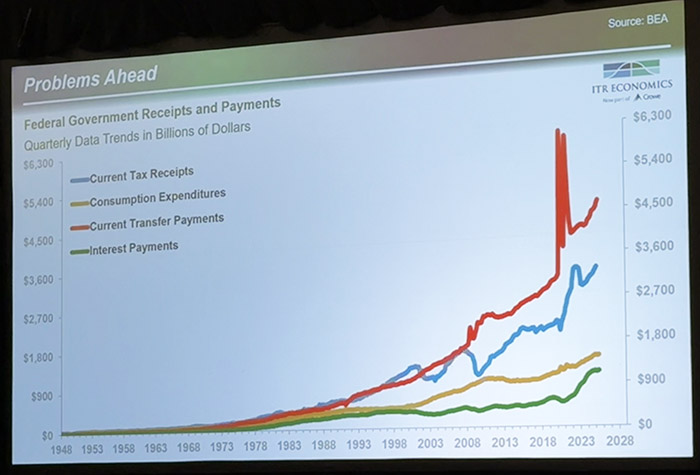
A look at some of the structural concerns in the U.S.
“If we think that somehow our bills are going to look like they did five years ago, you’re going to turn to dust while you wait,” he said. “If your kid has been waiting to buy a house and they think, ‘I missed it in 2020 but someday, surely soon, somehow, I’m going to get mortgage rates back to 3% — but also home prices aren’t going to go up and I’m going to be able to get in again,’ they’re going to turn to dust slowly, as well.”
Filed Under: Featured, Industry News
