Fluid Power World

  • Home
  • Technologies
    • Hydraulics
      • Cylinders & Actuators
      • Filtration/Contamination Control
      • Fittings, Couplings & Adapters
      • Fluids
      • Fluid Conditioning
      • Hose & Tubing
      • Pumps & Motors
      • Related Technologies
      • Sealing
      • Sensors & Gauges
      • Valves & Manifolds
    • Pneumatics
      • Air Preparation & Regulation
      • Compressed Air Technologies
      • Cylinders & Actuators
      • End Effectors & Grippers
      • Fittings, Couplings & Adapters
      • Hose & Tubing
      • Sensors
      • Vacuum
      • Valves & Manifolds
  • Engineering Basics
  • Trending
  • Resources
    • Digital Issues
    • Pneumatics Tech Toolbox
    • Podcasts
    • Special Reports
    • Subscribe to Fluid Power World Print Magazine
    • Videos
    • Webinars / Digital Events
    • White Papers
  • Women in Engineering
    • Women in Fluid Power
    • Women in Engineering
  • Design Guides
  • Classrooms
    • Hydraulic Filtration
    • Hydraulic System Design
    • Pneumatics Classroom
  • Advertise
  • SUBSCRIBE

FRLs for compressed air prep and care

By Josh Cosford | August 3, 2026

Share

When a pneumatic system suffers a catastrophic failure, such as a blown seal, a ruptured airline, or a seized cylinder, the maintenance team must respond instantly to treat it. These unexpected ailments reduce productivity, increase costs, and work your millwrights ragged. Many pneumatic systems experience chronic unwellness, much as we humans do with cardiovascular disease; so too do pneumatic systems suffer from “pneumatic cholesterol.”

Pneumatic cholesterol is the gummy, sometimes abrasive varnish that forms when raw, compressed air is permitted to contaminate the veins and organs of your air circuit. When you combine atmospheric moisture, compact it into a smaller space, and add microscopic particles too fine for the inlet filter and ingested by the air compressor, you create dangerous LDL-level pneumatic cholesterol. Now add the heat of compression along with a sprinkle of compressor oil, and you’re looking at oxidized ApoB level lipoproteins ready to infect your entire pneumatic system.
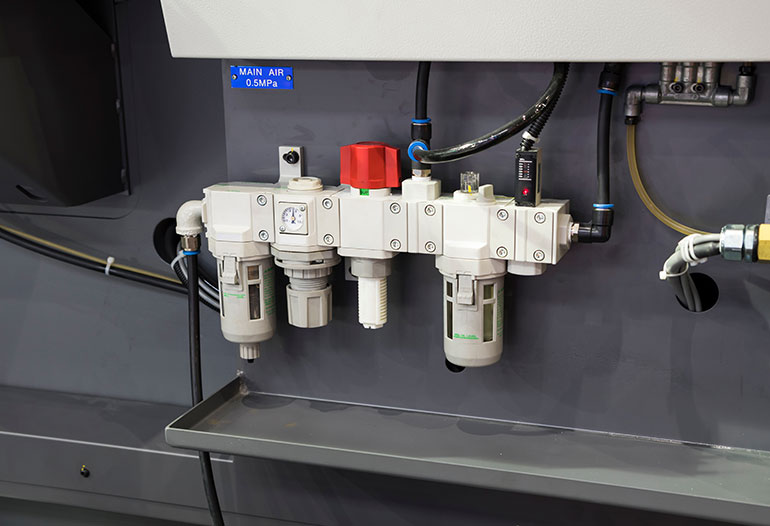
FRLs are the single most effective component to install throughout your facility to ensure the health of your pneumatic machines.

Unlike the myocardial infarction, which is a catastrophic pneumatic failure, such as a burned-out valve coil or blown manifold O-ring, pneumatic cholesterol manifests slowly yet malignantly. It coats high-precision spools, emulsifies with water and assembly lube, and turns to varnish when exposed to prolonged heat. Valves stick, cylinders chatter, and repeatability goes out the window.

You will experience a gradual loss of efficiency, and, just as with your own body, you may not notice until symptoms arise (hopefully mild in both cases!). You may experience reduced cycle times, production bottlenecks, or a single-point failure that can lead to cascading failures in sophisticated factory automation applications. When you practice reactive maintenance rather than preventive maintenance, you essentially subscribe to “sick care” rather than healthcare.

We now know that lifting heavy weights, eating whole, unprocessed foods, and engaging in bursts of high-intensity exercise will prevent 99% of today’s cardiovascular and metabolic diseases, and so too can you prevent such chronic conditions in your pneumatic system.

Preventing the slow, operational decay of your machine from the inside out doesn’t have to be the sole responsibility of your FRL (Filter, Regulator, Lubricator). Still, it’s certainly one of the most important and effective interventions for the task. There’s a reason you see FRLs strategically positioned throughout your facility and at nearly every leg of the system.

The filter traps the raw materials required to formulate pneumatic cholesterol, such as water, particles, and oils, before they can combine into a nasty paste ready to destroy the inside of all you love. Pneumatic filters use a cyclonic effect to remove fluids, and the sintered bronze filters trap what’s left with a single-digit micron efficiency. Filters will collect so much water, in fact, that manufacturers offer them with automatic drains.

The regulator keeps (“blood”) pressure in check, providing enough to operate cylinders and motors without dizzy spells while preventing excessive, damaging pressure that would tax the compressor. Remember that up to 90% of the energy used in pneumatic systems is wasted as heat from compressing air, so get that “resting heart rate” (pressure) down by reducing your compressor’s unloading pressure.

Of course, any solid health regimen can’t do without a supplementation protocol. Vitamin D, magnesium, creatine, and fish oil are staples to any health journey, and so too is the lubrication you add back in for your precious and sensitive valves, regulators, and actuators.

A lubricator will deliver a micro-mist of fresh, clean oil to neutralize friction while protecting moving components with minimal friction and maximum cooling, helping wash away varnish buildup before it clogs pneumatic arteries.

Just like diet and exercise are mandatory to good bodily health, FRLs are the single most effective component to install throughout your facility to show your pneumatic machines how much you love them and care about their cardiovascular health.


Filed Under: Air Preparation, Components, Components, Engineering Basics, Pneumatic Tips


About The Author

Josh Cosford

Current Digital Issue

Fluid-Power-World-October-2026-issue-Cover-feature-image-template-copy

  A note from the editor In our October issue of Fluid Power World, my commentary takes a look at the growing role of automation and sensors in mobile machinery, where OEMs are increasingly focused on automating specific functions and improving machine performance rather than chasing fully autonomous equipment. Josh Cosford gets cheeky comparing the auto…

View Back Issues

Subscribe!

Fluid Power World is written by engineers for engineers engaged in designing machines and or equipment in Off-Highway, Oil & Gas, Mining, Packaging, Industrial Applications, Agriculture, Construction, Forestry, Medical and Material Handling. Fluid Power World covers pneumatics, mobile hydraulics and industrial hydraulics.

Fluid Power Design Guides

fluid
“fpw
EXPAND YOUR KNOWLEDGE AND STAY CONNECTED
Get the latest info on technologies, tools and strategies for Fluid Power Professionals.

RSS feed: Featured White Papers Featured White Papers

  • Moving fluid power forward
  • High-force linear motion: How to convert from hydraulic cylinders to electric actuators and why.
  • A technical comparison: Performance of pneumatic cylinders and electric rod actuators
Fluid Power World
  • Hose Assembly Tips
  • Mobile Hydraulic Tips
  • Pneumatic Tips
  • Sealing & Contamination Control Tips
  • About us
  • Contact Us

Copyright © 2026 Arrowfly LLC. All Rights Reserved. The material on this site may not be reproduced, distributed, transmitted, cached or otherwise used, except with the prior written permission of Arrowfly
Privacy Policy | Advertising | About Us

Search Fluid Power World

  • Home
  • Technologies
    • Hydraulics
      • Cylinders & Actuators
      • Filtration/Contamination Control
      • Fittings, Couplings & Adapters
      • Fluids
      • Fluid Conditioning
      • Hose & Tubing
      • Pumps & Motors
      • Related Technologies
      • Sealing
      • Sensors & Gauges
      • Valves & Manifolds
    • Pneumatics
      • Air Preparation & Regulation
      • Compressed Air Technologies
      • Cylinders & Actuators
      • End Effectors & Grippers
      • Fittings, Couplings & Adapters
      • Hose & Tubing
      • Sensors
      • Vacuum
      • Valves & Manifolds
  • Engineering Basics
  • Trending
  • Resources
    • Digital Issues
    • Pneumatics Tech Toolbox
    • Podcasts
    • Special Reports
    • Subscribe to Fluid Power World Print Magazine
    • Videos
    • Webinars / Digital Events
    • White Papers
  • Women in Engineering
    • Women in Fluid Power
    • Women in Engineering
  • Design Guides
  • Classrooms
    • Hydraulic Filtration
    • Hydraulic System Design
    • Pneumatics Classroom
  • Advertise
  • SUBSCRIBE