
Electrohydrostatics has evolved over the last four decades from its beginnings in aviation to uses throughout more industrial applications.
Contributed by Bill Perry, Managing Partner, MARCH 24 Media LLC, on behalf of Moog Inc.
In the 1980s, aircraft manufacturers began exploring ways to eliminate the potential leaks from hydraulic lines and gain efficiency in energy transfer. Electromechanical actuation wasn’t an option because the industry didn’t want to risk primary flight controls failing. So, the aircraft industry began using electrohydrostatic actuation for flight controls. An electrohydrostatic actuation system, or EAS, works like electromechanical actuation with a bidirectional motor controlling linear or rotary motion, yet mirrors a hydraulic system with a hydraulic transmission transferring motion.
The electric servomotor drives a bidirectional, variable-speed pump connected to a single- or double-rod hydraulic cylinder. The cylinder speed is directly proportional to the pump’s flow rate, so by changing the pump’s rotation speed you can control the actuator’s movement. The energy or power demand is load-dependent without any inherent losses. Engineers can integrate a hydrostatic drive into a very compact unit with a completely self-contained hydraulic circuit, which appealed to aircraft makers.
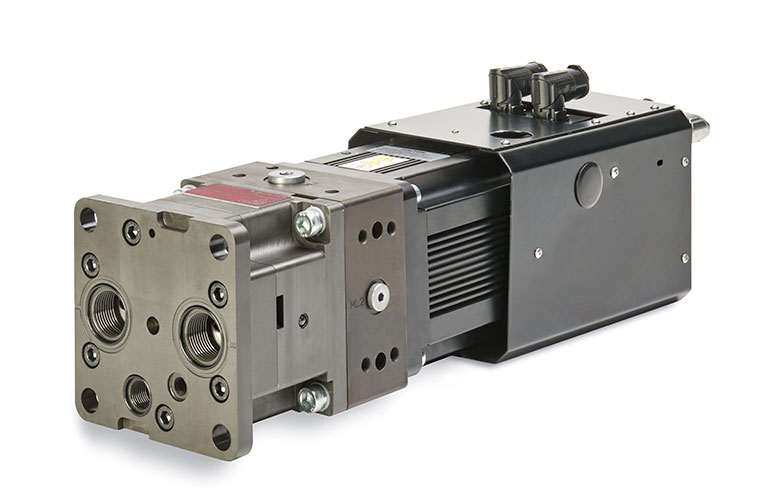
Electrohydrostatic Pump Unit-G (EPU-G). Image courtesy of Moog Inc.
Eliminating the central hydraulic power unit (HPU) as well as hoses, pipes, and couplings and integration of traditionally separate components for hydraulic drives offer advantages over a conventional hydraulic solution. The heart of the EAS is an electrohydrostatic pump unit (EPU), which comes in various designs and sizes. There are also linear and customized EAS. Whether a design engineer chooses to use certain components, or an entire EAS, depends on the application. For example, an engineer might choose the:
1) EPU alone; the EPU is the system’s core component, and ranges in size from 5 to 140 cc. Implementing this requires a lot of hydraulic/electronic know-how.
2) EPS, which is the EPU plus the manifold. This is an entry-level sub-system with the highest flexibility for various applications and requires some electronic know-how.
3) EAS, which is the EPU plus manifold and cylinder; this offers a self-contained actuator and is a turnkey solution requiring no special know-how.
An EAS solves many motion control challenges that aircraft makers and industrial machine designers wrestle with:
- energy efficiency,
- limited installation space,
- safety requirements,
- shock resistance against pulsation,
- lack of hydraulic know-how,
- environmental cleanliness,
- noise emissions,
- high forces, and
- backlash
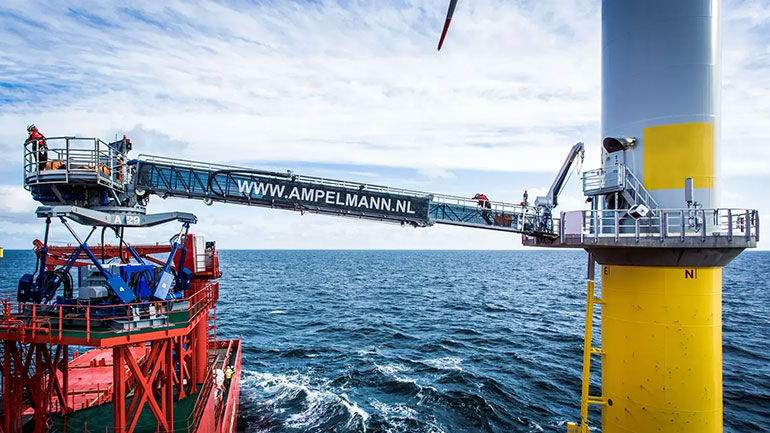
Here is an offshore access system (i.e., gangway) from Ampelmann, underpinned by a Moog 6 DOF motion base using electrohydrostatic actuation. The gangway allows personnel to transfer from a ship to, for example, an offshore wind turbine in seas up to 3m Hs. Because of its full motion compensation, there is no movement in the gangway during operation, resulting in a safe way to transfer workers. The gangway can transfer 20 people in under five minutes from a vessel to a fixed or floating object. Also attached a close-up photo of the Moog 6 DOF.
For example, the EAS has been adopted by manufacturers like Ampelmann, a provider of high-tech offshore gangways; Meritor, an automotive supplier; Plastic Metal, an injection molding machine maker, and Frey & Co. GmbH.
Germany-based Frey & Co. sought an EAS to replace the hydraulic system in its EasyISO2000, which is a 4000-kilonewton isostatic press. Frey’s press produces ceramic parts by applying high pressure to ceramic powder in a sealed elastomer container, shaped specifically for the application. The press’ original design included a traditional hydraulic system for five axes but required frequent maintenance. The design consumed high levels of energy, too. The original hydraulic design included a hydraulic power unit (HPU) with pump, filtration and cooling — all based on conventional hydraulics. The EAS adopted by Frey & Co. includes a function block and integrated, energy-saving EPU to control the machine’s five press axes. The EPU is five to 10 times smaller than the HPU. The EPU also includes smaller filtration and cooling mechanisms, so the press uses less oil, has fewer maintenance points, and is more stable.
Since the EAS is a closed system, there is no pressure drop, and that translates into energy savings for the EasyISO2000. The EAS is also a direct-drive system between the cylinder and the pump. The original design had a 250-cc HPU and an oil tank measuring 400 to 500 liters; the design also required the system to cool oil, which draws additional energy. The new design with the EAS has a 70-liter oil tank reservoir and 32 cm3 EPU. With the EAS’s smaller tank there’s less need for cooling. The EAS controls the main axes of the EasyISO2000 press and all additional tool axes. The solution also includes a manifold assembly, accumulator, and a small auxiliary power unit.
The EPU running with the EasyISO2000 is a four-quadrant pump made by Moog, with a compact design and interface enabling direct mounting on a manifold; this minimizes the space required on each axis. The four-quadrant pump offers power-on-demand, which reduces operating costs. An EPU like this can reduce oil demand by 90%, providing an ecofriendly and safe power unit. Moog designs and manufactures these EPUs as fixed, dual and variable displacement units with digital control to cover different cylinder sizes, loads, and process cycles across an array of industrial applications.
For other industrial applications, Moog Introduces its EPU-G
For applications with smaller pump volumes, Moog introduced its EPU-G, which is available in sizes as small as 5 cm³. This adds smaller pump volumes to an EPU product range spanning from 19 to 140 cm³. Equipped with a four-quadrant internal gear pump and servomotor, the EPU-G is for applications with volume flows as low as 10 lpm. The EPU-G reduces noise emissions at partial load and lowers energy consumption leading to a reduction of operating costs. With high dynamics, low inertia and minimal pulsation at variable speed, the EPU-G improves the overall performance of industrial machines. Examples of industrial applications where the EPU-G fits are process valves; gas, steam, and water turbines; transportation; renewables (e.g., adjusting solar panels); and pulp and paper presses.

A close-up photo of the Moog 6 DOF used on the offshore access system (i.e., gangway) from Ampelmann.
Recommending the best technology, not one system
Moog offers electromechanical actuation, hydraulic actuation and EAS. So, Moog’s engineers pair an application with the best technology instead of advocating for a particular system. That said, opting for an EAS (versus other technologies) offers several benefits including:
- A decentralized motion control technology without servo or proportional valves reduces oil requirements by up to 90%.
- A self-contained system eliminating hydraulic hoses, which reduces installation and maintenance time by two to three days on average.
- Removing the central hydraulic system reduces the weight and size of the system by up to 50%, so machine builders and integrators can install within smaller spaces.
- Streamlining the hydraulic circuit simplifies planning and reduces potential sources of faults and leaks; this boosts reliability and makes maintaining the whole system easier.
- The connected servomotor and hydraulic pump. — without coupling and bell housing — is impervious to pressure surges and nearly wear-free, even in continuous operation.
Generally, the retrofit and transition to an EAS pays off for machine operators within a few years. A reduction in maintenance and energy costs over ten years of operation reduces the total cost of ownership, or TCO, meaning the upgrade pays for itself after two to three years on average. The result: an industrial machine combining the power density of electrohydraulics and the efficiency of electromechanical actuation. The benefits of earlier EAS for aircraft now bring a high-flying payback for industrial machinery too.
Moog Inc.
moog.com
Filed Under: Components, Pumps & Motors, Trending
