
From its massive beginnings to more controllability and efficiency, electrification has changed mobile hydraulics for the better.
By Josh Cosford, Contributing Editor
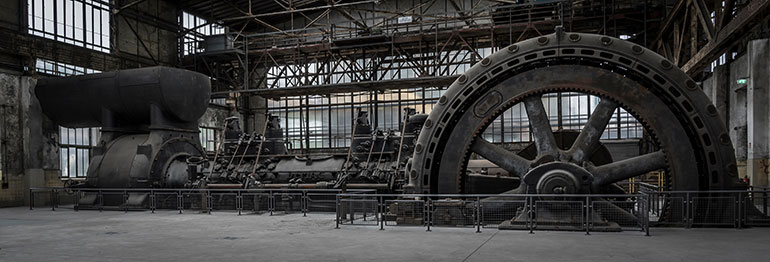
The electrification of hydraulics has come a long way since the first AC induction motors powering hydraulic pumps replaced centralized power distribution systems. Such immense systems, Figure 1, employed giant, stationary steam engines rotating flywheels, which in turn drove a downstream array of shafts, pulleys, and leather belts to power lathes, drills, mills, or even hydraulic pumps.
A line shaft factory was an insane, noisy place where injuries were as frequent as repairs. They were ingenious at the time, as there was no other method to create a room full of industrial or commercial machinery, but a decentralized power system would clearly be a welcome change. If you could run said lathe, drill, or mill with electric motors, you would save on the investment cost and the real estate required for steam engines and their accoutrements.
Those individual electric motors were great for rotating hydraulic pumps, of course. When power was provided at the place of operation rather than at the place of creation, the functional opportunities expanded exponentially, with creative new ways to solve problems. Hydraulic pumps with rudimentary power units, often with just a pump and motor, powered presses, shears, machine tool and various other mechanical production technologies.
Hydraulic machines were previously nothing like what you know today, and any technician who’s had the opportunity to work on a centenarian press can back me up. Individual spool valves, such as monoblock lever valves or industrial stack valves, had not yet been invented. Their control methods were entirely bespoke and products of the manufacturer’s engineering team. The reservoir, fluid passages, and valves were part and parcel of the machine itself, contained within the enormous casting rather than separately plumbed, bought-out components.
Eventually, of course, manufacturers began integrating electrical technology into their control systems, and electric solenoid valves were combined with poppet and spool valves to create bang-bang valves that could be operated remotely via switchgear rather than by machine operators using levers.
Controlling what moves in the air
Of course, this article is about mobile machinery, so it’s clear our discussion must switch gears. In fact, if you consider aviation to be mobile technology, missiles and airplanes were one of the first industries to adopt electrohydraulic technology. Sometimes technology advances out of necessity, and the electronic control of hydraulics was no different. You might be surprised to learn that Bill Moog invented servo valve technology out of necessity during the Cold War.
As America’s supersonic missile technology pushed the limits of speed, the forces applied to fin and canard surfaces increase with the square of velocity. Imagine the difficulty of aiming something that requires millisecond precision at over Mach 3. In 1951, Moog was contracted by the U.S. Navy to develop hydraulic control technology for advanced surface-to-air systems.
It didn’t end there — Moog valves played a role in American air dominance, being employed on everything from B-2 bombers to Saturn V rockets, and eventually, every advanced fighter jet. Fly-by-wire systems use analog control methods with feedback, comparing the desired position with the actual position to make fine adjustments quickly and accurately. Using current rather than voltage control signals, ±8 to ± 50 and eventually 4-20mA, this method was important to prevent voltage drops over long distances using other methods.
Moving to the ground
I know what you’re thinking: aviation isn’t exactly “mobile” hydraulic technology, at least not as we describe it today. But c’mon, what’s more mobile than an intercontinental ballistic missile? Servo valve technology wasn’t ignored by the Army, of course, and it was adopted for the M1 Abrams tank.
So-called “shoot on the move” technology allowed the Americans to keep the aim of their turret and heavy gun fixed on their target despite the bouncing and swaying of a massive machine moving at speed. Previous systems required the tank to be stationary to aim, so imagine, for the first time, facing such a moving target that shot back. And with that, servo-controlled, land-based mobile hydraulic machinery was born.
Of course, commercial mobile equipment wasn’t quick to adopt servo valves for every actuator. It turns out excavators and tractors weren’t practical with military-level budget and cleanliness requirements. Hydraulic pilot controls, such as joysticks and levers, work perfectly well, despite the expense of plumbing, which also adds complexity and mass.
Changing the mobile valve game
It wasn’t until we Gen X were toddlers that manufacturers such as Rexroth and Danfoss began introducing proportional solenoids for the mobile market, and since then have been competing in a 50-year-old game of heads-up electro-proportional poker. Instead of the micron-level precision of servo-valve internals, which require the world’s finest filtration and continuous maintenance, proportional valves offered variable flow via metered spool valves and PWM control, marrying directional and metering valves.
PWM (Pulse Width Modulation) is a method for digitally mimicking a variable current by rapidly switching between full and zero power. Using an analog input, such as a joystick outputting 4-20mA signals to a valve controller, mobile machinery was able to mimic the effect of a servo valve, albeit with less precision, but also less cost and maintenance in a more robust package.
For decades, and still today, these sectional proportional valve systems have controlled everything from excavators to stone slingers and everything in between. A cab with only electrical wires routed to pedals and joysticks eliminated the cost and complexity of running dozens of pilot lines between each pilot controller and the pumps and valves at various locations throughout the machine.
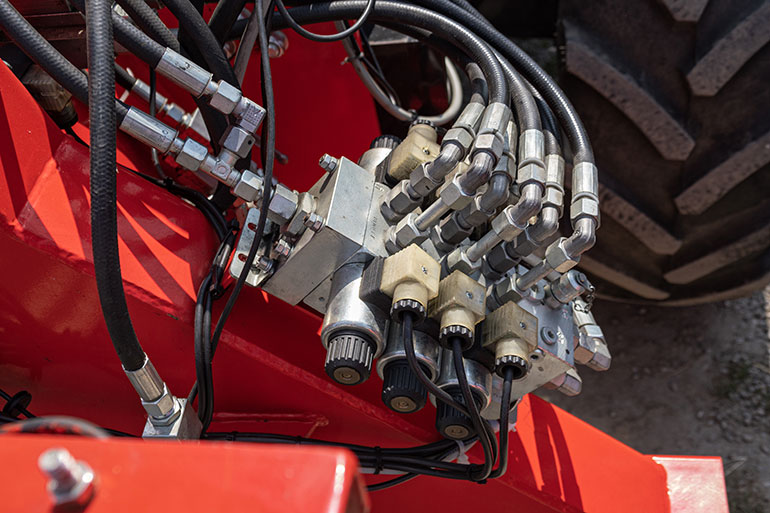
Electrification wasn’t limited to proportional control, and manufacturers liked the idea of operating simple functions with switchgear and bang-bang valves, so installing solenoid valves on mobile machinery was a natural progression (Figure 2). For simple on/off, up/down, and side-to-side functions like downriggers, 3-point-hitch functions, and conveyors, the solenoid valve was the best choice for cab-operated hydraulic functions, especially aftermarket attachments.
Despite the popularity of computer technology, including displays, it gained popularity within the industrial space first, helping operators and technicians in myriad ways. The first and most obvious is the visual execution of functions, as opposed to simply pushing buttons or operating switches.
And with the capacity to interface with the Human Machine Interface (HMI) in new ways, infrequent functions could be buried in menus, which, in a contradictory way, both reduce and increase machine complexity. Manufacturers could hide a function within a menu rather than install rarely used switchgear, avoiding the appearance of an airliner cockpit. Conversely, machine functions could be embedded in software, allowing engineers to increase functional complexity without additional hardware.
Slow adoption of electronic control
But early digital electronics were not known for their all-weather ruggedness, and mobile hydraulic machinery was slow to adopt what was common in the factory. A farm tractor was just not a good place for an electron-tube television, with poorly conditioned electrical power, high vibration, and electromagnetic interference.
It wasn’t until Liquid Crystal Displays (LCD’s) or Vacuum Fluorescent Displays (VFDs) were invented that mobile hydraulics were able to offer digital displays, and even then, were more likely to replace simple mechanical gauges with information such as speed, RPM, pressure, and temperature, and were hard-wired with no menus or configurability.
Fast forward to the mid-90s, and the electronic control of mobile machinery took off. It was Bosch’s invention of Controller Area Networks that allowed multiple computers to communicate, and then the decreasing costs of microchips that enabled computers and their software systems to take off in mobile machinery.
Growing use in the new millennium
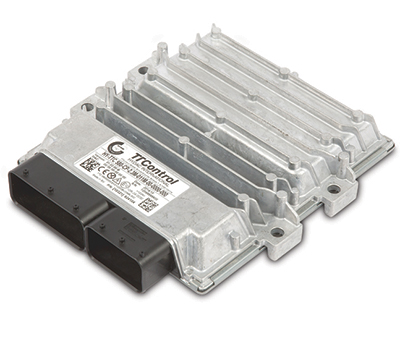
Throughout the 2000s, big players such as Danfoss, Rexroth, and HydraForce offered rugged, programmable controllers that enabled small OEMs to customize the performance and functionality of their offerings. Previously, only the big guys, like John Deere or CASE, could take advantage of such advanced technology. Now, feed mixers, stone slingers, woodchippers, and the small OEMs building them can employ CAN-ready ECUs, various transducers, LED displays, and all the weatherproof connection technology needed to pull it together.
Throughout the 2000s and until the pandemic, electrification exploded. Not only did the hardware become economical, but trade colleges, equipment manufacturers, and associations such as the International Fluid Power Society also emphasized the importance of electrical integration, so the number of fluid power professionals educated in digital electronics grew rapidly as well. Mechatronics diplomas, electronic controls specialist, and various micro-credential certifications could be achieved by students and mature professionals alike. In fact, if you’re a hydraulic professional at any age, you’re likely well-trained in some form of electronic control.
Becoming digital
Industry 4.0 didn’t overlook mobile hydraulics and has only accelerated the use of digital electronics in machinery. Telematics and advanced data transmission technology keep machines connected to the World Wide Web, providing data and feedback on machine status and performance for the benefit of both bean counters chasing profitability and mechanics chasing reliability.
No matter where you stand with online, offshore retailers such as Temu, AliExpress, and let’s be real, Amazon, you can’t deny the saturation of inexpensive digital electronics in mobile hydraulics. Sure, it’s caused the displacement of some hydraulics within our industry, as electric motors are as inexpensive and powerful as ever. But Bluetooth controllers, microcontrollers, commodity-priced sensors, digital screens, and everything you could need to build a machine with as little hydraulic control as possible, it’s hard to hide from the paradigm shift.
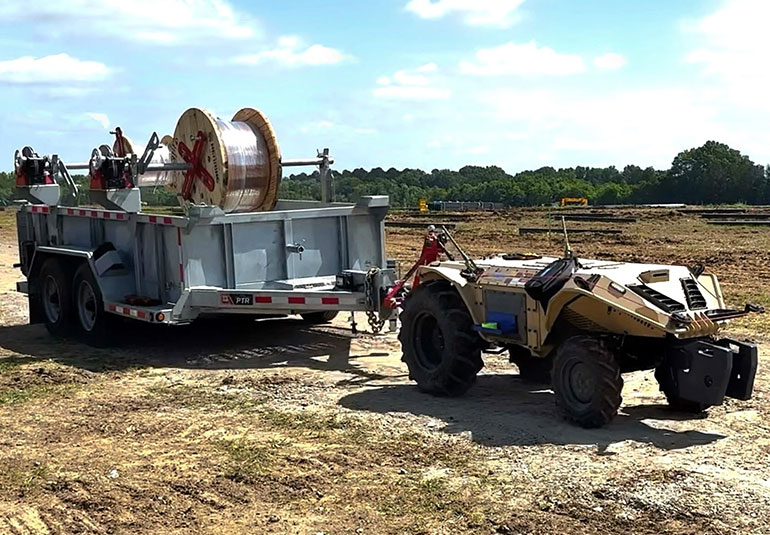
ultra-low profile utility robot, are growing in use.
Today, pumps, motors, and cylinders are means to an end, at the whim of digital control, and part of an ecosystem expanding at light speed, so fast that most of us don’t know what is next. Mobile hydraulic robots are flooding the industry, artificial intelligence is coding on our behalf, and online connectedness tells us everything about our machine or fleet, all at once.
It’s hard to deny the importance of electrification in mobile machinery, but I’m here to reassure you that hydraulics will always be a critical piece of the puzzle. Electrical linear actuators can never achieve the performance of hydraulic cylinders, but I’ll concede these next twenty years are going to be a wild ride.
Filed Under: Components, Electrification, Engineering Basics, EV Engineering, Featured, Mobile Hydraulic Tips, pumps, Trending
