
With new components, systems, and architectures, hydraulic system efficiency can be increased by 50%, with a one-third reduction in emissions as well.
By Alessandro Carmona, President, Industrial division, Danfoss Power Solutions
The much-scolded aviation sector produced nearly 950 Mt of carbon dioxide emissions in 2023, according to the International Energy Agency. Meanwhile, a paper to be presented at IFK 20261 estimates that emissions from fluid power machinery amount to about 1,844 Mt of CO₂ per year — nearly two times the emissions of global aviation and 5% of global energy-related emissions. Even more startling is that over 40% of fluid power machinery emissions (~767 Mt) are related to transmission losses. Useful work accounts for approximately 613 Mt of emissions, while electric/combustion losses account for 464 Mt of emissions.
The good news is we have the opportunity to create a significant impact, particularly in industrial hydraulics. Decarbonizing fluid power is possible by reducing energy consumption through what’s known as digital hydraulics. With new components, systems, and architectures, we can increase efficiency by 50% and reduce emissions by one-third. In fact, innovation and efficiency step improvements in industrial applications are essential for developing sustainable and competitive machinery. Let’s take a look at how this is possible.

Decarbonizing industrial hydraulics is possible by reducing energy consumption through digital hydraulics solutions.
The relevance of fluid power
But first, a word about electrification. It’s no secret that electric machinery is much more efficient than hydraulic machinery. So, if we simply electrify, don’t we eliminate a good portion of those transmission losses and, thereby, emissions? While on some applications this is possible, even preferable, in many industrial applications it’s not feasible to replace fluid power. In sectors such as discrete and process manufacturing, primary metals, marine and offshore, energy, and others, fluid power is indispensable due to characteristics not achievable with electric transmission: high power and force density, flexibility and comparatively low weight, inherent safety and robustness, and precise control of high-powered movement.
That’s not to say that all industrial sectors will retain fluid power. Rotary actuation applications and those sectors with lower power/force requirements can and are moving to electric drives. Robotics and automation is a good example. But for sectors and applications where fluid power will remain the best technical and commercial fit, the industry has a responsibility to deliver the best, most efficient solutions. We need to fully leverage opportunities from digitalization and electrification, and that’s where digital hydraulics plays a key role.
Digital hydraulics defined
Variable speed drives (VSDs) have long been touted as a solution to increasing efficiency in industrial hydraulic applications. But digital hydraulics encompasses more than adding a VSD to a machine. Digital hydraulics entails controlling the speed of the motor and pump with a new system architecture. A variable speed-on-demand electric motor is coupled with a fixed- or variable-displacement hydraulic pump, and the motor and pump speed are used to directly control flow and/or pressure and ultimately the force and speed/position of an actuator. That’s in contrast to the conventional setup — a fixed speed electric motor coupled with a fixed- or variable-displacement hydraulic pump alongside pressure-, flow-, and directional-control valves — where the pump displacement and valves control pressure and flow.
The conventional setup always runs at the rated speed, either 1,500 or 1,800 rotations per minute (rpm), depending on the region. Excess hydraulic oil flow is sent to the tank via a bypass or relief valve. In a digital hydraulic setup, the VSD is programmed to match the load requirements of the current duty cycle, thus eliminating energy waste. The pump and motor run and stop as needed, delivering power on demand, with a speed range of zero to 2,800 rpm. There is no or very limited excess flow. In comparison to the baseline conventional setup, the digital hydraulic setup lowers energy consumption by up to 70%, depending on the machine duty cycle.
Energy efficiency is the key benefit of digital hydraulics. Reducing energy usage significantly lowers operating costs, which results in a quick return on investment. Improved efficiency also reduces heat generation, which often allows downsizing or even elimination of oil coolers. At a minimum, it can help reduce the amount of hydraulic oil required and tank size of the tanks, thereby extending the life of the oil and seals.
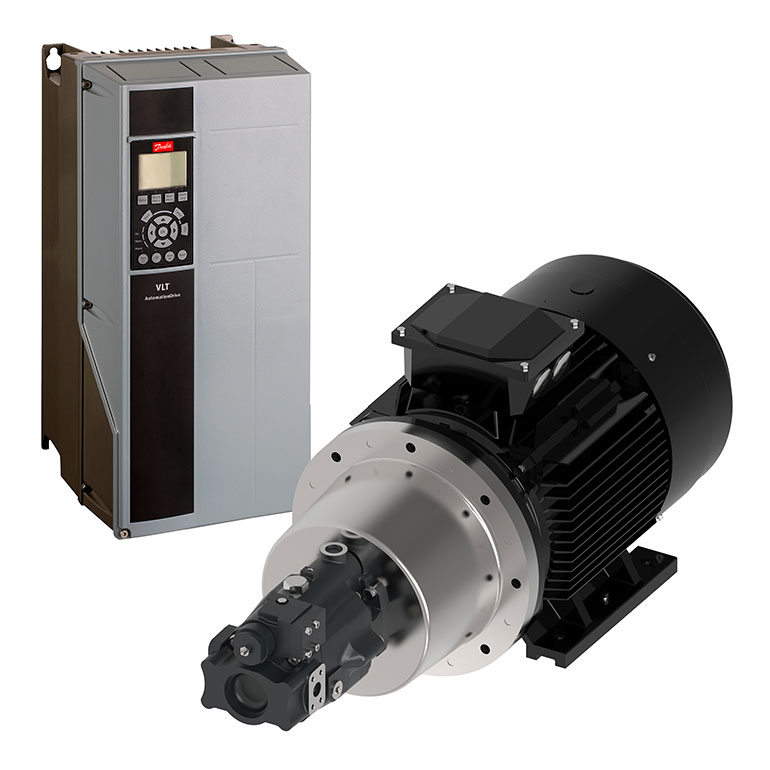
Induction motor solutions upgrade traditional architectures by providing speed on demand via an open-loop control systems comprised of a hydraulic pump, an asynchronous induction motor, and a VSD to match.
Variable speed also enables the pump to be downsized, which reduces costs. Because the system can use the full motor speed range (up to 3,600 rpm) rather than running at a fixed rpm, it reduces the pump displacement requirement without changing the maximum available oil flow, shrinking the machine’s overall footprint. Pump downsizing opens the same possibility for the motor. A pump with a smaller displacement requires less torque to deliver the same pressure. Meanwhile, variable speed enables utilization of the high overload capability of electric motors to deal with the short high-torque portion of the machine duty cycle. Both of these characteristics allow selection of a smaller motor size, further improving total cost of ownership and decreasing power unit size.
Noise reduction is another significant benefit of digital hydraulics. Varying the electric motor and pump speed to match the duty cycle reduces constant noise, which helps protect operators’ hearing and meets more stringent noise regulations.
Digital hydraulic technologies
Digging deeper into what the technology looks like, there are several means for building digital hydraulic systems for industrial applications. At Danfoss, we classify them into three types: induction motor solutions, servo motor solutions, and electrohydraulic actuators.
Induction motor solutions upgrade traditional architectures by providing speed on demand. These open-loop control systems comprise a hydraulic pump — generally a piston pump — an asynchronous induction motor, and a VSD to match. These solutions may be available as pump-motors or hydraulic power units (HPUs).
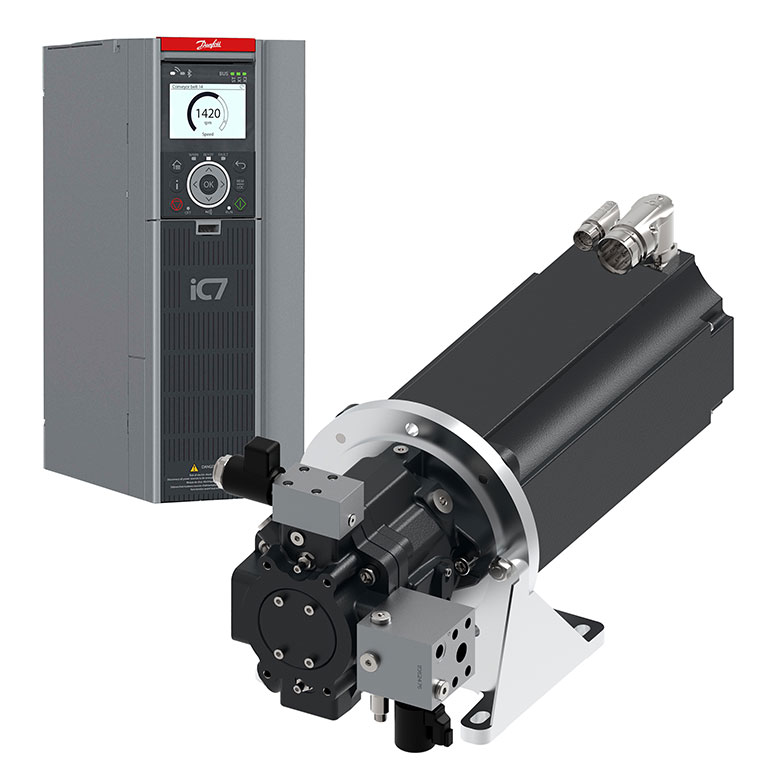
Servo motor solutions provide pressure and flow on demand as well as closed-loop control. The hydraulic pump is typically an internal gear pump or piston pump, while the motor is a permanent magnet synchronous motor (PMSM) paired with a servo motor VSD.
Servo motor solutions are where we start to see new machine architectures, providing pressure and flow on demand as well as closed-loop control. The hydraulic pump is typically an internal gear pump or piston pump, while the motor is a permanent magnet synchronous motor (PMSM) paired with a servo motor VSD.
In addition to hardware, both system types require P/Q (pressure and flow control) and application software, enabling the proper dynamic and controllability. Induction motor solutions are for low dynamic and control requirements and are generally offered in low-, medium-, and high-power ranges. Servo motor solutions are for high dynamic and control requirements and are generally offered in low- and medium-power ranges. Induction and servo motor solutions are better equipped for traditional centralized architectures.
For decentralized architectures, electrohydraulic actuators (EHAs) are a better option. An EHA is a fully contained linear actuator consisting of a hydraulic cylinder with position sensor, force-cooled PMSM servo motor with speed sensor, bidirectional four-quadrant internal gear pump, manifold with valves and sensors, accumulator, and VSD plus software. EHAs are best for machines in which most functions are electrified — in other words, there’s no HPU — and for isolated functions where the HPU is not close by or an HPU is serving only one cylinder. They also work well in applications with high sensitivity to oil leakage, such as food processing.
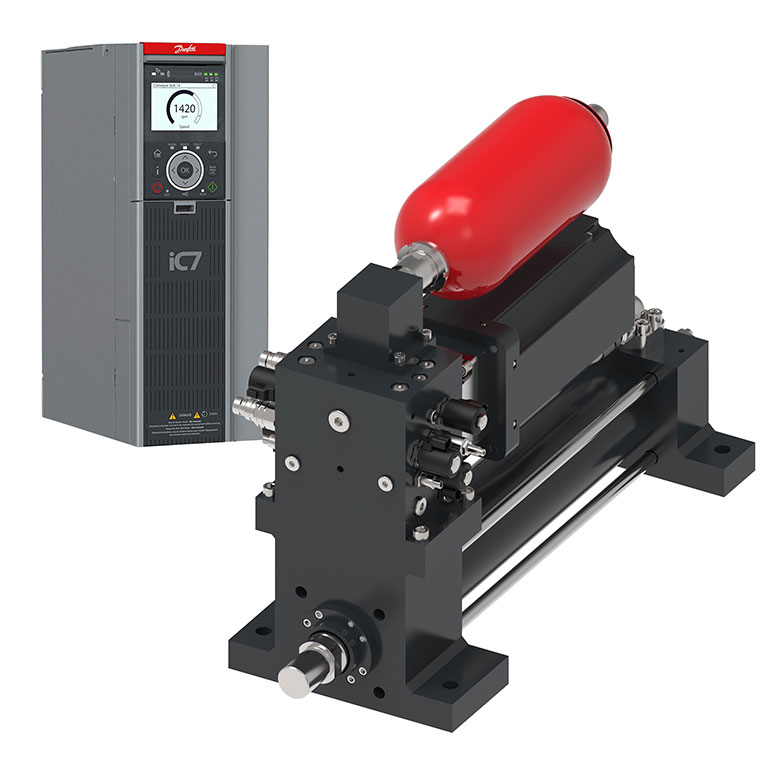
Decentralized architectures are better fit for electrohydraulic actuators. EHAs have lower oil volumes and a lower risk of leakage and also require less space, offer quick setup and commissioning, and have lower maintenance requirements.
Compared to traditional centralized hydraulic circuits, EHAs have lower oil volumes and a lower risk of leakage. They require less space, offer quick setup and commissioning, and have lower maintenance requirements. Compared to electromechanical actuators, EHAs offer higher power density and force capabilities. There is no need for a load cell for force measurement, and they are resistant to external shocks and vibrations.
Digitalizing the future
Fluid power is changing, moving to efficient solutions and architectures that are closely linked to electrical actuation and digitalization. We need to build new competencies at component manufacturers, OEMs, and end users, and we need stronger collaboration between industry and academia to accomplish the changes necessary to reduce emissions. An initiative called Industry-Science Dialog in Europe is bringing together industrial and academic fluid power stakeholders plus country trade associations and CETOP to coordinate fluid power research in Europe. It has established a technology roadmap and identified key areas for research. The benefits of such an approach include the potential for disruptive, rather than evolutionary, developments, plus greater technology relevance and easier transfer into industry.
Digital hydraulics represents a significant advancement in industrial applications, offering solutions that meet the demand for efficiency improvement and emissions reduction, and enabling competitive decarbonization. The integration of digital control and power on demand into fluid power systems will play a critical role in shaping industrial operations now and into the future.
Danfoss
danfoss.com
1 Lasse Schmidt, Katharina Schmitz, Tatiana Minav & Adolfo Senatore, Estimating the Global Emissions by Fluid Power Machinery, Proceedings of IFK, 2026, Germany (under review).
Filed Under: Components, Components, Electrification, Engineering Basics, Pumps & Motors, Trending
