
By Josh Cosford, Contributing Editor
I’ll bet you didn’t even know hose expansion was a thing, did you? Sure, we know that hydraulic hose is made primarily from synthetic rubber, which is pliable and soft. Indeed, the whole point of using rubber is to add flexibility to the plumbing routing options, literally and figuratively. The rubber inner tube and cover layer are the not-so-delicious bread to the reinforcement meat of our hose sandwich. The combination is both strong and flexible, but not immune to expansion.
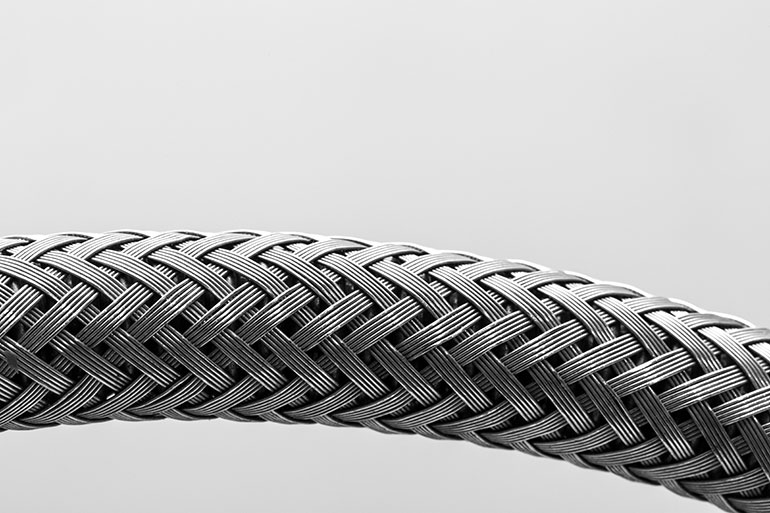
Hose expansion occurs when the tube ID increases under pressure despite the backing of the steel, synthetic fiber, or textile reinforcement layer(s). Although the reinforcement stretches a little, the hose expansion is both linear and radial: as the hose gets slightly longer while the tube compresses under pressure, the internal diameter effectively increases as it’s pinched between the oil and the reinforcement.
Hose expansion is bad news for a few reasons, especially in precise motion-control applications operating at high pressure. In systems with high-speed, high-precision actuators, long runs of hose add elasticity to the hydraulic oil, reducing its effective bulk modulus (the oil’s resistance to compression). In high-precision applications, sometimes a bit of this hose-induced stiffness reduction is good, as it helps reduce pressure spikes and provide damping during high-frequency operation.
However, it’s easy to get too much of a good thing here, because hose expansion leads to sluggish performance, poor control, and even increased heat as the rubber generates its own deformation-induced internal friction. Servo-valve-controlled applications don’t work like standard hydraulics — there is always pressure applied to both sides of a piston, and movement works by controlling the differential, not just absolute pressure exhausting one port to the tank. This keeps the actuator in a state of tension that is easy to accelerate and to control precisely.
The pressure can cycle dozens of times per second between the cap port and work port, each time expanding the hose’s tube and reducing performance. Every time the rubber compresses, it also stores energy, releasing it as the pressure state changes. But there are ways to mitigate it, and even one extreme method to eliminate it.
Some hose construction types are more prone to expansion, so you can start by selecting a stronger hose during the machine design stage. Braided hose is highly flexible, and modern versions of 100R17 braided hose will be superior to older 100R2 construction, especially given the isobaric nature of R17 (all sizes are typically rated for 4,000 psi). For ultimate expansion resistance, choose a 100R12 or 100R13 spiral-wound hose with four or six layers of reinforcement. Spiral windings can contain radial force better than braided reinforcements, eliminating a bit of the outward flexibility.
And, of course, a shorter hose will have less overall area to expand. Whenever installing actuators, try to install the valves as close as possible to the actuators. This provides a more responsive system not only because of the reduced surface area of the rubber, but also because it eliminates the extra mass of oil between the valve and the cylinder that must be accelerated.
Finally, to eliminate hose expansion entirely, just get rid of the hose. You can plumb your actuator using high-strength steel tube, which is vastly stiffer than hydraulic hose. Or, mount the servo or proportional valve directly to the cylinder, which requires just a short run of plumbing to both work ports. It helps when the valve’s work ports are equidistant to the cylinder’s work ports, maintaining equal fluid volume in both directions.
Hose expansion is an interesting topic, and you could dig much deeper into the subject than I’ve been able to elucidate here. Compliance effects can be modelled to include various parameters, including the aforementioned oil bulk modulus, load mass, and valve dynamics, and don’t bother to look into it if you’re not good with differential calculus. The bottom line is that you must factor hose expansion into your high-performance designs, and if required, stop it in its tracks.
Filed Under: Components, Engineering Basics, Featured, Hose & Tubing, Hose Assembly Tips
