
HYDAC, which is known for its filtration and hydraulic power and drive technologies, used CONEXPO as a launchpad for several new technologies, including its SustainMicron filtration technology, but more importantly, its new Fluid Architecture Engineering approach. This comes as the company argues that the hydraulics industry must rethink how systems are designed, integrated, and optimized.
The company said this marks a transition from traditional hydraulic design that relies on oversized components to one that optimizes the entire fluid architecture to achieve improved performance and reliability of compact hydraulic systems. According to HYDAC, this new design philosophy addresses a missing discipline in hydraulics manufacturing, centered around fluid health, deaeration, tank right-sizing, space optimization, electrification, automation integration, and predictive maintenance.

HYDAC’s Fluid Architecture Engineering incorporates all of their technologies into one integrated system.
By engineering how fluid is stored, conditioned, filtered, and managed, Fluid Architecture Engineering helps OEMs design machines that are more compact, more energy efficient, safer, and significantly more reliable. It compels OEMs to rethink the way they design, package, and maintain hydraulic and fluid systems, moving beyond traditional component-centric approaches toward a more holistic fluid architecture strategy.
Chris Kolbe, Senior Vice President of Sales and Marketing at HYDAC Technology Corp., said that electrification is still a consideration and the trend towards automated user assist functions is growing, which is forcing a new level of scrutiny on hydraulic efficiency. As Kolbe explained, inefficiencies that were once tolerated are now becoming limiting factors.
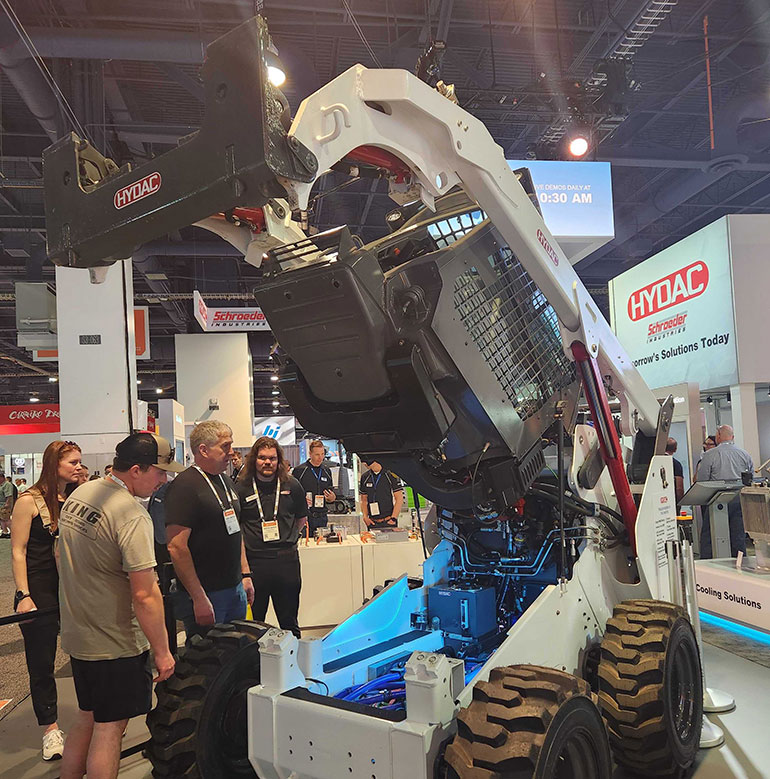
Skid steer model showed how all of HYDAC’s technologies can work together in one machine.
“When people had gas or diesel engines, the efficiency level of the engine was so poor that the efficiency of hydraulics was not as important,” he said. “When things become hybrid or full electric, the amount of power draw from hydraulics is critical.”
One of the biggest culprits, said Kolbe, is pressure drop. Any pressure drop through a filter is waste, he said.
SustainMicron targets filtration’s biggest tradeoff
That challenge is what led to the development of HYDAC’s newest filter design. “We just released a new product called SustainMicron, which reduces the pressure drop. And typically to reduce pressure drop, you must give up the amount of load holding or dirt holding that filter is capable of. But this filter actually increases dirt holding capability and reduces pressure drop,” he said, adding that the patented material makes this possible while also removing static electricity from oil.
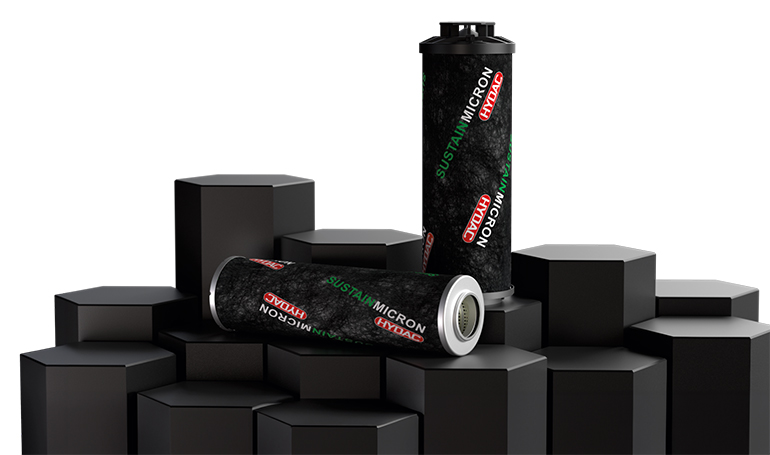
Hydac SustainMicron filtration
According to HYDAC, SustainMicron delivers up to 30% lower differential pressure while maintaining high filtration efficiency and extended service life. The technology combines elements of its previous Optimicron, Optimicron Pulse, and Stat-Free lines into a single platform — simplifying system design while improving performance.
Within HYDAC’s Fluid Architecture Engineering framework, this capability is critical. Stable, clean fluid underpins everything from efficiency to reliability to predictive maintenance.
From components to system-level design
Fluid Architecture Engineering formalizes a shift away from designing around individual components toward engineering the entire fluid environment — how oil is stored, conditioned, filtered, and managed. In the end, users are looking for more system-level integration versus one-off products, Kolbe noted, especially among mid-sized OEMs.
“The big OEMs can do a lot of that integration themselves,” he said. “But a lot of the mid-sized customers…we want to help them package and integrate all the technologies into one.”
That integration challenge is becoming more acute as machines incorporate steer-by-wire, brake-by-wire, and user-assist functions. HYDAC’s approach combines hydraulics, sensors, and controls into pre-integrated systems that are already functionally safety-rated, reducing the burden on OEMs to validate multi-vendor architectures.
Efficiency gains beyond the filter
For decades, hydraulic systems have largely been designed around volume and oversized safety margins using rule-of-thumb calculations. Fluid Architecture Engineering challenges OEMs to plan fluid architecture in tandem with their electrical, software, fuel, and other critical systems — during the design phase. In a press release, HYDAC said this paradigm shift results in a hydraulic system that is fit for today’s compact and electrical machines, offering better fluid health, performance, maintainability, and a longer productive lifecycle.
Filtration is only one part of the efficiency story. HYDAC is also focusing on how fluid moves through the system and where energy is lost. Kolbe pointed to load-holding valves as a classic example.
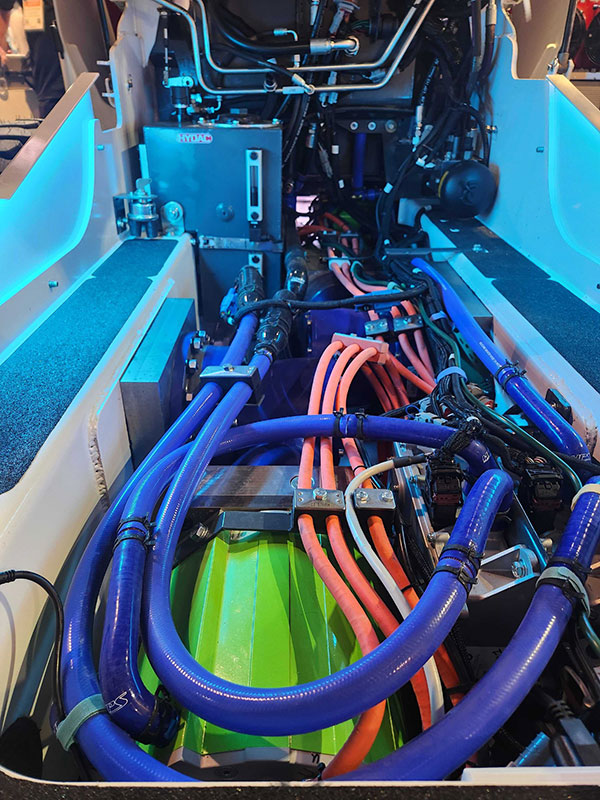
Close-up of HYDAC technologies on their skid steer demo.
“To lower something, you have to push oil over a mechanical valve…which creates a lot of energy and a lot of heat,” he said. “Even though gravity is doing all the work.”
HYDAC’s electrically actuated load-holding approach removes that restriction, allowing loads to be lowered with minimal energy input. “Now I can lower it with no power…let gravity do its work,” Kolbe said. “It reduces heat, and it reduces the amount of power you need, which in turn reduces the need for excess battery or fuel consumption.”
Similarly, decoupling hydraulic pumps from diesel engines and driving them electrically allows systems to operate only at the flow and pressure required.
“If I speed the diesel engine up, my pump is spinning faster than I probably need,” Kolbe explained. “If you decouple it…now I can run it at just the right speed. Now, I can make the efficiency of the hydraulic system much greater.”
The result: efficiency gains of around 25%, according to HYDAC.
Rethinking tanks and space constraints
Fluid architecture also extends to reservoir design, particularly as space becomes a premium in hybrid and electric machines. “One thing you’re finding is when people are going electric or hybrid, they run out of space,” Kolbe said.
Here, HYDAC demonstrated how effective its Air-X tank technology is at changing how fluid flows through the reservoir. By reducing turbulence and air entrainment, the system can achieve the same performance with significantly less volume.
“In a standard filter, you would take the oil, flow it through the filter, and then it would shoot out the bottom and that creates all that turbulence,” he said. “With Air-X, the surface area is much bigger, so the velocity of the oil is very slow. There’s no air generation and low turbulence. If I don’t have as much air generated because of my filtration technique, I can use a much smaller tank. We can usually shrink it by 60%.”
That’s translates into more space for the overall machine design. “If I shrink my reservoir by 8 gal of oil, I could get 8 gal more fuel,” he added. “You’re seeing a lot more criticality when it comes to space.”
Hydraulics’ role isn’t shrinking — it’s evolving
Despite the focus on electrification, Kolbe was clear that hydraulics remain central to machine design. “Fluid power still has a strong place, even when things are electrified,” he said. “It’s not going anywhere anytime soon.”
Instead, the role of hydraulics is evolving and must become more efficient, more integrated, and more tightly coupled with electronics and software.
That realization is what underpins HYDAC’s broader push. With Fluid Architecture Engineering and technologies like SustainMicron, the company is positioning fluid behavior rather than just components as a primary lever for improving performance in next-generation machines. It formalizes what HYDAC has practiced for decades with its long history in filtration, cooling, sensors, accumulators, and mechatronics. Fluid Architecture Engineering formalizes this expertise into a clear framework the industry can use to solve today’s compact, electrified design challenges.
HYDAC
https://www.hydac.com/en-us/fluid-architecture-engineering/
Filed Under: Components, Electrification, Filtration, Filtration/Contamination Control, Fluid Conditioning, Trending
