Fluid Power World

  • Home
  • Technologies
    • Hydraulics
      • Cylinders & Actuators
      • Filtration/Contamination Control
      • Fittings, Couplings & Adapters
      • Fluids
      • Fluid Conditioning
      • Hose & Tubing
      • Pumps & Motors
      • Related Technologies
      • Sealing
      • Sensors & Gauges
      • Valves & Manifolds
    • Pneumatics
      • Air Preparation & Regulation
      • Compressed Air Technologies
      • Cylinders & Actuators
      • End Effectors & Grippers
      • Fittings, Couplings & Adapters
      • Hose & Tubing
      • Sensors
      • Vacuum
      • Valves & Manifolds
  • Engineering Basics
  • Trending
  • Resources
    • Digital Issues
    • Pneumatics Tech Toolbox
    • Podcasts
    • Special Reports
    • Subscribe to Fluid Power World Print Magazine
    • Videos
    • Webinars / Digital Events
    • White Papers
  • Women in Engineering
    • Women in Fluid Power
    • Women in Engineering
  • Design Guides
  • Classrooms
    • Hydraulic Filtration
    • Hydraulic System Design
    • Pneumatics Classroom
  • Advertise
  • SUBSCRIBE

Hydraulics continues to bring its A-game

By Mary Gannon | October 1, 2025

Share

Just a few years ago, the hype over electrified machinery was giving some pause to many machine makers and users, as they wondered if electromechanical actuators could top the power density of hydraulics. But that pause was short-lived, and most experts on both sides of the aisle agree hydraulics still has one big advantage — power density. Two recent examples come to mind.

Over the past few months, we’ve heard about a new market disruptor in the cylinder market — Rise Robotics’ new Beltdraulic design, which it says is faster and smoother than hydraulics. The company says it offers the power of hydraulics without the fluid and efficiency losses. As someone covering these technologies for 20 years, this is an amazing feat. Especially as efficiency loss is our biggest foe in the fluid power industry.
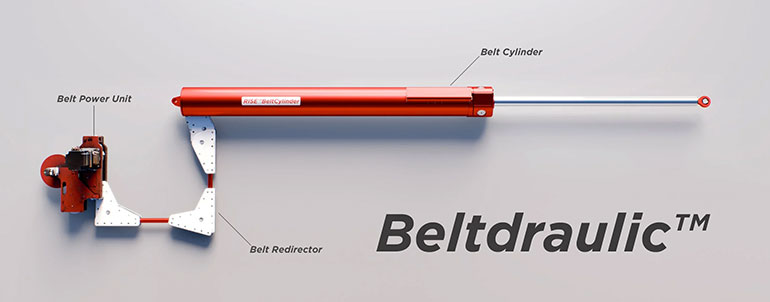
 

Rise Robotics' Beltdraulic cylinder replaces hydraulics with an all-electric design.

Rise Robotics’ Beltdraulic cylinder replaces hydraulics with an all-electric design.

I’ve seen the Rise design in person recently at a trade show and watched videos of it online. It’s an incredible design, but it still seems longer than many cylinders offering comparable forces. So, while I do see great potential in this design, I don’t see it completely displacing hydraulics anytime soon, especially where compact designs are required.

At Cedar Point in Sandusky, Ohio (not far from my hometown) we have one of the world’s most famous roller coasters. Originally, the Top Thrill Dragster shot riders 420 ft up a nearly completely vertical hill using a hydraulic launch at 120 mph. Throughout its many years, the hydraulic system needed maintenance and sometimes the ride was down for days at a time.

After a metal bracket came loose a few years ago and struck a rider waiting in line, the amusement park shut the ride down for evaluation and decided to reimagine the ride. It’s now called Top Thrill 2 and instead of a hydraulic launch, the ride uses linear synchronous motors to propel the train up the hill.

When I first learned about the engineering on Top Thrill Dragster more than 20 years ago, I was informed by Cedar Fair’s engineering team that the ride could only accomplish the incredible speeds and height with hydraulics — any electric motors would just be too large for the allotted space. Here, we could truly sing the praises of hydraulics — power density meant smaller pumps and motors could easily launch the train over the massive, nearly 90-degree hill.

So when I learned that the ride now uses LSMs, I was so impressed that they have come that far in the past 15 to 20 years. Imagine that they could now sling-shot 18 passengers up that hill!

The new Top Thrill 2, which replaced the hydraulically-powered Top Thrill Dragster, requires a triple launch to shoot riders of a massive 420 ft hill.Image courtesy of Cedar Point.

The new Top Thrill 2, which replaced the hydraulically-powered Top Thrill Dragster, requires a triple launch up a second tower, to shoot riders of a massive 420 ft hill.
Image courtesy of Cedar Point.

Then I visited Cedar Point with my family for the first time since the ride opened. And I saw just exactly how they accomplish this feat. No, LSMs are not suddenly more powerful. It’s a triple-launch coaster, meaning that it is launched forward, partly up the hill, then rolls back up a vertical tower to gain the proper momentum and then, it flies up the 420 ft hill. Engineering marvels don’t need to apply, this is straight up physics at this point.

I’m not throwing shade on LSMs — they are incredibly fast motors that propel riders smoothly on many roller coasters, including Cedar Point’s Maverick, one of the best coasters out there. But they can’t stand up to the power density that hydraulics offer, and likely won’t anytime soon.

https://www.fluidpowerworld.com/wp-content/uploads/2025/10/Top-Thrill.mp4

There are many detractors that say the maintenance issues were a big problem with the hydraulics on Top Thrill Dragster. And it did have its fair share. But from what I saw myself in person and what I’ve seen online, the new Top Thrill 2 still has many issues and is constantly shut down for maintenance. You can’t blame the hydraulics anymore.

Hydraulics biggest advantage is its power density.

Hydraulics biggest advantage is its power density.

I’ve always sung the praises of hydraulics. I love this industry and see the power and strength it provides to keep our world moving. There’s a place for all modes of power transmission in industry, and they can all get along (in fact, on Cedar Point’s newest coaster, Siren’s Curse, the vertical drop would not be possible without the combination of hydraulics, mechanical and electrical designs). If only we can say that about the rest of our world.


Filed Under: Trending


About The Author

Mary Gannon

Mary Gannon is editor of Fluid Power World. She has been a technical writer and editor for more than 13 years, having covered fluid power, motion control and interconnect technologies.

Current Digital Issue

Fluid-Power-World-October-2026-issue-Cover-feature-image-template-copy

  A note from the editor In our October issue of Fluid Power World, my commentary takes a look at the growing role of automation and sensors in mobile machinery, where OEMs are increasingly focused on automating specific functions and improving machine performance rather than chasing fully autonomous equipment. Josh Cosford gets cheeky comparing the auto…

View Back Issues

Subscribe!

Fluid Power World is written by engineers for engineers engaged in designing machines and or equipment in Off-Highway, Oil & Gas, Mining, Packaging, Industrial Applications, Agriculture, Construction, Forestry, Medical and Material Handling. Fluid Power World covers pneumatics, mobile hydraulics and industrial hydraulics.

Fluid Power Design Guides

fluid
“fpw
EXPAND YOUR KNOWLEDGE AND STAY CONNECTED
Get the latest info on technologies, tools and strategies for Fluid Power Professionals.

RSS feed: Featured White Papers Featured White Papers

  • Moving fluid power forward
  • High-force linear motion: How to convert from hydraulic cylinders to electric actuators and why.
  • A technical comparison: Performance of pneumatic cylinders and electric rod actuators
Fluid Power World
  • Hose Assembly Tips
  • Mobile Hydraulic Tips
  • Pneumatic Tips
  • Sealing & Contamination Control Tips
  • About us
  • Contact Us

Copyright © 2026 Arrowfly LLC. All Rights Reserved. The material on this site may not be reproduced, distributed, transmitted, cached or otherwise used, except with the prior written permission of Arrowfly
Privacy Policy | Advertising | About Us

Search Fluid Power World

  • Home
  • Technologies
    • Hydraulics
      • Cylinders & Actuators
      • Filtration/Contamination Control
      • Fittings, Couplings & Adapters
      • Fluids
      • Fluid Conditioning
      • Hose & Tubing
      • Pumps & Motors
      • Related Technologies
      • Sealing
      • Sensors & Gauges
      • Valves & Manifolds
    • Pneumatics
      • Air Preparation & Regulation
      • Compressed Air Technologies
      • Cylinders & Actuators
      • End Effectors & Grippers
      • Fittings, Couplings & Adapters
      • Hose & Tubing
      • Sensors
      • Vacuum
      • Valves & Manifolds
  • Engineering Basics
  • Trending
  • Resources
    • Digital Issues
    • Pneumatics Tech Toolbox
    • Podcasts
    • Special Reports
    • Subscribe to Fluid Power World Print Magazine
    • Videos
    • Webinars / Digital Events
    • White Papers
  • Women in Engineering
    • Women in Fluid Power
    • Women in Engineering
  • Design Guides
  • Classrooms
    • Hydraulic Filtration
    • Hydraulic System Design
    • Pneumatics Classroom
  • Advertise
  • SUBSCRIBE