Fluid Power World

  • Home
  • Technologies
    • Hydraulics
      • Cylinders & Actuators
      • Filtration/Contamination Control
      • Fittings, Couplings & Adapters
      • Fluids
      • Fluid Conditioning
      • Hose & Tubing
      • Pumps & Motors
      • Related Technologies
      • Sealing
      • Sensors & Gauges
      • Valves & Manifolds
    • Pneumatics
      • Air Preparation & Regulation
      • Compressed Air Technologies
      • Cylinders & Actuators
      • End Effectors & Grippers
      • Fittings, Couplings & Adapters
      • Hose & Tubing
      • Sensors
      • Vacuum
      • Valves & Manifolds
  • Engineering Basics
  • Trending
  • Resources
    • Digital Issues
    • Pneumatics Tech Toolbox
    • Podcasts
    • Special Reports
    • Subscribe to Fluid Power World Print Magazine
    • Videos
    • Webinars / Digital Events
    • White Papers
  • Women in Engineering
    • Women in Fluid Power
    • Women in Engineering
  • Design Guides
  • Classrooms
    • Hydraulic Filtration
    • Hydraulic System Design
    • Pneumatics Classroom
  • Advertise
  • SUBSCRIBE

IoT-ready sensor fundamentals

By Josh Cosford | September 17, 2026

Share

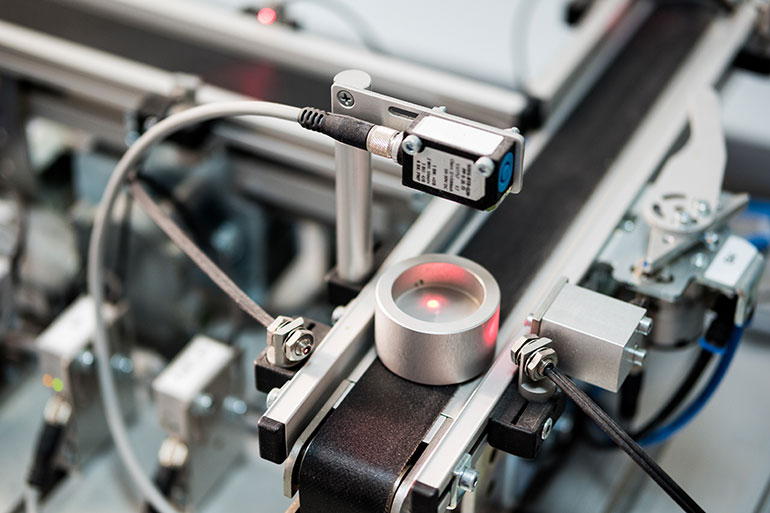
Sensors are not as talked about as some other Internet of Things technologies, despite their critical role within the Industry 4.0 community at large. Sensors are technologies in fluid power that read, interpret, and transmit data based on one or more criteria important to observe: pressure, temperature, flow, contamination, water saturation, and vibration, to name a few.

The Internet of Things describes technologies that are connected through wires, Bluetooth, or wireless routers to the same internet we use to scroll through social media or perform our daily banking. Of course, your particle counter rarely logs on to your local internet service provider directly. Rather, it transmits data to a hub or router in your facility, which then directs the data to cloud servers using typical internet protocols.
IoT-sensors-AdobeStock_319208114

Smart sensors may begin their digital information transmission journeys at the “edge,” while running on batteries or low power, which requires a gateway to transmit further than Bluetooth range. A hub or router must be located near these types of compact sensors, which send their signals using interestingly named technologies like Zigbee and Thread — two low-power technologies similar to Bluetooth. Long-range technologies exist but still require a hub at some point to broadcast to the internet. LoRaWAN can operate across miles of open space but still requires a router to make the connection.

It’s easy to imagine your smart home technologies making a connection between industrial IoT-ready sensors. Just as your smartwatch, thermostat, or outdoor lighting control system are equipped with short-range wireless technologies, sensor connections work through technologies similar to those used by Apple HomePod or Amazon Echo (or even your smart phone, which makes a great hub).

There are no limits to the IoT sensors available to offer expansive data in real time, which allows you to move away from reactive production and maintenance practices into the world of predictive operational telemetry. To best elucidate the benefits of IoT-ready sensors, I’ll use a couple of examples you should all generally be familiar with.

Because it’s generally accepted that contamination is the number one cause of hydraulic failure, it follows that advanced knowledge of a rapid rise in contamination provides maintenance personnel with failure-prevention superpowers. When your power unit is equipped with real-time contamination sensors programmed to send push notifications when your target ISO 4406 cleanliness code is exceeded, you can act quickly to investigate the source of contamination before catastrophic component failure and further damage occur.

Pneumatic systems benefit from IoT-ready sensors that can help high-paced automation plants run at higher speeds with fewer periods of unexpected downtime. A smart air-efficiency module can be installed alongside your FRL to measure air consumption, pressure drop, moisture, and downstream pressure. The sensor can trigger a warning when unexpected air usage rises, for example, sending a notification that leakage is occurring somewhere within that subcircuit.

If you can sense it, you can transmit it over the airwaves. What used to be six figures’ worth of hard-wired technology running miles of physical wires throughout your plant is now available at commodity-level pricing and online availability, with everyone able to access the data through a PC, laptop, or smart device. Like it or not, humans no longer exclusively enjoy access to the internet, as we now share that access with “things.”


Filed Under: Components, Engineering Basics, Sensors, Sensors & Gauges


About The Author

Josh Cosford

Current Digital Issue

Fluid-Power-World-October-2026-issue-Cover-feature-image-template-copy

  A note from the editor In our October issue of Fluid Power World, my commentary takes a look at the growing role of automation and sensors in mobile machinery, where OEMs are increasingly focused on automating specific functions and improving machine performance rather than chasing fully autonomous equipment. Josh Cosford gets cheeky comparing the auto…

View Back Issues

Subscribe!

Fluid Power World is written by engineers for engineers engaged in designing machines and or equipment in Off-Highway, Oil & Gas, Mining, Packaging, Industrial Applications, Agriculture, Construction, Forestry, Medical and Material Handling. Fluid Power World covers pneumatics, mobile hydraulics and industrial hydraulics.

Fluid Power Design Guides

fluid
“fpw
EXPAND YOUR KNOWLEDGE AND STAY CONNECTED
Get the latest info on technologies, tools and strategies for Fluid Power Professionals.

RSS feed: Featured White Papers Featured White Papers

  • Moving fluid power forward
  • High-force linear motion: How to convert from hydraulic cylinders to electric actuators and why.
  • A technical comparison: Performance of pneumatic cylinders and electric rod actuators
Fluid Power World
  • Hose Assembly Tips
  • Mobile Hydraulic Tips
  • Pneumatic Tips
  • Sealing & Contamination Control Tips
  • About us
  • Contact Us

Copyright © 2026 Arrowfly LLC. All Rights Reserved. The material on this site may not be reproduced, distributed, transmitted, cached or otherwise used, except with the prior written permission of Arrowfly
Privacy Policy | Advertising | About Us

Search Fluid Power World

  • Home
  • Technologies
    • Hydraulics
      • Cylinders & Actuators
      • Filtration/Contamination Control
      • Fittings, Couplings & Adapters
      • Fluids
      • Fluid Conditioning
      • Hose & Tubing
      • Pumps & Motors
      • Related Technologies
      • Sealing
      • Sensors & Gauges
      • Valves & Manifolds
    • Pneumatics
      • Air Preparation & Regulation
      • Compressed Air Technologies
      • Cylinders & Actuators
      • End Effectors & Grippers
      • Fittings, Couplings & Adapters
      • Hose & Tubing
      • Sensors
      • Vacuum
      • Valves & Manifolds
  • Engineering Basics
  • Trending
  • Resources
    • Digital Issues
    • Pneumatics Tech Toolbox
    • Podcasts
    • Special Reports
    • Subscribe to Fluid Power World Print Magazine
    • Videos
    • Webinars / Digital Events
    • White Papers
  • Women in Engineering
    • Women in Fluid Power
    • Women in Engineering
  • Design Guides
  • Classrooms
    • Hydraulic Filtration
    • Hydraulic System Design
    • Pneumatics Classroom
  • Advertise
  • SUBSCRIBE