
By Josh Cosford, Contributing Editor
My children are nearing university age, so we’ve been having discussions regarding careers that are less likely to survive in the face of artificial intelligence. If you’re a graphic artist, you’re pretty much screwed and might as well switch to hairdressing. AI is already replacing jobs in literature, media, art, music and computer programming. It got me thinking … is my hydraulic specialist career on the line?
To see how close I am to being unemployed, I recruited my two new best friends, Grok and ChatGPT. I challenged them with some simple tasks any first-year fluid power professional could pass with ease; draw me the ISO 1219 symbol for a relief valve, and using ISO 1219 symbology, draw me an example of a log splitter.
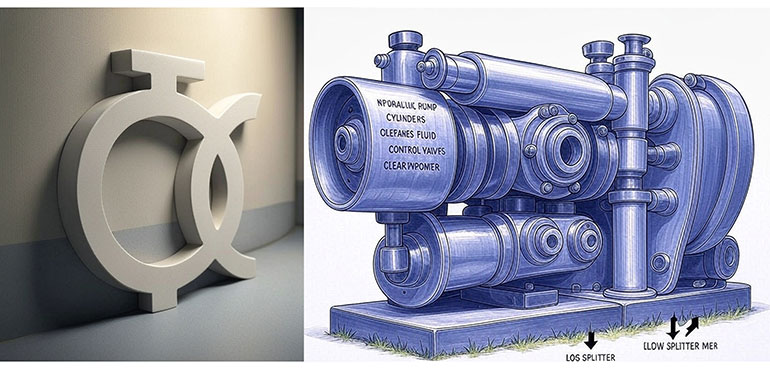
When tasked with creating a symbol for a hydraulic log splitter, Grok, Figure 1 above, failed the test, while ChatGPT, Figure 2 below, at least had an idea of what was required, but still created an inaccurate circuit drawing.
Starting with Grok (Figure 1), you can see he (sorry, Grok is a dude’s name) really doesn’t know what’s going on, at least when his virtual pen hits his virtual paper. I think he confuses what a graphic of a symbol is supposed to be, representing it more as a religious or language character. And just so you know how precise I was with my wording, the exact question asked was, “Draw me a logsplitter hydraulic schematic using ISO 1219 symbols.” The result was an odd experiment with a broken telephone where a fluid power specialist described the circuit of a log splitter to a nine-year-old, who then described it to a 1940s encyclopedia graphic artist.
To be fair, Grok was able to describe what he was drawing when I asked to express the symbols with wording. Describing the log splitter circuit, he got pretty darn close with “Depicted as a rectangle with internal flow paths and arrows, showing four ports and two positions. This valve controls the direction of fluid flow to the cylinder. In one position, it directs fluid to extend the cylinder; in the other, it retracts it.” However, he was simply unable to translate that visually.
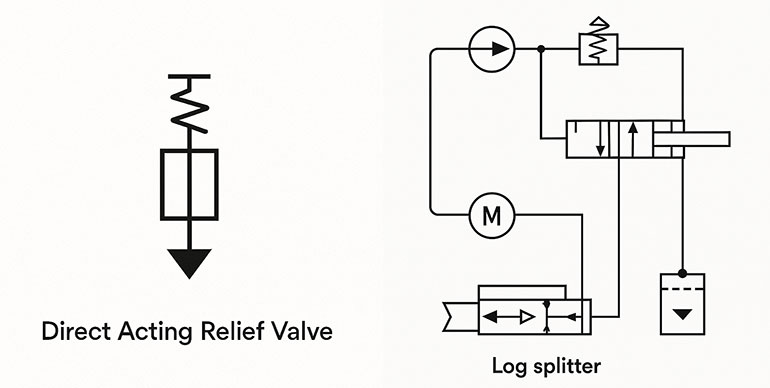
Figure 2. ChatGPT’s log splitter circuit
With ChatGPT, at least she knew what I was going for (Figure 2). The relief valve looks relief valve-ish, with a directional arrow, springy pressure line and a rectangular envelope. And ChatGPT was nice enough to label them for me! The log splitter circuit, however, appears as though fluid power shaped tiles were placed into a Yahtzee shaker and spewed across the table before semi-random lines were drawn to connect tiles. It’s definitely a schematic and kind of gets the pump and motor correct, aside from the convoluted series of universal joints required to drive 180 degrees axially.
ChatGPT definitely has me more worried than Grok, and because it actually resembles a fluid power circuit, maybe all it will take is some domain-specific training for a large language model to create hydraulic schematics accurately. But does it really matter since a qualified fluid power professional must still confirm that the schematic is correct and operable? And therein lies our job security.
There’s a difference between using AI to automate tasks and replacing jobs entirely. Someone with fluid power knowledge currently has to draw a schematic, which is time-consuming, but it’s always wise to get a second set of eyes to check your work. If replacing the daily grind on CAD software with a circuit created in minutes allows mental resources applied to finding creative solutions AI generates rather than busy work, our entire field advances. Conversely, having AI create an image of a busy café for your local food blog takes seconds and requires no technical training or education to judge the quality of the result. Sorry graphic designers, you may want to head back to trade school for that certificate in hair design.
Filed Under: News, Trending
