
If you’re a longtime reader, you know I’m a car guy. I love the look and smell of a hot rod, but I grew up on Japanese hot hatches and eventually developed a taste for the power and refinement of German luxury brands. I love discovering great new music while still keeping the soundtrack of my childhood dear to my heart, and that’s generally how I’ve felt about cars. I’d love to own a ’93 Mazda RX-7, but I can recognize just how spectacular new cars are today … or, are they?
I guess in the same way that a “new” song feels like 2020 to me, and how my kids will point out how “Circles” by Post Malone is now “old school music,” the cars from 2020 still feel new to me. They have digital dashes, active safety functions, direct injection, and in many cases, more than what’s being released for 2027.
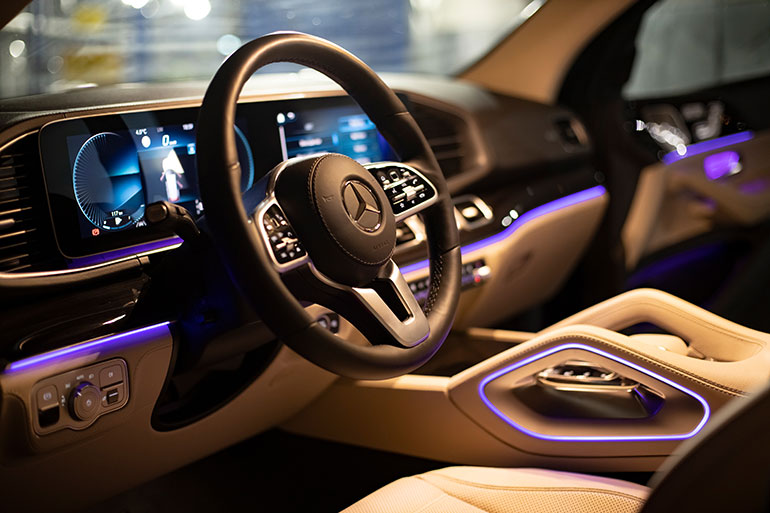
Close-up of interior of Mercedes GLS class
In fact, I look at the new offerings from Mercedes-Benz and see how the interior is just a discotheque full of lights and visual effects in such a drab, otherwise minimal interior. They’ve removed the physical knobs, dials, and switchgear for operating HVAC and the stereo. The new Lincoln Navigator, believe it or not, has the air vent directional control buried in the touchscreen menus. So, if you don’t like where the air is blowing, you need to sort through menus while trying to drive. “Just use the active cruise control,” you say? Well, we have an older Nav’ with “Blue Cruise,” and the car will freak out on you for taking your eyes off the road long enough to change the radio station!
Etymology: Coined by author Cory Doctorow in 2022 to describe the systematic lifecycle of platform decay.
Related forms: enshittify (v.), enshittified (adj.)
The fact that these manufacturers are posturing this ridiculous transition away from physical switchgear as a “luxury feature” is a sign that they a) are clearly only in it for profits, and b) don’t know their customer base. Vehicle functions within the touchscreen are simply lines of code, compared to the cost of producing millions of little dials for the AC temperature control. Peak car was 2018-2023, and if you’re lucky enough to own a premium vehicle from this era, hang onto it to avoid the wave of enshittification.
I’ve written a lot lately about AI, robots, and the connected world of fluid power, so the enshittification of cars had me thinking about fluid power. Are we pushing ourselves too hard and far to take usability and satisfaction out of fluid power machinery? Sure, much of the hydraulics is hidden away and ignored, like the hydraulics that power machine tool or stamping presses. We’ve been using HMIs for years now, so it’s no big deal.

Agricultural machinery users have pushed back against overly electronic interiors to maintain some level of buttons, gears and levers.
But what about mobile machinery? I’m not going to call out any single manufacturer, but you can bet your weight in manure that farm tractors, excavators, and every modern machine are pushing to have as many functions buried in screens as possible. I get it, a tractor cab can have a dizzying number of buttons and switches, and to a point, it’s worth cleaning that up.
But farmers are a fussy bunch, and they’re also good at what they do. They can operate all their older tractor’s functions using muscle memory, can still press the correct button over rough terrain, they often work with dirty gloves, and want to wear those same gloves on a cold morning. The AG bunch were quick to push back on enshittification, and the manufacturers are starting to listen.
It doesn’t matter if you use a function only once per year; there are zero people mad that a physical interface exists for it. Well, maybe the iPhone designers who prioritize “aesthetics” over function by adding secret functions that are unlocked when you three-finger-swipe a figure-eight pattern while standing on one leg.
I can guarantee that machine manufacturers are playing the long game, where they remove physical switchgear and replace it with digital technology, haptic feedback, and touchscreens, only to bring back physical controls a decade later and brand them as a “luxury feature” so they can charge even more for machines.
Even Mercedes Chief Design Officer, Gorden Wagener, has admitted, “screens are not luxury.” Yet here they are, putting screens spanning the entire dash while removing the HVAC and stereo switchgear. Guess what, Mercedes? If you cover the logos and I sit down in a Hyundai and a Mercedes and I can’t tell the difference, you’re going down the wrong path.
I believe the path will correct itself, and not because manufacturers will give up on chasing profits. In fact, they’ll chase profits by bringing it all back again. Will tractor manufacturers switch back to physical gauges and joysticks using hydraulic pilots? No, because there is real functionality buried in these machines’ electronics that provides benefits well past the method of activation. But they will eventually listen to customers and provide us with a better balance of what works and what is cheap. Let’s hope that happens before your 2003 John Deere 7810 finally kicks the bucket.
Filed Under: Components, Electrification, EV Engineering, Trending
