
Optimizing industrial systems can be done easily with variable-displacement axial piston pumps.

Michael Budda, Senior Industrial Hydraulics Product Engineer at Bosch Rexroth
As industrial manufacturers continue to focus on improving efficiency, controllability, and energy usage, variable-displacement axial piston pumps have become an increasingly important technology for optimizing hydraulic system performance. While the core technology has been established for decades, continued advancements in pump controls, variable speed drives, and system integration are helping engineers achieve greater efficiency across a wide range of industrial applications.
In this Q&A, Michael Budda, Senior Industrial Hydraulics Product Engineer at Bosch Rexroth, discusses how variable-displacement axial piston pumps have evolved, where they provide the greatest benefits, and what OEM engineers should consider when selecting and implementing this technology.
FPW: What are the biggest benefits for variable-displacement axial pumps?
Budda: The biggest benefit is the ability to adjust the flow rate of the pump to the specific needs of the hydraulic system at that moment. How and when you control that adjustment is where all the magic happens. If you are working with simple pump controls, they can offer the best match to meet the requirements (i.e. machine load and cycle) of your system. The ability to match the flow rate for when a machine truly needs energy is a big benefit when implementing this technology.
FPW: How does pump displacement control improve machine efficiency during varying load conditions?
Budda: When systems are designed, a main consideration is that not all systems run 100% of load all the time, something that would be very rare. When using a fixed-displacement pump, you have designed a system that is good for 100% of the load, but any time you don’t need that much power, you have to burn it off. Typically, that extra power (in the form of flow and pressure) is burned over a relief valve and wasted as heat. With a variable-displacement pump, in its simplest form, you dial back the flow, so you aren’t having to waste as much energy as heat.
FPW: How has this tech changed or improved since first launch?
Budda: Overall, the design of axial piston pumps with variable displacement is in a consistent place. The core principle of the technology itself has been around for decades for industrial hydraulic companies. However, over the years companies have introduced new pumps with mostly internal improvements and optimizations over years of experience in the field. The key to that variable-displacement technology — the swashplate design — will likely stay the same for some time. Prior to this, fixed pumps were the main solution.
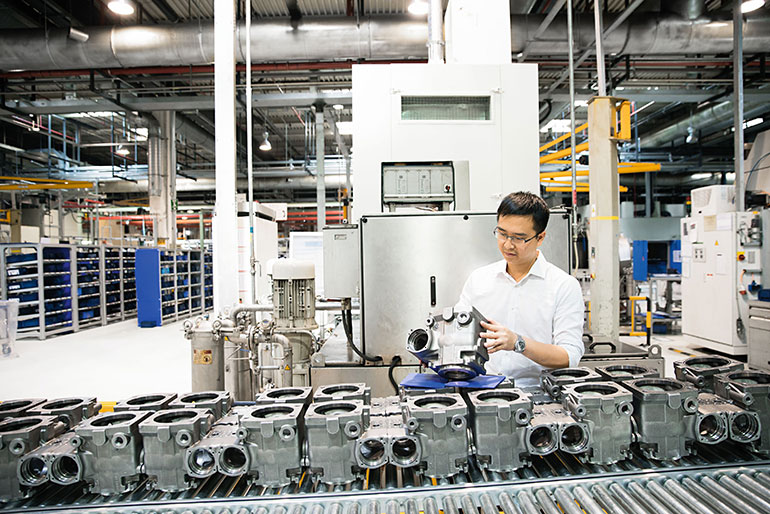
With optimizations of their design, variable displacement pumps can help provide a 30-50% reduction in energy with dynamic, on-demand flow.
FPW: What role do pressure and flow compensation controls play in optimizing hydraulic system performance?
Budda: Pressure and flow compensation play a vital role in optimization. There is a reason why a vast majority of pumps we sell at Bosch Rexroth to the market are standard pressure and/or flow control, often combined together. I would say nearly 60-70% of the market are these types of controls. They are a first large step into the variable displacement and eventually variable speed world. They are not the end all be all, but they are simple enough to implement and from a cost perspective, they lower the barrier of entry, especially when compared to something like torque (aka Horsepower) controls and electronic controls.
FPW: What applications are best suited for variable displacement pumps?
Budda: Overall, I think a lot of applications could benefit from variable displacement. Across the manufacturing industry, many have come to accept variable displacement pumps almost as the norm compared to fixed displacement. In general, I see variable displacement being useful in many applications, ranging from industry laundry machines, balers, railway maintenance (MOW), presses, and concrete block machines.

Variable displacement pumps are the first step to a better control logic for your system and lower the barrier to higher levels of technology, like variable speed drives.
FPW: Energy efficiency has become a major focus for industrial manufacturers. How do variable displacement pumps help reduce overall energy consumption?
Budda: Variable pumps give the ability to provide the energy to the hydraulic system at the point in the cycle when it needs it, rather than traditional fixed displacement systems that burn excess energy. In terms of everyday use, we can think of a fixed pump system like driving a car with the gas pressed down all the way and using your brakes to modulate the speed of your car. You could imagine how much heat and energy is being wasted. With a variable displacement pump, you have the ability to modulate that gas pedal, so when you need more, you press your foot down, and if you need less, you let off the gas. That is the primary reason for how variable displacement can help reduce overall energy consumption of a circuit.
FPW: Where are the biggest benefits in applications like injection molding machines?
Budda: Most injection molding machines now are starting or have started implementing fixed-displacement pumps with variable speed drives. However, there are a few manufacturers that have standardized the combined concept of a variable-speed drive with a variable-displacement pump. This can give better control of the machine over the whole cycle which often has different but repeatable requirements. For instance, the clamp cycle would often be low or no flow but at a high pressure while doing the injection would require a different load out of the hydraulic system. The variable speed of the drive along with the variable displacement can be used to optimize for each part of the cycle. This is prevalent with injection molding machines because it’s such repeatable cycles.
Another benefit is that with the scalability of the power coming from a hydraulic unit with variable speed and variable displacement you can have one hydraulic unit that can support multiple axis. Comparing that to a typical electric drive solution where you would need a separate electric drive for each axis this can have plenty of cost savings as you would only need one hydraulic unit to replace several electric drives on one machine.
FPW: How much energy savings can machine builders realistically expect when transitioning from conventional fixed-displacement systems to modern variable displacement technology?
Budda: Typically, we see savings between 30-50% reduction in energy when advancing from a fixed displacement system to variable displacement. The caveat is that this is highly dependent on your machine cycle and load cycle, but in general terms that’s what we see.

The core design philosophy of an axial piston variable displacement pump – the swashplate – has been refined for the modern era.
FPW: How are variable speed drives and servo-hydraulic systems changing the way axial piston pumps are being applied?
Budda: It’s interesting because variable speed drives do affect your choice in the pump. It’s very common to see fixed displacement pumps in these types of systems, but those are typically within the more dynamic systems. This is mostly because a fixed displacement pump is one less variable to have to think about when selecting a drive. However, when discussing systems that are usually more dynamic, there are limitations with fixed. Another common approach would be to use variable-displacement pumps. This gives your pump the ability to act like an additional set of “gears” for your hydraulic system. Servo drives are very torque specific — meaning you need to select them based on the torque required for your drive. Having a variable displacement pump is like using a CVT in a car, which perhaps allows you to downsize your drive when you ‘flip the switch’ on the displacement control of your pump.
FPW: What role do these pumps play in helping manufacturers meet sustainability or carbon reduction goals? Are there any benefits with noise reduction?
Budda: While I have not experienced a company coming to me specifically with the pure intent of reducing carbon in their facility, these pumps are certainly a way to help achieve those goals. If a manufacturing plant is running a lot of machines that are wasting energy over fixed pumps and not optimizing them with variable displacement or variable speed, there is a potential for them to reduce their CO2. How much would really be a case-by-case basis and you can conduct a power system study to see if it would be beneficial.
Another big benefit of these pumps is noise reduction. If you pair a variable displacement pump with a variable speed drive, this can — in most instances — significantly reduce overall noise levels and also help meet OSHA noise guidelines in some situations.
FPW: How have customer expectations changed regarding hydraulic system efficiency, controllability, and energy usage over the last decade?
Budda: I’ve seen a lot more focus from engineers on overall efficiency over the years. I’m sure the cost of energy is a big influence on this alongside the advancements in engineering tools such as simulation programs which require efficiencies of components to be inputted into their program. These are additional steps that can be taken to create the most efficient system, which is making this topic and adoption increasingly prevalent in the industry and in the US.
FPW: How can proper pump selection influence overall system efficiency and total cost of ownership?
Budda: Choosing the right pump can certainly help with system efficiency. Despite what many may think, pumps do have their own operating range ‘sweet spots.’ The point at which their volumetric and mechanical efficiencies result in the best overall efficiency of the pump. But, outside of efficiency, you also need to consider the lifetime of the pump. As an example, running a larger pump slower usually results in an extended lifetime of the pump, but it might not be the most efficient compared to spinning a smaller pump faster. But there are other tradeoffs to consider too, because a small pump spinning fast could have reduced life/longevity and be noisier.
FPW: What should OEM engineers consider when sizing or selecting a variable displacement axial piston pump for industrial machinery?
Budda: The biggest consideration is the tried-and-true basics of hydraulics, how much pressure and how much flow do you need. Next, you need to discern what type of pump control is required. In some instances, you can have up to three options on the pump at the same time with different variations.
This can be a tricky point, but companies with a history in various industries can really help. Overall, a vast majority of applications can be lumped into standard pressure control (aka compensation) or flow control basics, but that doesn’t mean that if you choose a pressure compensation pump for your system that it will automatically be the best selection. Because there are so many options, the types of controls are often identified in data sheets from companies.
FPW: How important is the relationship between the pump, valves and control architecture in maximizing performance?
Budda: The relationship is quite important; you don’t want to marry these solutions together if they don’t fit. For instance, oftentimes when a proportional valve is being used in a circuit, the pump control is a secondary layer of control. The proportional valve is the main control valve for the actuator, whether that is force or speed. You don’t want the pump control to get in the way of that, so most of the time in that situation you would have a pressure control on the pump. But if you were to have a simple bang-bang valve for direction control of the actuator, then you could up the control architecture on the pump to make it a be more sophisticated to control the force and speed of the actuator.
In the end, choosing the right pump for the circuit is about as important as it can get, especially when you are entering the world of variable displacement. When it’s a fixed pump with a fixed drive speed, you don’t have a lot of options to consider on the pump control, because there are none, but you should think about how much energy you could be wasting.
Bosch Rexroth
boschrexroth.com/en/us
Filed Under: Components, Engineering Basics, pumps, Pumps & Motors
