
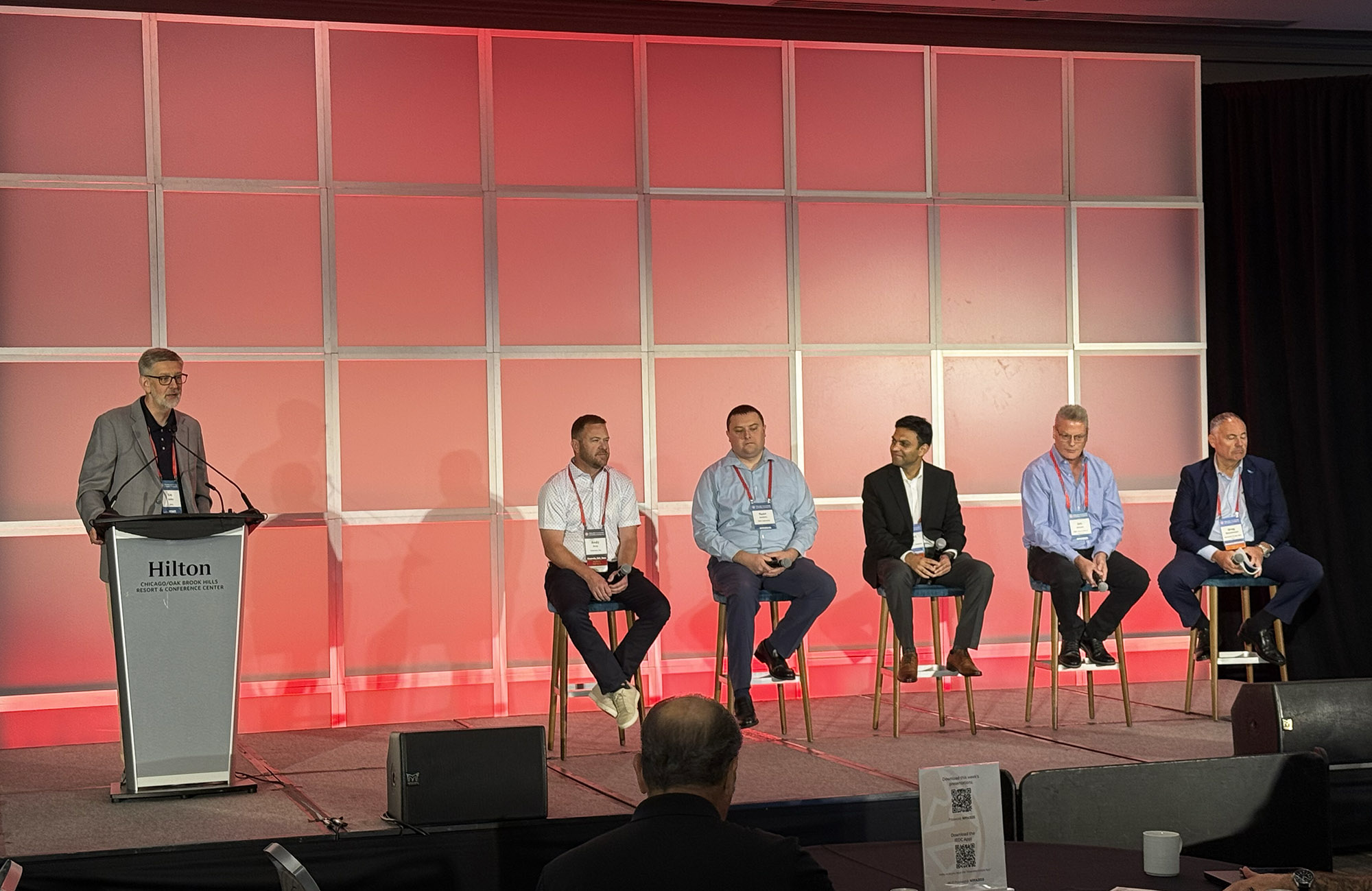
NFPA maintains a Road Map Committee, one of the association’s largest and most active committees. Its job is to develop, maintain, and supplement a document called the NFPA Technology Road Map. This effort tries to align the ongoing development of fluid power technology with the needs of customers in the numerous core end markets. At this year’s NFPA International Economic Outlook Conference, several panelists from the committee discussed how fluid power is working with mobile and industrial machinery to drive efficiency, as well as what customers are asking for today.
Performance and priorities
For builders of mobile and industrial machines, the committee has identified four high-level machine level performance objectives. Customers of these OEMs are asking that those machines provide increased availability and uptime, increased productivity and performance, lower total cost of ownership, and compliance with environmental and other regulations.
Ryan Jenkins, Hydraulics Engineer, CNH Industrial explained that all of these metrics matter to his company, although customers’ opinions can vary.
“They’re really hard to separate. When we talk about the drivers of why we build the machines the way we build them, it’s usually all of these together, almost with equal importance. But in some ways, productivity and performance outweighs the others because that’s really what is defining the value to the customer,” he said.
Jenkins noted that different customers have different approaches. Some really don’t care about the regulations, and instead are laser focused on how much they can get done with their machine and get the work done that they need to.
“In the mobile sector at least, there’s a lot of importance on the total cost of ownership. It also depends on what segment of the industry you’re in. If it’s agriculture versus construction, if you’re talking high horsepower versus low horsepower, the way that these show up and the way that they get graded and weighed is different.”
For Anant Jain, Area Sales Manager, Danfoss Power Solutions, the key customer drivers also depend on the industry they are dealing with.
“For industries like oil and gas, the key value for them is uptime. They cannot have downtime. The key part for them is if they have downtime, they are paying penalties. So, we need to provide the product which is in line with that,” Jain explained.
“I think the availability of time and productivity and performance have always been the key drivers,” said Jon Jensen, Product Sales Manager for Energy Related Products, SMC Corp. “[A customer may say] ‘I need to make so many widgets per minute on this machine, and I want it to be at an attractive price for that particular machine.’ The lower total cost of ownership conversation was not one we were having. Now, we’re starting to see more of that because traditionally the capital equipment buyer does not get any incentive to purchase a machine that costs less to run or costs less to own. That was another person’s department.”
However, Jensen said they are starting to see that there’s more cross talk in the bigger companies — that not only do they need to buy a machine at a good price that does what they need it to do — but they also need to consider the cost of ownership.
“I think along with the total cost of ownership, we’re also seeing, especially in large manufacturers of fast-moving consumer goods and food products, that they’ve all published a goal to be carbon neutral in the next few years and some of them have an idea that’s not moving the needle,” he said. “So, we’re starting to see not only should we reduce our energy costs, we need to also reduce our carbon footprint of our own factory and including the products we buy; they need to have a lower carbon footprint.”
Electrifying (some) mobile markets
Given the size of equipment that CNH produces, Jenkins said that electrification is not one of their top priorities, but there are a couple of different sides to electrification.
“It’s not just decarbonizing the prime mover,” he said. “In my mind, it’s also an evolution to more electronification. A lot of our equipment that we’ve produced, we’ve produced for years and years and it’s great iron, as we call it. But it’s a largely mechanical system that doesn’t have a lot of circuits on it that are electrical or intelligent. Part of what we’re trying to do is become a tech company as well is making those machines have more of an electronic presence — to increase our connectivity and be able to increase some of the performance, whether that’s precision control, automation, and all sorts of tools.
Jenkins said that sometimes what he sees discussed is going to a full electric machine. And in other areas of the mobile industry, electrification is certainly a higher priority for more of that traditional electrification concept.
“But I think with the larger equipment in ag and construction, it’s more of a broad sustainability point of view and electrification may not be the most reasonable approach. However, it will come in parts of the machine that are going to be more electrified or at least have more of an electronic presence than they used to,” he said.
Jain added that maybe the electrification bandwagon has slowed just a bit.
“All our distribution partners we work with are working on an electrification package and all the OEMs we work with also are building some sort of electrified machine. But when I was in Bauma in April, I noticed that it wasn’t as big of a push as it was back at Bauma in 2022. Everything then was electrification, electrification — and then you go this year and there was not much noise about it. Electrification is not going anywhere, I just think it’s cooled a little bit,” said Andy Gray, Director of Sales – North America, Scanreco.
“I think it really does depend on what part of the industry you’re looking at,” said Jenkins. “For something like a Class Nine combine, electrification probably won’t make sense. But if you’re talking about little 100-hp or below tractors, it starts to make a lot more sense. We’ve seen that maybe some of that initial excitement has cooled down some because we’re realizing that certain markets are not going to be asking for it.”
Filed Under: Electrification, Featured, Industry News
