
At the Danfoss Distributor Meeting earlier this month, I had the opportunity to sit down with Daniel Winter, president of Danfoss Power Solutions, for the first time since he took the helm in January 2025. Read on to see where he says Danfoss will continue to grow, what its strategic advantages are, and how it’s working with current market challenges.
Daniel Winter, president of Danfoss Power Solutions, opens the presentations to the nearly 1,000 attendees at its Danfoss Distributor Meeting in Phoenix earlier this month.
MARY GANNON: You’ve been in the role of president of Danfoss Power Solutions for about two years now, after having served as CFO. How has your perspective changed, running the business from the financial side to leading the whole company?
DANIEL WINTER: As a CFO, you typically know everything that is happening in the company, but from a different perspective — more from an internal view, and often in much more detail. Now I’m really enjoying getting the external, more holistic view, and also the feedback from customers. That’s why it’s fantastic to be here, meeting with our distribution partners.
I’ve been in the role for almost two years now, so I’ve met most of them already and received feedback, and I can see how that feedback changes over time. The main change for me is moving from an internal to an external view, and from a very detailed view to a much more strategic one: where we need to invest, what M&As we are looking into. That’s probably the biggest change.
MARY GANNON: That leads into some of my other questions. Where do you see the biggest opportunities for growth and the biggest challenges as you look toward your Leap 2030 goals over the next few years?
DANIEL WINTER: There are opportunities all around. Globally, we have a very strong market position in the U.S., in Europe, and particularly in China. Right now, we’re identifying certain geographies — Canada, for example — where we believe we need to serve the market differently because of geopolitical tensions and the way the U.S. and Canada are working together, or not working. There are now a lot more ties between Canada and Europe. In the past, we served Canada through the U.S.; now we’re changing that, and that’s a big opportunity.
We’re heavily investing in India, because in the past the driver of global GDP growth was China, and that is shifting. In the future, there is no doubt it will be India. We’re also looking more closely at Brazil, because a lot of agricultural products that China used to buy from the U.S. are now bought out of South America, particularly Brazil. So geographically, we’re finding more interesting spots beyond the obvious ones.
In terms of our portfolio, I wouldn’t rule out a single area where there’s no potential. Even in businesses like our hydrostatic pumps and motors — where we already have a strong market position — there are still ample opportunities to grow.
If you look at our big competitors like Bosch Rexroth and Parker, they are much bigger than we are in the industrial market. But we have a strong product portfolio, a fantastic brand, and a super team, so I think there’s a huge amount of opportunity.
On the challenges side, we really need a little more stability in the world. Many of the disruptions we’ve seen in the last two to three years have been either politically created or caused by natural disasters — or however you would classify COVID. On one side, that creates a significant down cycle in demand, and then a strong backswing. No company was really prepared for that.
No company was prepared for a tariff war, with a constant change of tariffs back and forth, up and down. To develop business, we need stability and predictability. Then we can serve customers well, customers will serve economies well, and we are doing good. What we don’t need is more of these “unnatural” and not good disruptions.
MARY GANNON: It’s been a pretty good year despite those challenges, and 2027 is looking optimistic. How have you combated all this instability while continuing the growth momentum? What has been the focus that helped with that?
DANIEL WINTER: You said it yourself: our trick was focus. I’m not saying I did things dramatically differently from under Eric Alstrom (previous President of Danfoss Power Solutions) but we came out of 2024 in a situation that was unhealthy for us. That’s when we made a lot of changes in our operating model, in our organization and structure.
In 2025 we started asking: what are the things we really need to focus on? One was our customer-first mindset, because we had lost some of that. That had been building over time, and the Eaton acquisition for us was, if we are very honest, heavier and more troublesome than we anticipated. We were too internally focused for too long.
So we changed that and said we need to go out to customers again. On purpose, we created specific touchpoints: we needed a DDM, we held “PS Days” in Nordborg, we had software conferences in Boston and Dublin. We brought back meetings with specific customer touchpoints, and we pushed our salesforce out to be with customers. We were very specific about creating that, and we did this during 2025.
Now, as Kim Fausing, president and CEO of Danfoss, also mentioned, we’ve been very explicit that every one of our businesses needs to know: what is their core business, why are they able to win in the market, what is their value proposition, and what do they need to do? We cleaned up our portfolio, not with big moves, but by making sure what we keep is where we really believe we have a stronghold and can win.
So it’s focus, driving this customer-first mindset, and listening, not only to customers, but also internally. We now have a more open culture in Power Solutions than before. We don’t hide things; we talk openly about problems. You heard me this morning: our on-time delivery performance is not good, and I will say that. There’s no reason to hide it. Our customers all see it. We need to talk about things that are working and make us proud, and also talk about things that are not working.
MARY GANNON: Absolutely. Letting the customers know that you are aware it’s a problem is a big deal.
DANIEL WINTER: This customer-first mindset is critical, and I practice it myself by visiting customers. When I moved into the role, the first thing I did when I came to the U.S. was visit our large distribution customers. That’s a big portion of my agenda, and I think it sends a signal to everyone in the organization that we’re not here just because we have fantastic products. We’re here because we sell our products to customers.
MARY GANNON: That ties into a big theme for manufacturers: being a full system solution provider, not just selling components. I’m seeing this everywhere. Is that push coming from inside Danfoss, or from your customers? Are they asking you to help simplify their machinery, or are you going to them saying, “We can help you with this”? Is it a two-way street, or mainly from one side?
DANIEL WINTER: I’d be happy if our customers would engage more with us on system solutions than they do today. Some customers do, but of course it’s a unique opportunity for us to differentiate, especially compared to companies that only produce cheap components.
That’s why it’s our ambition to move more and more from being a component manufacturer and designer into the system business. We have all the means to do that. I can tell you, as soon as we bring a customer to one of our Application Development Centers, in 80% of the cases we get a purchase order. That’s where we demonstrate our system design competence and create value by bundling components into smart systems with software. That’s the way we need to go, and the way to differentiate from Chinese competitors.
MARY GANNON: I’d like to talk a bit about mergers and acquisitions. Alfagomma is the latest and the biggest. Where do you see Danfoss taking that? Will you keep growing with bigger acquisitions, or focus more on smaller ones?
DANIEL WINTER: Alfagomma will create scale and brings us into a unique, leading position in that market. It also helps us complete our product portfolio. Traditionally, we’ve been very strong in hydraulic hose and not so strong in industrial, and now we’re completing that portfolio.
The other acquisition — Hydro Holding — was about moving beyond a single component: you have a hose, you have a fitting, and you create hose assemblies. That’s where you add more value. In Europe, we only produced hose; we didn’t have fittings. In the U.S., we had hose and fittings, but in Europe we only had hose. So we bought that company not because it’s a huge product range, but because it solved a problem for us so we can move into that next value-adding step and do more hose assemblies. You will see us focus on both: solving strategic portfolio problems or issues, and doing more transformational M&As.
MARY GANNON: Fluid conveyance is a huge part of the business right now, especially with data centers. If the construction of new data centers slows down, is there still a big play for your technologies in maintenance and ongoing operation?
DANIEL WINTER: I don’t think it’s going to drop off the way a “bubble” would. Everything we hear from customers we deliver to is not about a bubble. Even if we talk about a slowdown, that slowdown is still providing higher growth than what we see in our traditional markets. When they talk about a slowdown, they mean we’re not growing by a factor of four or two anymore, but maybe “only” 50% or 25%. That’s the slowdown we expect. Over the next couple of years, we don’t expect a real downturn. If you go out to 2030 and beyond, there will be a slowdown, or better said, a normalization.
But I don’t think we’ll end up in a situation where you no longer build data centers. The technology inside data centers is moving so rapidly that the lifetime of a data center is uncertain. What we hear is that when a data center reaches the end of its lifetime, they don’t refurbish. They throw away the equipment because they’re already in the next technology cycle. So I think we are looking at something that has longer-term growth potential for us.
MARY GANNON: What about electrification? I don’t think anyone at Danfoss believes hydraulics is going away anytime soon. Where do you see the sweet spot for the Editron division and electrification technologies? Where will the real takeoff point be?
DANIEL WINTER: Our industry is moving into electrification and electrical hybrid solutions, and we will support our customers in that. We had believed it would happen more in the Americas, but that’s changing because of subsidies and political mindset. The fact that electrification is changing our industry is clear — it’s just currently not happening as strongly in the Americas. It’s driven by Europe and, in particular, China. I was with a Chinese customer the other day producing wheel loaders. They produce wheel loaders, and 50% of their wheel loaders are electrified originally.
MARY GANNON: The Chinese manufacturers are really huge into electrification.
DANIEL WINTER: Exactly. That’s why we are reacting. Strategically, we need to be in that business, because if somebody needs to disrupt hydraulics, it must be ourselves. We have a unique position with our application know-how. We can support customers as they move into hybrid electric and fully electric equipment as that transition happens.
Now we’re working much more with European and Chinese customers, and once the U.S. starts looking again for more electrified or hybrid machines, we’ll be ready to support U.S. customers too. It might not happen first in the U.S. on large machines, but we’re seeing a lot of demand for hybrid machines. There are niche areas — golf courses, in-house distribution — where you want electric machines: forklifts, scissor lifts, etc. So, it will happen. We thought it would happen more in the U.S. and more in high-voltage applications; instead, it’s happening more with smaller equipment and in different geographies. But we strongly believe we will grow with electrification.
MARY GANNON: What about AI? How will AI change engineering or electrification and the autonomous machines that are slowly emerging? Do you see large machinery becoming fully autonomous, or is Danfoss focusing more on using AI to automate specific operations on a plant or a machine?
DANIEL WINTER: Let me answer it this way: I’ve seen other customers talking about AI on a machine and so on, and I’m not sure where that creates value right now. For me, AI is more about how we, as a company, use it to create productivity and efficiency.
I was in Palo Alto two weeks ago, talking with companies there. Right now, we look at specific use cases, find a way, scale it, and then we save a couple of thousand hours. What I learned in California is they turn that around — basically they say you should do everything with AI, and then ask where you still need a human. I’m not sure that’s the right mindset, but that’s where this is going.
We are looking in the company at whether we are thinking big enough and holistically enough about AI. We don’t see strong demand for fully autonomous machines, except again in China. What we see more demand for is user-assistant machine equipment. That’s where we are running projects with customers, and I think that will continue to grow.
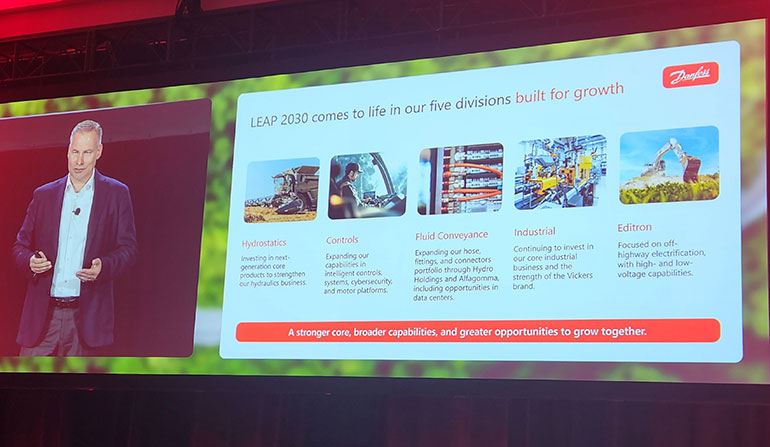
Daniel Winter introduced Danfoss Power Solutions’ LEAP 2030, a growth framework and technology roadmap to better develop its entire product portfolio and serve customers in specific markets.
MARY GANNON: One final question, and I’ll let you go for the night. As you look toward the 2030 LEAP goals, where do you believe Danfoss can differentiate itself most strongly from its competitors? You talked a little about industrial versus mobile — where do you see the big focus?
DANIEL WINTER: We’re in a unique position because hydraulics is really our core business, and we’ve proven that we’re investing heavily in it. That’s across the board: in hydrostatics and controls, in industrial hydraulics, and in our electrification business, which we also count as hydraulics.
This is core for us, and we will continue to invest in it. Sometimes we see that our competitors are not investing across the full breadth of their product portfolios. That’s why I believe we have one of the broadest, if not the broadest, product portfolio in the industry. We’re heavily investing in it at both the product and regional level.
We can support global customers. As you’ve seen here, we have very strong regional distribution partners to support us. We can work with global customers and with smaller customers, and we have great technology. Whether we are better than competitors is something the market will decide, but our starting point is really, really strong.
The other good thing is that we are in an industry where there is still ongoing consolidation. We certainly want to be on the side that acquires companies rather than being acquired. We can take advantage of organic growth and enhance our portfolio where needed.
Filed Under: Electrification, Industry News, Trending
