
Many of you reading this are into cars, and I know this because I know hydraulic people — you like to modify and tinker using old-fashioned elbow grease while working on old-fashioned cars (sorry, your ’90 Civic is a classic, too, old man). A popular trend in classic car circles is the “RestoMod.” You take that classic car shape that caught your eye growing up, and you drop in a fuel-injected LS6, K20, or B58, along with coilover suspension and a big brake kit. Now you have a modernized hot rod that is efficient and reliable with a big boost in performance.
Retrofitting hydraulics will offer similar benefits to a tired, old machine that still has good bones and lots of years left, despite not being as pretty/ugly as your BMW 2002tii. In fact, similar to RetroMods, upgrading the power unit, actuators, and controls goes a long way toward turning a press, excavator, or injection molding machine into a highly productive and efficient machine despite its age. This is the first article in a series on retrofitting and upgrading old hydraulic machinery.
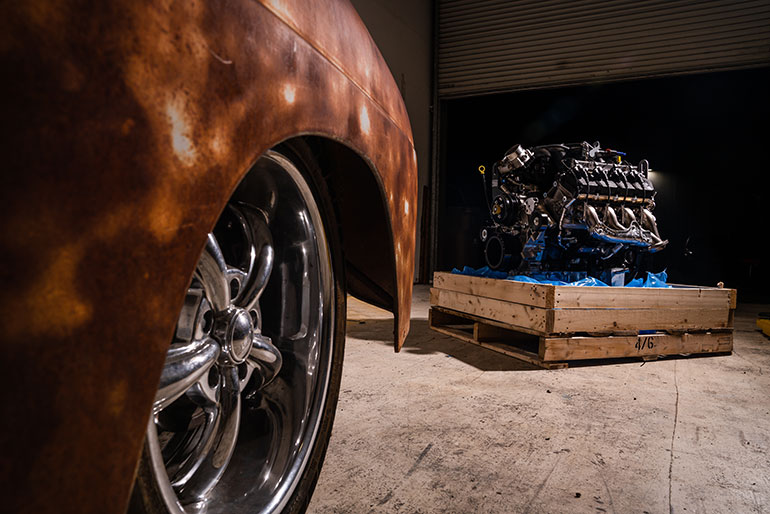
Just as with the old car, you can get a lot out of the box by upgrading the pump-motor group. The power source will be either a new, efficient engine or a premium-efficiency electric motor. Depending on the age of the motor being replaced, you could see a 25% reduction in fuel or electrons right out of the box. You can choose to reduce the motor size to match the actual output the old, tired unit was mustering together, or increase the power output slightly, so long as the machine itself can handle it.
Old diesel or gasoline engines were rated using archaic horsepower rating systems, such as SAE gross, where they ran at full power on an engine dyno to represent the power they could make without any accessories, such as alternators, water pumps, or emissions equipment. Such designations ignored important considerations, such as brake-specific fuel consumption, which is the rpm and load at which the engine makes the most power with the least amount of fuel. Selecting an engine that provides the lowest BSFC at the output you require while including all the drive accessories will offer the lowest fuel consumption while leaving plenty of horsepower on tap for increased load.
The good news/bad news about upgrading your old ICE-powered machine is that modern emissions control systems are optional, although you’d be hard-pressed to find an engine more than 25 horsepower without Tier IV Final decals on the valve cover. The right thing to do is purchase the newest engine you can, which will be the most efficient and spew the fewest emissions.
That being said, in most cases, a whole new engine will not be plug-and-play — it will require new engine mounts, wiring, cooling system, and pump interface, to say the least. In some cases, a new engine is simply not possible, especially when it is a critical structural component of the chassis. If your engine cannot be replaced, spend the time to rebuild the old one and upgrade what you can (such as the ignition system).
Electric motors, on the other hand, are quite easy to replace, especially when the pump and mount are replaced as well. Most frequently, a pump-motor group is mounted together with a bellhousing — and a set of drive couplers — directly to the motor face flange, although older units may also employ foot brackets or drive pullies. The latter can be difficult to precisely mount, so take this opportunity to upgrade to a bellhousing, which simplifies installation and maintenance because of the already-machined pilot holes.
Depending on your jurisdiction, electric motors will be a minimum IE3 premium efficiency in the range of 90-95% efficiency, although if you’re rebuilding this machine for your own purposes, there is little downside to choosing an IE4 or IE5 motor that is 95-97% efficient. The investment cost is easily offset by reductions in your utilities bill over time.
With your prime mover sorted, we can move on to pump selection. Just like the motor choices, select a pump with efficiency in mind. It’s not much of a RestoMod if you replace your 50-year-old gear pump with a new one of the same displacement. Sure, even a new gear pump is superior to an antique, but spend the dough on a piston or inside-gear pump, and you won’t regret it.
Even an average piston pump should easily achieve 90% efficiency, and the inside-gear design at least as much as well. Just don’t expect the inside-gear to come in anywhere close to the price of a spur-gear pump, because it will be at least as expensive as the piston pump, anyway. It’s just a bit more compact, with a different sound profile, and is only available as fixed displacement.
Selecting a piston pump — especially the axial variety — offers a plethora of control options for its variable-displacement ilk. If your current machine uses a closed-circuit control system, you’ll need the same option for the replacement. If you’re replacing an open-circuit pump, you’ll need a fixed-displacement pump unless you plan on changing the valves to suit the change, which is not such a bad idea in many cases.
It’s possible that a load-sensing or horsepower-control pump could be integrated if the downstream valve circuit isn’t especially complicated, but if such a system already exists, there’s no advantage but investment cost to switching for something simpler, so stick to the original format. Just like with your internal-combustion or electric motor, you can expect significant energy cost savings by upgrading to the best possible solution. A load-sensing pump, however, will require significant modifications to the control valves and a network of load-sense check valves to detect pressure on the work port side of the control valves.
If you plan to upregulate the pressure of your hydraulic RestoMod, be sure the valves, actuators, and machine itself are up to the task. Otherwise, the extra force could give itself a pretzel-themed makeover. If you’re unsure, the responsible thing to do is maintain the original pressure settings to maintain the original safety factor.
Going even further, if your budget allows for it, consider one of the new, network-ready electronically controlled pump designs. If you or your hydraulic supplier has the expertise, these systems can help with Industry 4.0 integration, advanced data and predictive maintenance, and an overall efficient and powerful design.
Although installing a new pump-motor group on your loader won’t give you the same street cred as your neighbor with the LS7-powered Miata, you’ll know in your own heart how badass your setup is. Join me next month when I’ll discuss how to upgrade the control system to suit your new and improved pump, which could range from bang-bang valves to sophisticated machine control, to match any IIoT-ready machine you’ll see at the upcoming CONEXPO CON/AGG.
Filed Under: Components, Engineering Basics, Pumps & Motors
