
Keeping contamination at bay and protecting cylinders in mining applications requires careful selection of hydraulic seals.
By Josh Cosford, Contributing Editor
Let’s just cut to the chase; mining makes for a horrific environment for seals. From incessant contamination to pressure spikes, and from exotic fluids to environmental extremes, pretty much every cause of hydraulic seal failure is well represented in both open-air and underground mining. Mining machines are the heaviest of the heavy-duty, both because of the absolute strength required to extract mountainous volumes of material, but also for their operating conditions, which are some of the harshest on Earth.
Limestone quarries, iron mines, tar sands, and open-pit coal mines all produce a tremendous amount of dust. In many cases, the dust is sized perfectly within the range most damaging to hydraulics — 14 microns or smaller. Of course, such particulate matter is also dangerous to humans, where 85% of occupational deaths occur not from trauma but from occupational disease. So prevalent is mining dust that many jurisdictions require workers to be clean-shaven to prevent particles from penetrating past the tiny gaps in the respirator seal caused by facial hair.
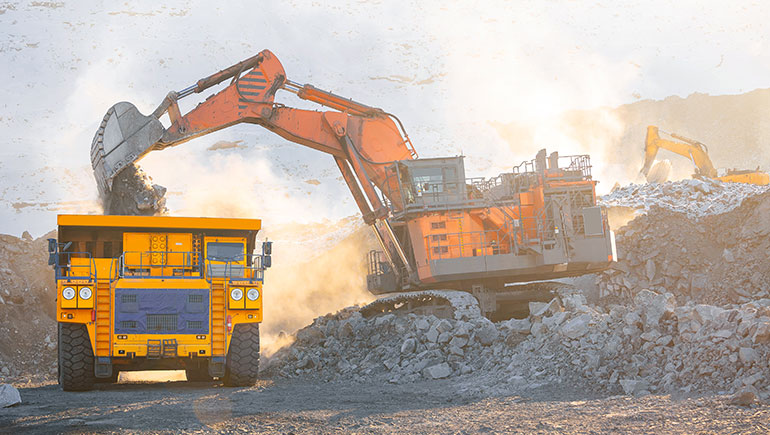
The dust, dirt and debris in mining operations require specialized sealing systems to prevent contamination and eliminate the risk of cylinder failure.
Such aggressive dust penetration is also a concern for hydraulic machinery, where breather caps are put to task, and cylinder wiper seals are challenged to prevent the ingestion of damaging particles. Drilling, explosions, digging, transportation, crushing, handling, and conveying all contribute to what is essentially taking massive chunks of solid material and reducing it to finer pieces. Those finer pieces make for superior ingredients in concrete, fertilizer, steel, and everything else that makes up the world around us, but act like a lapping compound when allowed to enter a hydraulic system.
Cylinder wipers: the first line of defense
The two primary entry points into the hydraulic system’s blood are through the reservoir itself or past the rod wiper and seals in the cylinders. The filter/breather is not limited by sealing technology, but understand that many mining machines may skip the breather altogether for sealed or pressurized systems that avoid inhalation of fine dust and particles. Cylinder rods, on the other hand, may sometimes equip two wiper seals in series to safeguard against drawing dust inward during retraction.
Wipers are durable seals and offered in a surprising number of configurations. For mining, expect only the most reliable combinations, such as a hard rubber or plastic scraper to remove the bulk of the incoming material, followed by an internal wiper made from Buna-N to clean up the remaining fine particles. Expect to see energizers that push the wiper into the rod as it wears, providing longer life while maintaining the interference fit required to wipe contaminants effectively.
Super-duty wipers could be manufactured from bronze or brass, or a combination of polymer and metal. Oil-impregnated bronze with a rubber expander makes a great combination that removes even the most stubborn contamination, while the oil in the bronze lubricates the rod as it wears. Ductile brass is the best gatekeeper, breaking only in the event of a catastrophic event, although it offers the least fine-dust protection due to its lack of compression.

Hydraulic scrapers or wipers — like this High-Metal Scraper from Trelleborg — scrape dirt, foreign particles, chips and moisture from piston rods as they retract into the system, preventing contamination of the hydraulic medium that could damage wear rings, seals and other components.
Wiper construction runs through the catalog with similar diversity as rod or piston seals; urethane, fluorocarbon, polyester, Buna-Nitrile, and nylon are all available to suit the specific needs of the machine and environment. Without the rod wiper’s protection, the ingress of fine dust makes quick work of valve, pump, and motor internals, wearing everything away like fine sandpaper.
Before we move on from wiper seals, there is one more type of seal important to mobile machinery that is rarely discussed: the dust seal. Because mining dust gets everywhere, like flour at a bread factory, dust seals are used on cylinder pivot pins to protect the critical internal surfaces and prevent grease from turning into pumice hand soap. Cylinder pins are a common wear location when not properly maintained and lubricated, so steel-backed rubber dust seals keep grease in and dust out, ensuring reliable operation of everything from dump trucks to roof supports.
High pressures and extreme environments
Although many mining hydraulic systems don’t operate above standard pressure settings seen in comparable technologies, shock loads and their resulting pressure spikes are a real concern in mining. You’ll notice mining machinery is comically large, such as ultra class haul trucks that stand many stories tall. Their height and wheel size make their beds appear relatively small compared to the same ratio of your wheelbarrow, but don’t be fooled — these machines can haul hundreds of tons of material while travelling over 40 mph (having thousands of horsepower helps).
The strength of mining machinery isn’t just a reflection of their scale, but also of the abuse they endure in their daily roles. Consider that an open-pit mine shovel (a form of excavator) can bomb single loads over 90 tons, impacting the dump truck like a sledgehammer carnival game. Although lowered dump beds use physical stops to prevent damage to hydraulic cylinders, they must be designed to withstand such loads regardless. The same concerns apply to underground mine roof supports, which use robust hydraulic cylinders to create a temporary roof that must bear the weight of a cave-in. Those loads create pressure spikes, and seals are the first place a pressure spike attacks.
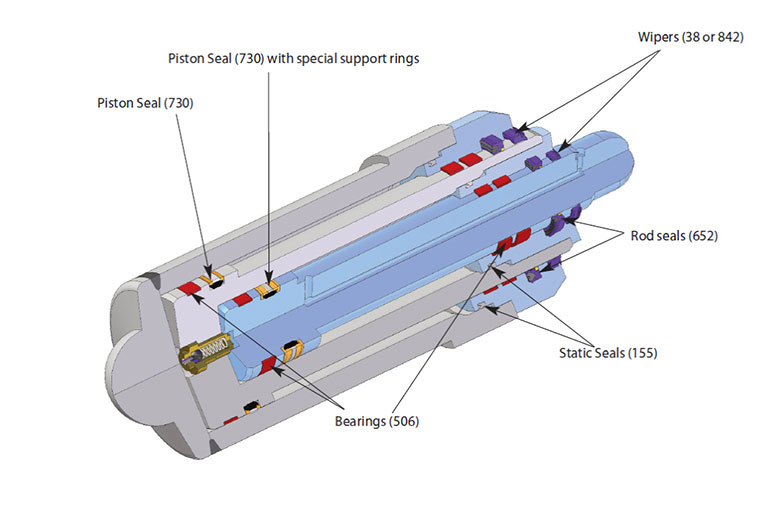
Constant yield double telescopic mining roof supporting leg cylinder showing position of major seals and bearings. Image courtesy of Hallite
Cylinders perform well when equipped with specialized seals on top of traditional, robust designs. Buffer seals added to the rod gland help absorb some initial shock load, and then harder polyurethane primary seals make a great choice for strength and longevity. Even in static locations, such as barrel end seals or rod gland seals, backup rings are used to help prevent extrusion, while lighter-duty applications make do with simple O-rings.
Such heavy-duty applications are also highly dependent on precise seal pocket geometry. Sometimes holding tight tolerances is difficult when machining a 40 in. bore, multi-stage cylinder, so don’t expect to repair these cylinders at your local hose shop. With ultra-small extrusion gaps, even high-pressure spikes cannot push synthetic rubber out through the microscopic clearances these cylinders are machined with.
Premium materials a must
Mining machines, depending on their purpose and location, may generate tens of thousands of dollars per hour in revenue, so downtime must be mitigated at all costs. Quality and reliability are the main drivers behind any hydraulic machine, especially when you factor in the remote locations many mines operate at. Then, when you add the complexity of deep mines and enclosed spaces, the ability to deliver replacement seals to their repair location can be difficult at best, so mine operators expect only the most premium synthetic rubber compounds.
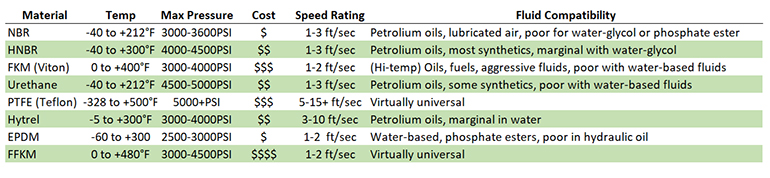
Premium materials are crucial to sealing systems used in mining operations, as they must be able to withstand extreme temperatures, exotic fluids, and high pressures.
You’re probably wondering what makes rubber “premium,” so let’s just discuss how not everyone has the same product offering, without naming any brands or getting too specific. If you’re going to use Nitrile Butadiene Rubber, be sure it’s hydrogenated. Hydrogenation adds hydrogen to unsaturated carbon bonds, and despite the same effect it has on food oils, you don’t need to worry about trans fats here.
HNBR offers superior heat resistance compared to standard Buna Nitrile, especially when cycles span a wide range of cooling and heating, where it’s better able to resist hardening. When standard Buna Nitrile experiences frigid temperatures and then rapid warm-ups to operating conditions, repeated cycles can lead to the seal becoming brittle over time, so HNBR provides superior resistance to this type of degradation. Additionally, HNBR offers superior abrasion resistance, providing a more reliable solution even in temperate climates.
Polyurethane is already extremely common in high-pressure hydraulics, but you’d be shocked to discover the vast range of quality that thermoplastic polyurethanes now range. Some advanced, proprietary urethane chemistries further increase resistance to abrasive wear, extending seal life even in the face of fine mining dust.
These advanced compounds use stabilized chemistries that resist hydrolysis and swelling from extended water exposure, which is quite common in mining because of the prominence of fire-resistant water- and glycol-based fluids. Combine these features with improved shear strength and reduced friction, and you’ll find across-the-board improvements with only one downside: cost.
Of course, other technologies complement the fire-resistant, water-based fluids required for underground mining, which prevent hose failures or leaks from turning into explosion-inducing flame throwers. FKM (Viton) is the go-to technology that works great with water and other exotic fluids while also offering extreme temperature resistance. However, be careful with extreme pressure; Viton requires extremely precise pocket dimensions to prevent extrusion, as it is quite soft. If your fluids are especially aggressive, such as polyol esters, also consider Viton’s brother, FFKM, which is essentially chemically bulletproof.
Speaking of bulletproof, the rise of PTFE (Teflon) based composites has accelerated in recent years. Because PTFE is a plastic, it does not mold well to the shape of its seal groove, so leakage is a potential downside. However, with spring or rubber energizers to help push the PTFE into its cavity with more vigor, it’s better able to operate while passing less fluid.
Some manufacturers may acknowledge and accept some leakage for what is possibly the most durable material available for hydraulic cylinders, and I mean that despite the most pressure, heat, and chemical aggression you can throw at it. When combined with fillers such as glass, bronze, and carbon, the PTFE seal also exhibits excellent wear resistance even under high velocity and load.
Mining in general is not for the faint of heart, and everything from mine hoists to shovel buckets is supersized to meet the demand that our world places upon the extraction of natural resources. Temperature extremes, elevated working and spike pressures, and one of the dirtiest operating environments make sealing a challenge. However, modern materials, geometries, and installation techniques have allowed mining to enjoy one of the most productive and efficient industries on Earth.
Filed Under: Components, Engineering Basics, Sealing, Seals
