Fluid Power World

  • Home
  • Technologies
    • Hydraulics
      • Cylinders & Actuators
      • Filtration/Contamination Control
      • Fittings, Couplings & Adapters
      • Fluids
      • Fluid Conditioning
      • Hose & Tubing
      • Pumps & Motors
      • Related Technologies
      • Sealing
      • Sensors & Gauges
      • Valves & Manifolds
    • Pneumatics
      • Air Preparation & Regulation
      • Compressed Air Technologies
      • Cylinders & Actuators
      • End Effectors & Grippers
      • Fittings, Couplings & Adapters
      • Hose & Tubing
      • Sensors
      • Vacuum
      • Valves & Manifolds
  • Engineering Basics
  • Trending
  • Resources
    • Digital Issues
    • Pneumatics Tech Toolbox
    • Podcasts
    • Special Reports
    • Subscribe to Fluid Power World Print Magazine
    • Videos
    • Webinars / Digital Events
    • White Papers
  • Women in Engineering
    • Women in Fluid Power
    • Women in Engineering
  • Design Guides
  • Classrooms
    • Hydraulic Filtration
    • Hydraulic System Design
    • Pneumatics Classroom
  • Advertise
  • SUBSCRIBE

Shock absorbers for machine longevity

By Josh Cosford | May 7, 2026

Share

Imagine driving your car around with fixed wheels and no suspension. If it weren’t for the pneumatic tires, it would feel like riding across the grocery store parking lot in a shopping cart. Not only would the ride quality shake the stones from your kidneys, but it would also shake the nuts from your Johnson Rod, if so equipped. Indeed, your vehicle wouldn’t get very far down the road before impacts and instantaneous forces made quick work of wheels, seat frames, and everything in between.

Springs help absorb shock, but also store much of the energy absorbed, only to release it immediately in the opposite direction. The resulting oscillations are often benign, but they reduce precision and increase cycle times in applications that require predictability and repeatability.
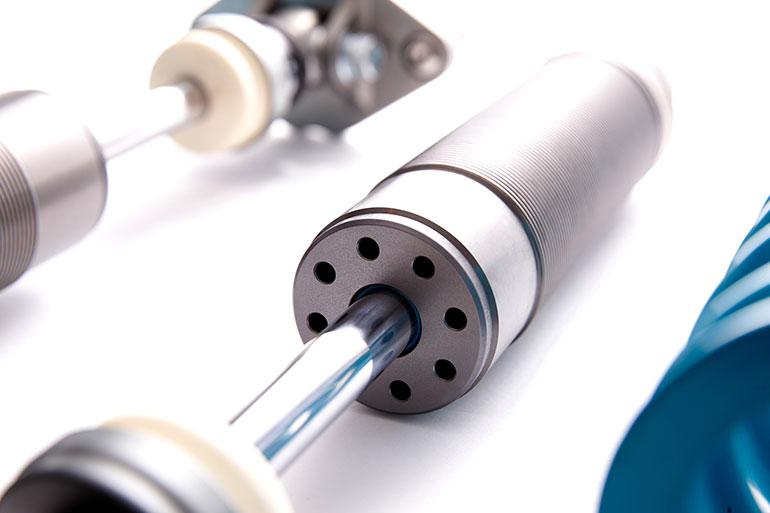
shock-absorbers-AdobeStock_1763948827

Industrial shock absorbers

Shock forces occur in fluid power systems, especially in air and hydraulic cylinders capable of high velocity, as well as in the parts of machinery powered by them. Most manufacturers offer cushions on their air and hydraulic cylinders, which act to rapidly decelerate the load by forcing hydraulic fluid through an orifice over the last inch or so of piston travel. However, in most cases, cushions operate only over the last inch or so of travel and may not have enough time to decelerate the load safely.

The ideal shock absorber slows machine movement at positional extremes to spread forces out over time, lowering peak forces by converting inertia into heat. Engineers must calculate an ideal maximum g load based on mass, velocity, and fragility of the equipment, and then select shock absorbers to achieve the appropriate damping.

Shock absorbers, also called dampers, are essentially linear braking systems. They convert linear motion energy into heat by pushing fluid through an orifice. The smaller the orifice, the more rapid the damping due to increased pressure drop. Many shock absorbers can be tuned by adjusting the orifice size or switching to a different size.

When applications such as presses, high-speed automation, robotics, or material handling experience high shock loads, those forces can damage bearings and bushings, stress structural components, and pose a risk of personal injury. The strain of high impact forces is transmitted through connecting points, pivot joints, fasteners, and welds, slowly degrading them through mushrooming, fissuring, or material fatigue.

Shock absorbers are available in various force capacities, lengths, and damping rates, providing solutions for everything from small material-handling carts to multi-ton coil cars. The ideal shock absorber selection should decelerate the load over the entire stroke length, which should be factored into machine cycle times.

Shock absorbers allow higher-speed operation that would otherwise be limited when the machine deadheads against stops or when the cylinders bump into their heads and caps, both of which are options that reduce machine life. With such disregard for machine function, you can also expect terrifying noises and reduced safety.

If you’re experiencing shock loads on your machine, explore the various shock absorbers available. They often look like miniature cylinders and are available in various mounts to suit any machine, including rigid, trunnion, or clevis styles. Shock absorbers not only improve machine performance but also extend machine longevity, so be sure to specify them for your demanding applications.


Filed Under: News


About The Author

Josh Cosford

Current Digital Issue

Fluid-Power-World-October-2026-issue-Cover-feature-image-template-copy

  A note from the editor In our October issue of Fluid Power World, my commentary takes a look at the growing role of automation and sensors in mobile machinery, where OEMs are increasingly focused on automating specific functions and improving machine performance rather than chasing fully autonomous equipment. Josh Cosford gets cheeky comparing the auto…

View Back Issues

Subscribe!

Fluid Power World is written by engineers for engineers engaged in designing machines and or equipment in Off-Highway, Oil & Gas, Mining, Packaging, Industrial Applications, Agriculture, Construction, Forestry, Medical and Material Handling. Fluid Power World covers pneumatics, mobile hydraulics and industrial hydraulics.

Fluid Power Design Guides

fluid
“fpw
EXPAND YOUR KNOWLEDGE AND STAY CONNECTED
Get the latest info on technologies, tools and strategies for Fluid Power Professionals.

RSS feed: Featured White Papers Featured White Papers

  • Moving fluid power forward
  • High-force linear motion: How to convert from hydraulic cylinders to electric actuators and why.
  • A technical comparison: Performance of pneumatic cylinders and electric rod actuators
Fluid Power World
  • Hose Assembly Tips
  • Mobile Hydraulic Tips
  • Pneumatic Tips
  • Sealing & Contamination Control Tips
  • About us
  • Contact Us

Copyright © 2026 Arrowfly LLC. All Rights Reserved. The material on this site may not be reproduced, distributed, transmitted, cached or otherwise used, except with the prior written permission of Arrowfly
Privacy Policy | Advertising | About Us

Search Fluid Power World

  • Home
  • Technologies
    • Hydraulics
      • Cylinders & Actuators
      • Filtration/Contamination Control
      • Fittings, Couplings & Adapters
      • Fluids
      • Fluid Conditioning
      • Hose & Tubing
      • Pumps & Motors
      • Related Technologies
      • Sealing
      • Sensors & Gauges
      • Valves & Manifolds
    • Pneumatics
      • Air Preparation & Regulation
      • Compressed Air Technologies
      • Cylinders & Actuators
      • End Effectors & Grippers
      • Fittings, Couplings & Adapters
      • Hose & Tubing
      • Sensors
      • Vacuum
      • Valves & Manifolds
  • Engineering Basics
  • Trending
  • Resources
    • Digital Issues
    • Pneumatics Tech Toolbox
    • Podcasts
    • Special Reports
    • Subscribe to Fluid Power World Print Magazine
    • Videos
    • Webinars / Digital Events
    • White Papers
  • Women in Engineering
    • Women in Fluid Power
    • Women in Engineering
  • Design Guides
  • Classrooms
    • Hydraulic Filtration
    • Hydraulic System Design
    • Pneumatics Classroom
  • Advertise
  • SUBSCRIBE