
CFI leads multiple fluid power companies to modernize the hydraulic system responsible for raising and lowering the walls of the Advanced Electro-Optical System (AEOS) telescope dome on Maui.
By Bill Perry
Imagine taking on an engineering project tied to national security on an island 4,000 miles away. The job site is situated along the crest of a dormant volcano at an altitude of 10,023 feet, surrounded by a national park. Add to those challenges a timetable that forces work in weather alternating between sunshine and snow, wind and high humidity — sometimes on the same day. That is what Beaumont, Texas-based fluid power company Controlled Fluids Inc. (CFI) faced when Boeing, acting on behalf of the U.S. Space Force, awarded the firm the job of modernizing the system responsible for raising and lowering the walls of the Advanced Electro-Optical System (AEOS) telescope dome on Maui.

The AEOS Dome Modernization Project was a three-year, multimillion-dollar project to replace aging hydraulics and controls that supported a retractable dome housing a high-powered telescope used for space surveillance, research, and situational awareness. The work included installing eight 20-ft hydraulic cylinders (when retracted) with a 14.5-foot stroke inside structural columns, upgrading position sensors, implementing a new motion-control platform, and addressing structural buckling concerns — all while operating within one of the most logistically challenging environments in the United States.
Located inside Haleakala National Park, the job site required what CFI described as a “logistics symphony.” CFI and its team of technology partners had to ship containers, move cranes, and transport equipment up a narrow mountain road that could become barely passable due to weather. A forgotten tool or missing component could mean a three-hour roundtrip from the job site to a base camp and back.
“A field service install 4,000 miles away on top of a mountain was a challenge; we presented a formal plan to Boeing detailing each step, member of our team, and when each thing would happen,” recalled Nicholas Albarado, general manager for CFI. “One of the first steps in actually getting there was making sure everything we needed — sensors, spill kits, bolts, tow ropes — was packed in 40-ft Conex containers.”
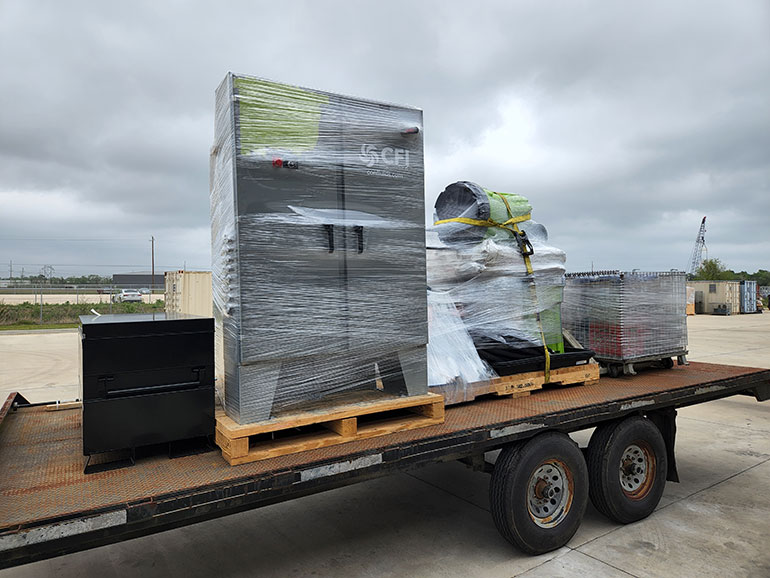
Logistics was critical in the project. CFI had to ship containers, move cranes, and transport equipment up a narrow mountain road that could become barely passable due to weather.
Aging infrastructure drives change
The telescope’s dome walls relied on eight hydraulically powered, single-acting cylinders originally deployed in 1996. Over time, engineers maintaining the system found the cost and frequency of overhauls increasingly difficult to justify.
To win the contract, CFI assembled a specialized team to respond to the Space Force and Boeing’s request for proposals. Cedar, Minn.-based Aggressive Hydraulics handled the design and manufacture of new cylinders. Battle Ground, Wash.-based Delta Motion was responsible for motion control hardware while supporting programming using its RMCTools platform. And Justin Courville, PE, director of mechanical engineering for Lafayette, La.-based Pelican Engineering, served as on-site project manager and lead engineer. CFI served as the designer, contractor, and installer of record. CFI then subcontracted portions of the project to its partners, while retaining responsibility for system design, integration, and installation.
“Our solution included replacing the cylinders originally installed in the 1990s with double-acting cylinders,” said Jason Allen, fluid power systems engineer for CFI. “In combination with Delta Motion’s control solutions, double-acting cylinders would give the Space Force collective leveling between all eight cylinders and much tighter tolerances at any point in the motion.”
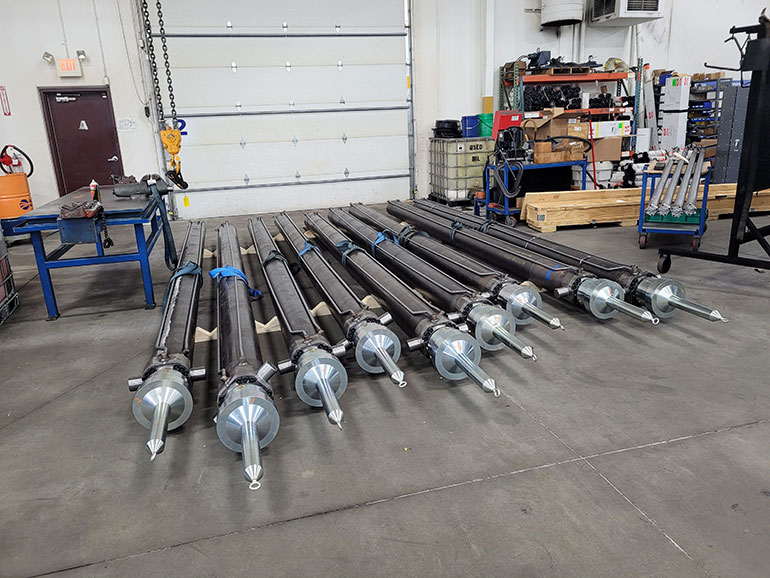
Each cylinder measured approximately 20 feet in length, weighed about 2,700 lb, and featured an 8-in. bore, a 5.5-in. rod, and a 174-in. stroke.
Other critical elements of the three-phase project included:
- replacing existing sensors on the cylinders with specialized ones that achieved far tighter tolerances and were easily serviced,
- testing and programming motion-control software, and
- developing a novel approach to buckling analysis.
At the project’s outset, testing of the legacy system revealed synchronization problems. One cylinder could drift as much as 0.25 in. out of alignment — enough to risk binding during extension or retraction. With the original controls, the risk increased the farther the walls moved.
Balancing engineering and environment
According to CFI Service Manager Brad Little, material selection and seal design were critical to developing cylinders that would have a longer service life and consistent performance, particularly given the environmental conditions at the site. Installing the cylinders was as demanding physically as it was technically. Courville recalls that the team often began workdays at 4:30 a.m., getting weather reports that would let them know if work could be undertaken on the site. Even after reaching the site, high winds — anything exceeding 20 mph — or precipitation could cause the Space Force to halt work.
“Sometimes we’d make the trip up only to turn around an hour later,” Courville said. “Safety always dictated the schedule.”
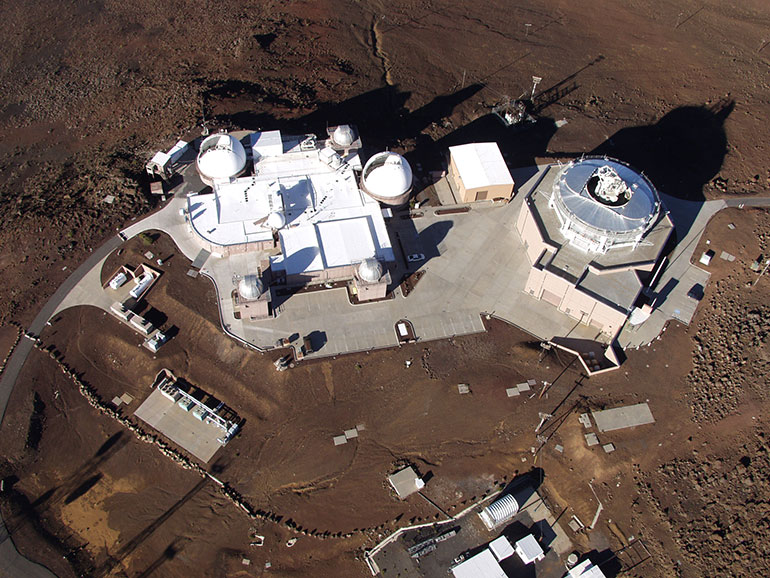
The remote mountaintop location required careful planning before work could begin each day.
CFI installed the first cylinder in February 2023, with the remaining seven completed by April. Each cylinder measured approximately 20 feet in length, weighed about 2,700 lb, and featured an 8-in. bore, a 5.5-in. rod, and a 174-in. stroke.
Buckling, loads, and failure modes
Aggressive Hydraulics is a designer and builder of custom hydraulic cylinders ranging from ones that can fit in your hand to those large enough to fill a semi-truck. The company’s experience in a variety of markets prepared them to address the unique aspects of the AEOS project. Aggressive Hydraulics Engineering Manager Tony Casassa said the cylinder design requirements changed as the project team members identified potential concerns. Casassa believed, in part, that the high level of attention to detail stemmed from his customer’s aerospace background. One specific detail was a precise surface finish, which, combined with the cylinder size, created a challenging requirement to satisfy.
“The initial inquiry came to us with basic cylinder information — bore size, stroke, some mounting considerations,” Casassa said. “As time went on, more features were requested, such as bleed and leak detection ports, seamless stainless-steel tubing, and a 20-year maintenance-free lifespan.”
One potential failure point was buckling. And the Space Force and Boeing wanted assurance that, if, for instance, a cylinder failed, the event could be controlled. The legacy cylinders had a unique mounting configuration. Courville conducted the buckling analysis and calculations, which required nearly three months of work to complete. Courville employed classical engineering calculations using Roark’s Formulas for Stress and Strain. But due to the non-traditional nature of the cylinder supports, he conducted a separate finite element analysis (FEA) to verify results.
To meet all the requirements, Steve Thor, vice president of Sales and Marketing for Aggressive Hydraulics, said his team designed the new cylinders to operate at 1,900 psi but withstand pressures up to 3,600 psi, generating forces approaching 180,000 lb. If one cylinder fails, the remaining units can absorb the load. The original cylinders, built by Rockwell Power Systems, were industrial tie-rod designs; the new cylinders are welded mobile-style units with bolted head glands, special zinc-coated rod mounts, and flanged ports in the end cap.
Solving a sensor access problem
Another significant improvement involved cylinder position sensors. The legacy design required removing an entire cylinder to replace a failed sensor — a process that required a mobile crane and could consume an entire day. The process risked damaging the replacement sensor during reinstallation.
“The base of each column only had a 6-by-12-in. access window, which wasn’t sufficient for removing the 176-in.-long sensor,” Albarado said. “Boeing’s engineers had to lift the cylinder out with a crane just to get to the sensor.”

CFI’s project team positions a rough terrain crane to reach one of the eight hydraulically powered cylinders that move the telescope’s dome walls.
CFI redesigned the system using flexible, compact, high-precision Temposonics linear sensors with an eight-inch bend radius. Aggressive Hydraulics designed piping integrated in the cylinder, so maintenance teams could feed the flexible sensor into the unit, while it remained in the column, eliminating the need for removal. The cylinder included a protective steel covering for the sensor’s exposed part.
The previous level of error with the legacy sensors was about a quarter inch. With the new sensors, the reachable tolerance is now 0.0001 in.
Modernizing controls
As part of phase two, CFI replaced three obsolete PLC enclosures and programmed the PLCs. Delta Motion supported the motion control programming and implemented its advanced control algorithms managing the cylinders. The system compares position and force feedback from each cylinder every millisecond, adjusting motion to maintain level and equilibrium.
“From a controls standpoint, this was an upgrade across the board,” said Jason Palmer, regional sales manager for Delta Motion. “The original control system was from the 1980s, and all of the manufacturer’s parts were obsolete.”
Rather than sequencing motion solely through a PLC, CFI specified Delta Motion’s RMC200 dedicated motion-control platform, improving response, precision, and ease of implementation.
“The nice thing with the solution we arrived at is we can accept multiple sensor types — PWM, SSI, start/stop — without changing cards,” Palmer said. “With the project phases, the motion controller needed to accept both the legacy PWM sensor outputs as well as the newer SSI signals.”
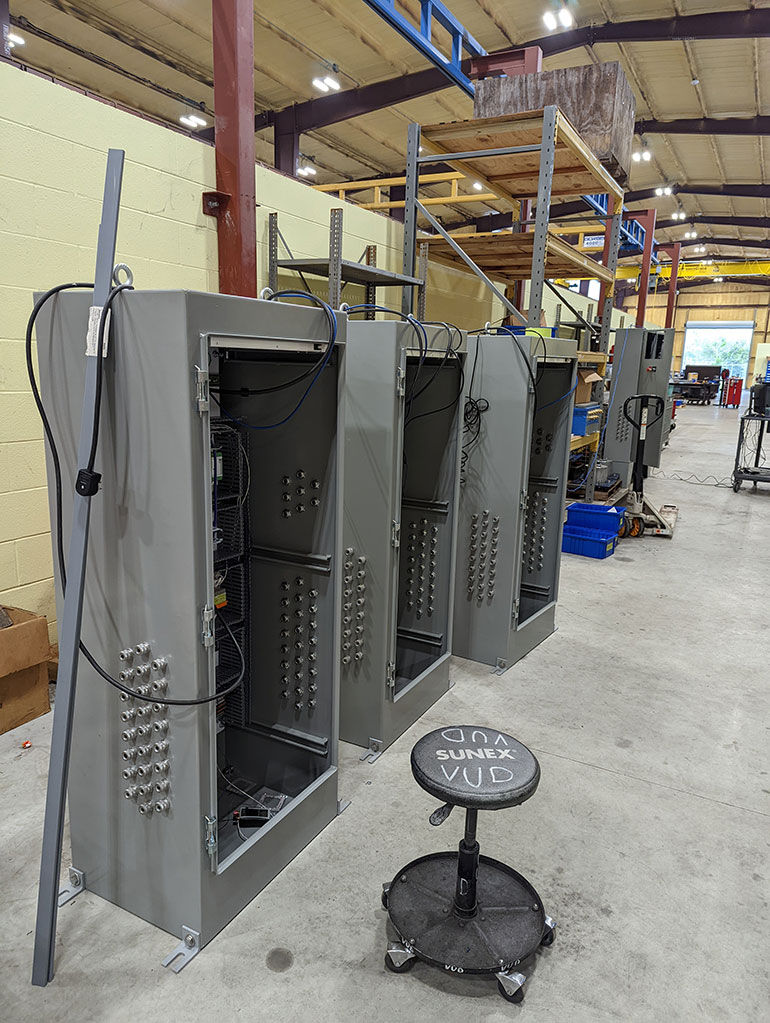
PLCs stand ready for wiring at CFI’s Texas facility before shipment to the AEOS Dome job site in Hawaii.
The control room design includes a wire from the sensor in each cylinder to a hydraulic valve mounted nearby. The control and electronics compensate based on the cylinder’s output and where the sensors are supposed to be versus their actual location. The multi-axis controller can manage all eight cylinders and compare feedback from all the cylinders to determine the skew, forces, and position. This is done every millisecond simultaneously for the eight cylinders. The maximum amount of skew between any one cylinder is 0.040 in. on a 174-in. stroke, while moving the entire building. This relates to 0.02% of skew across the range.
According to Palmer, one stamp of approval for the upgraded system came from an engineer who designed the facility’s telescope. Palmer described the engineer as someone who “thinks in differential equations” and completely understood the dome, building, and engineering behind it. The engineer, says Palmer, had calculated the natural frequences on the retractable walls as they moved with the legacy cylinders. With the new system, the engineer expressed shock and awe when he could no longer feel oscillations. The new cylinders, sensors, and controllers removed any harmonics in the building.
A smoother, more reliable system
Although the project did not involve modifications to the telescope itself, the upgraded system significantly improved operational performance.
The walls now rise and lower at 1.5 in. per second and more smoothly, with better load sharing. While the existing hydraulic power unit limited maximum speed, the new controls improved leveling efficiency and reliability.
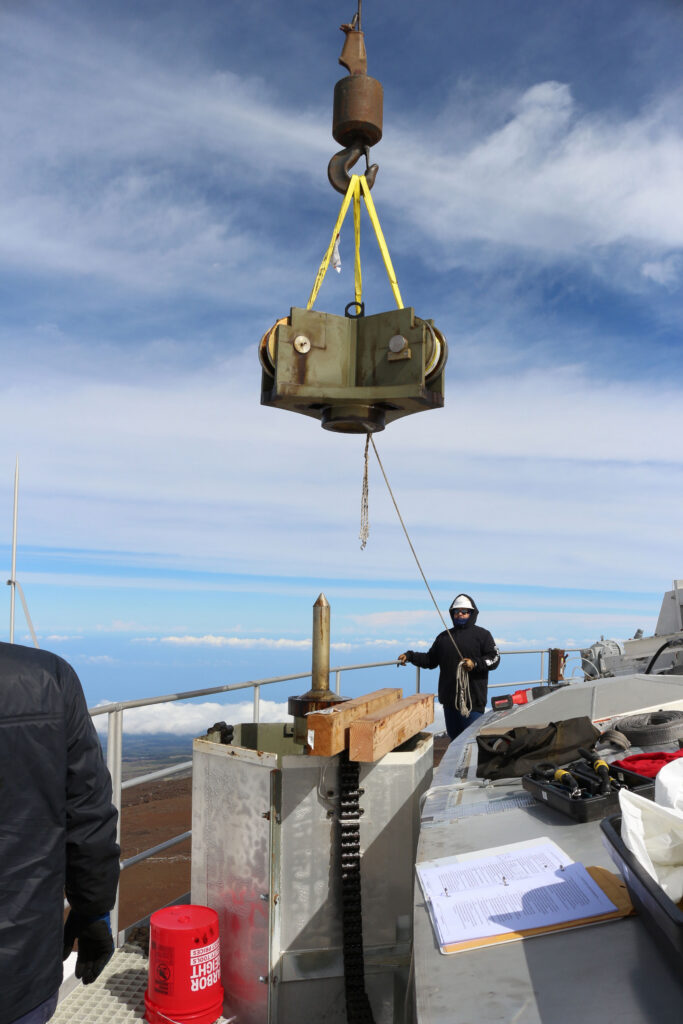
Along the roofline of the AEOS telescope dome, CFI’s crew hoists a platen assembly, which sits atop each of the eight columns. The crew removed the platen assembly as a first step to accessing and replacing each cylinder. The platen assembly connects each cylinder to the telescope’s roof.
“The old system was very analog,” Palmer said. “The new one is digital, with more memory, better algorithms, and far better diagnostics.”
Aggressive Hydraulics’ Thor said the project demanded collaboration by its very nature.
“This kind of project is in our DNA,” Thor said. “Working with CFI, Aggressive, Delta, and Boeing under very specific, changing requirements made all of us better.”
The result: A modernized system for precisely and reliably opening the AEOS telescope’s field of view, supporting national security.
Bill Perry is a freelance writer based in Upstate New York who has written about manufacturing, utilities, construction, and software for 30 years. Contact him at bperry[at]march24media[dot]com.
DISCLAIMER: “The views expressed are those of the author and do not necessarily reflect the official policy or position of the Department of the Air Force, the Department of Defense, or the U.S. government.”
Filed Under: Components, Controls, Cylinders & Actuators, Motion Controllers, News, Trending
