Fluid Power World

  • Home
  • Technologies
    • Hydraulics
      • Cylinders & Actuators
      • Filtration/Contamination Control
      • Fittings, Couplings & Adapters
      • Fluids
      • Fluid Conditioning
      • Hose & Tubing
      • Pumps & Motors
      • Related Technologies
      • Sealing
      • Sensors & Gauges
      • Valves & Manifolds
    • Pneumatics
      • Air Preparation & Regulation
      • Compressed Air Technologies
      • Cylinders & Actuators
      • End Effectors & Grippers
      • Fittings, Couplings & Adapters
      • Hose & Tubing
      • Sensors
      • Vacuum
      • Valves & Manifolds
  • Engineering Basics
  • Trending
  • Resources
    • Digital Issues
    • Pneumatics Tech Toolbox
    • Podcasts
    • Special Reports
    • Subscribe to Fluid Power World Print Magazine
    • Videos
    • Webinars / Digital Events
    • White Papers
  • Women in Engineering
    • Women in Fluid Power
    • Women in Engineering
  • Design Guides
  • Classrooms
    • Hydraulic Filtration
    • Hydraulic System Design
    • Pneumatics Classroom
  • Advertisers
    • Advertise
    • PR Submissions
    • Eblast Submissions
  • SUBSCRIBE

Specific power: Your compressor gas mileage rating

By Paul Heney | November 6, 2025

Share

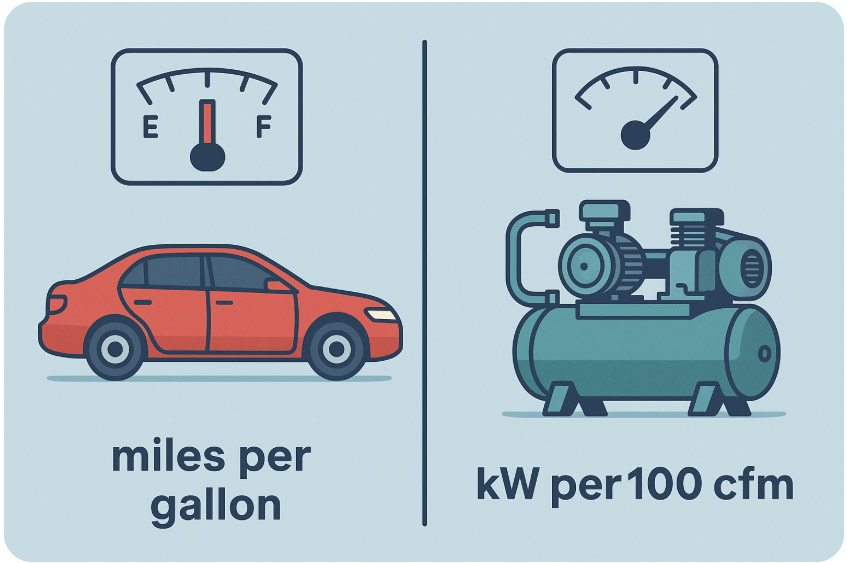
When choosing a car, consumers rely on fuel economy ratings to compare efficiency. Miles per gallon or liters per 100 kilometers allow buyers to understand how far a vehicle can travel with a given amount of fuel. This standard measure is an essential tool for making informed purchasing decisions.

Compressed air systems have a similar benchmark: specific power. Expressed in kilowatts per 100 cubic feet per minute (kW/100 cfm), specific power is essentially the gas mileage rating for air compressors. It tells operators how much electrical power is required to produce a certain amount of compressed air. Lower values indicate greater efficiency, just as higher miles per gallon signal better fuel economy in vehicles.
Why is this important? Electricity represents the single largest cost of owning and operating an air compressor. Over its lifetime, the purchase price of the compressor itself is often dwarfed by the energy bills required to keep it running. Understanding and comparing specific power gives plant owners and operators a clear way of evaluating efficiency, control costs, and select equipment that minimizes energy waste.

Just as cars vary widely in their fuel economy, compressors can differ significantly in their specific power. Factors that affect this rating include design type (rotary screw, centrifugal, reciprocating), operating pressure, control strategy, and the presence of energy-saving features such as variable speed drives. Even two compressors with the same nominal size can have different performance profiles, making it crucial to compare specific power values rather than assuming all machines are equal.

Monitoring specific power does not stop at the purchase decision. Over time, system conditions can cause efficiency to degrade. Leaks, fouled filters, incorrect control settings, or poor maintenance can raise the actual kW/100 cfm consumed by a plant’s system. Just as a car with under-inflated tires and neglected maintenance will burn more fuel, a neglected compressed air system will consume more electricity than necessary.

The Compressed Air Challenge emphasizes the value of measuring and tracking system performance, including specific power. By using data logging equipment or permanently installed monitoring systems, operators can calculate their system’s effective specific power and watch for changes over time. A rising trend signals that corrective action is needed—whether through maintenance, leak repair, or equipment adjustment.

In addition, benchmarking against industry best practices helps identify opportunities for improvement. A system running at 25 kW/100 cfm is less efficient than one delivering the same air at 18 kW/100 cfm. The difference represents wasted money, often thousands of dollars per year. Awareness of these numbers transforms compressed air from a hidden cost into a controllable efficiency target.

Specific power is the universal yardstick for compressor efficiency, just as miles per gallon is for automobiles. It provides a straightforward way to evaluate equipment, monitor performance, and identify savings opportunities. For plant operators and owners, knowing your system’s gas mileage rating is not just useful, it is essential for achieving reliable, cost-effective compressed air.

Don’t guess, measure it.


Filed Under: Air Compressors, Air Preparation, Components, Compressed Air Technologies, Engineering Basics, Pneumatic Tips


About The Author

Paul Heney

Current Digital Issue

Fluid-Power-World-November-2026-issue-Cover-feature-image-template-copy

A note from the editor This issue takes a look at some of the practical challenges engineers face when designing, maintaining and troubleshooting fluid power systems. Our Design Notes feature explores the particularly harsh environment of tunnel boring machines, where moisture and contamination can quickly become reliability problems. Eaton’s filtration expert weighs in here on…

View Back Issues

Subscribe!

Fluid Power World is written by engineers for engineers engaged in designing machines and or equipment in Off-Highway, Oil & Gas, Mining, Packaging, Industrial Applications, Agriculture, Construction, Forestry, Medical and Material Handling. Fluid Power World covers pneumatics, mobile hydraulics and industrial hydraulics.

Fluid Power Design Guides

fluid
“fpw
EXPAND YOUR KNOWLEDGE AND STAY CONNECTED
Get the latest info on technologies, tools and strategies for Fluid Power Professionals.

RSS feed: Featured White Papers Featured White Papers

  • Moving fluid power forward
  • High-force linear motion: How to convert from hydraulic cylinders to electric actuators and why.
  • A technical comparison: Performance of pneumatic cylinders and electric rod actuators
Fluid Power World
  • Hose Assembly Tips
  • Mobile Hydraulic Tips
  • Pneumatic Tips
  • Sealing & Contamination Control Tips
  • About us
  • Contact Us

Copyright © 2026 Arrowfly LLC. All Rights Reserved. The material on this site may not be reproduced, distributed, transmitted, cached or otherwise used, except with the prior written permission of Arrowfly
Privacy Policy | Advertising | About Us

Search Fluid Power World

  • Home
  • Technologies
    • Hydraulics
      • Cylinders & Actuators
      • Filtration/Contamination Control
      • Fittings, Couplings & Adapters
      • Fluids
      • Fluid Conditioning
      • Hose & Tubing
      • Pumps & Motors
      • Related Technologies
      • Sealing
      • Sensors & Gauges
      • Valves & Manifolds
    • Pneumatics
      • Air Preparation & Regulation
      • Compressed Air Technologies
      • Cylinders & Actuators
      • End Effectors & Grippers
      • Fittings, Couplings & Adapters
      • Hose & Tubing
      • Sensors
      • Vacuum
      • Valves & Manifolds
  • Engineering Basics
  • Trending
  • Resources
    • Digital Issues
    • Pneumatics Tech Toolbox
    • Podcasts
    • Special Reports
    • Subscribe to Fluid Power World Print Magazine
    • Videos
    • Webinars / Digital Events
    • White Papers
  • Women in Engineering
    • Women in Fluid Power
    • Women in Engineering
  • Design Guides
  • Classrooms
    • Hydraulic Filtration
    • Hydraulic System Design
    • Pneumatics Classroom
  • Advertisers
    • Advertise
    • PR Submissions
    • Eblast Submissions
  • SUBSCRIBE