Fluid Power World

  • Home
  • Technologies
    • Hydraulics
      • Cylinders & Actuators
      • Filtration/Contamination Control
      • Fittings, Couplings & Adapters
      • Fluids
      • Fluid Conditioning
      • Hose & Tubing
      • Pumps & Motors
      • Related Technologies
      • Sealing
      • Sensors & Gauges
      • Valves & Manifolds
    • Pneumatics
      • Air Preparation & Regulation
      • Compressed Air Technologies
      • Cylinders & Actuators
      • End Effectors & Grippers
      • Fittings, Couplings & Adapters
      • Hose & Tubing
      • Sensors
      • Vacuum
      • Valves & Manifolds
  • Engineering Basics
  • Trending
  • Resources
    • Digital Issues
    • Pneumatics Tech Toolbox
    • Podcasts
    • Special Reports
    • Subscribe to Fluid Power World Print Magazine
    • Videos
    • Webinars / Digital Events
    • White Papers
  • Women in Engineering
    • Women in Fluid Power
    • Women in Engineering
  • Design Guides
  • Classrooms
    • Hydraulic Filtration
    • Hydraulic System Design
    • Pneumatics Classroom
  • Advertise
  • SUBSCRIBE

System integration is changing the face of fluid power

By Mary Gannon | May 27, 2026

Share

Over the past few years, I’ve noticed a fundamental shift in how many fluid power companies are viewing themselves and the technologies and services they provide. Rather than calling themselves pump or cylinder companies, they are positioning themselves as system partners who are delivering more fully integrated systems that bring together the best of all engineering disciplines — hydraulics, electric, pneumatics, and mechanical systems.

Especially at CONEXPO this year, fluid power manufacturers say there is a need to have a complete grasp on all systems as OEMs are looking to build machines that are more intelligent, automated and electrified. Most of the larger fluid power companies demonstrated this with machines on the show floor. Hydac, for example, used its skid steer platform to showcase how its hydraulics, electronics, sensors, controls, and safety functions can be delivered as a cohesive package, particularly for midsized OEMs that lack the inhouse engineering horsepower of major players.

HydraForce and Bosch Rexroth described this as a “fully integrated solution program” where customers can either take a full system or selectively cherrypick components from a seamlessly compatible portfolio. Similarly, Danfoss displayed a massive board of a machine model in their booth, showing all the systems where their technology comes together. For example, the integrated X1P pump and Editron motor are presented not as separate SKUs but as a single tuned e-pump system running on its Plus+1 control software, to keep the combination operating in its sweet spot. Additionally, Danfoss emphasized hybrid architectures and digital displacement, focusing on reducing throttling losses and optimizing subsystems at the machine level rather than trying to improve individual components in isolation.
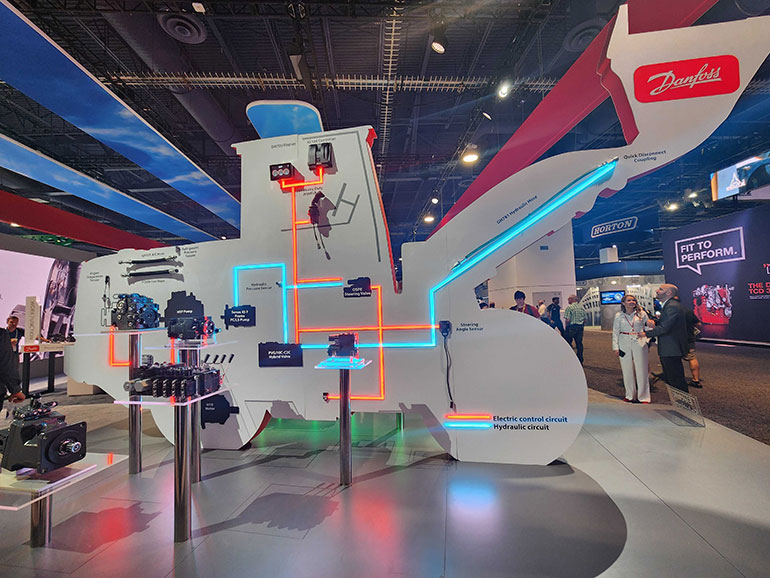
Danfoss' CONEXPO booth was hard to miss with the giant cutout board, highlighting its hydraulics technologies on side, and electronics on the other (below), and how they work together in a complete system.
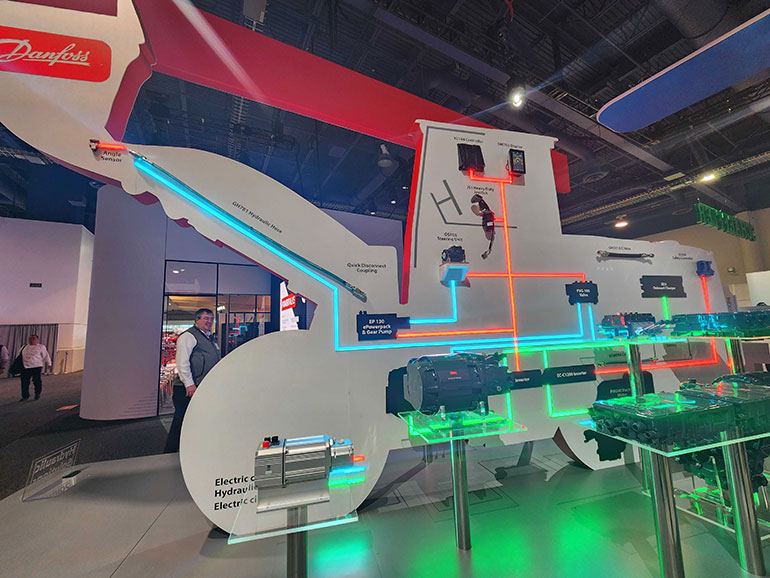
Danfoss’ CONEXPO booth was hard to miss with the giant cutout board, highlighting its hydraulics technologies on side, and electronics on the other (below), and how they work together in a complete system.

In both cases, the message is clear: the value proposition is no longer just a cartridge or valve; it’s in the way these components are packaged together. The differentiation now lies in how electric, hydraulic, and mechanical subsystems are designed, controlled, and supported as complete systems. As I continue to read through more discussions from CONEXPO, it’s clear that success increasingly depends on systems thinking, software competence, and close collaboration with OEMs.

We’re taking that approach here at Fluid Power World, trying to package our content together, focusing on more complete systems versus educating on just one single piece of technology. That’s why we designed our current webinar series to tackle the more common technologies and their final design into a system.

Although we’re midway through the six-part series, you are welcome to watch the first two on-demand webinars, Hydraulic Valves: Precision Control for Smarter Systems, and  Hydraulic Cylinders: The Workhorses of Linear Motion. But I’d like to invite you to join us for the remaining live events, which are all held on the following Thursdays at noon.

  • Thursday, May 28 – Pumps & Motors: Power and Performance in Motion
  • Thursday, June 4 – Filtration & Sealing: Contamination Control as a Design Priority
  • Thursday, June 11 – Hose Assemblies: Safe, Flexible Fluid Connections
  • Thursday, June 18 – Hydraulics in Harmony: Integrating Components for Efficient System Design

Stay tuned as you’ll see more content like this from us as we work to match the industry’s demands and needs in education on reliable, efficient and safe fluid power design.


Filed Under: Engineering Basics, News


About The Author

Mary Gannon

Mary Gannon is editor of Fluid Power World. She has been a technical writer and editor for more than 13 years, having covered fluid power, motion control and interconnect technologies.

Current Digital Issue

Fluid-Power-World-October-2026-issue-Cover-feature-image-template-copy

  A note from the editor In our October issue of Fluid Power World, my commentary takes a look at the growing role of automation and sensors in mobile machinery, where OEMs are increasingly focused on automating specific functions and improving machine performance rather than chasing fully autonomous equipment. Josh Cosford gets cheeky comparing the auto…

View Back Issues

Subscribe!

Fluid Power World is written by engineers for engineers engaged in designing machines and or equipment in Off-Highway, Oil & Gas, Mining, Packaging, Industrial Applications, Agriculture, Construction, Forestry, Medical and Material Handling. Fluid Power World covers pneumatics, mobile hydraulics and industrial hydraulics.

Fluid Power Design Guides

fluid
“fpw
EXPAND YOUR KNOWLEDGE AND STAY CONNECTED
Get the latest info on technologies, tools and strategies for Fluid Power Professionals.

RSS feed: Featured White Papers Featured White Papers

  • Moving fluid power forward
  • High-force linear motion: How to convert from hydraulic cylinders to electric actuators and why.
  • A technical comparison: Performance of pneumatic cylinders and electric rod actuators
Fluid Power World
  • Hose Assembly Tips
  • Mobile Hydraulic Tips
  • Pneumatic Tips
  • Sealing & Contamination Control Tips
  • About us
  • Contact Us

Copyright © 2026 Arrowfly LLC. All Rights Reserved. The material on this site may not be reproduced, distributed, transmitted, cached or otherwise used, except with the prior written permission of Arrowfly
Privacy Policy | Advertising | About Us

Search Fluid Power World

  • Home
  • Technologies
    • Hydraulics
      • Cylinders & Actuators
      • Filtration/Contamination Control
      • Fittings, Couplings & Adapters
      • Fluids
      • Fluid Conditioning
      • Hose & Tubing
      • Pumps & Motors
      • Related Technologies
      • Sealing
      • Sensors & Gauges
      • Valves & Manifolds
    • Pneumatics
      • Air Preparation & Regulation
      • Compressed Air Technologies
      • Cylinders & Actuators
      • End Effectors & Grippers
      • Fittings, Couplings & Adapters
      • Hose & Tubing
      • Sensors
      • Vacuum
      • Valves & Manifolds
  • Engineering Basics
  • Trending
  • Resources
    • Digital Issues
    • Pneumatics Tech Toolbox
    • Podcasts
    • Special Reports
    • Subscribe to Fluid Power World Print Magazine
    • Videos
    • Webinars / Digital Events
    • White Papers
  • Women in Engineering
    • Women in Fluid Power
    • Women in Engineering
  • Design Guides
  • Classrooms
    • Hydraulic Filtration
    • Hydraulic System Design
    • Pneumatics Classroom
  • Advertise
  • SUBSCRIBE