
Some inventions are just so damn good that no matter how much AI and data centers you throw at bettering them, modern technology simply cannot replace the simple, legacy equipment we enjoy today. There will be no better method to close your pants than a zipper, nothing superior to an umbrella for a sudden shower, and good luck improving on the bicycle for human-powered transportation.
Correspondingly, electrical linear actuators will never produce the force a hydraulic cylinder does without even trying. Despite the number of people working on electromechanical actuators, they simply can’t even come close. It all has to do with power density, which is the amount of force and velocity that can be achieved within a given packaging envelope.
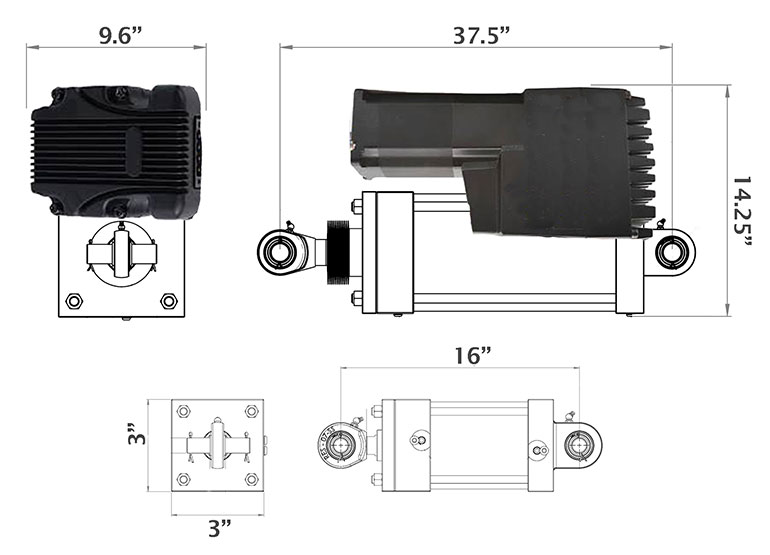
Figure 1. Illustration of one of Higginson’s hydraulic cylinders with electric motor attached.
An electric motor can only withstand so much magnetic flux before saturation occurs, as you can only pump a limited amount of current into the metal core before all magnetic domains are aligned. Throwing more current at a saturated motor, even those made with cobalt alloys, just results in heat generation. However, even at magnetic saturation, cooling the motor would be nearly impossible since heat scales exponentially with current.
There are linear actuators capable of high force but limited in velocity by the pitch of the screw, which helps add torque but requires more rotations. Think of it as a gear ratio, where you must trade force for velocity or vice versa. You can make them fast by increasing the pitch, but you lose the corresponding factor of torque. Linear actuators that are high-force and high-speed are also “high-sized,” and many times larger than a corresponding hydraulic cylinder.
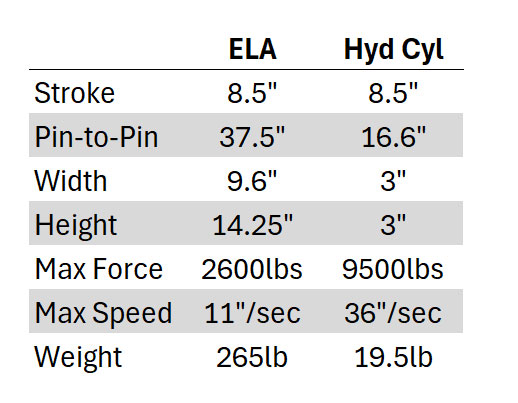
Figure 2. Comparison of ELA and hydraulic cylinder specifications
And there is no mechanical free ride with ball screws or rollers, so as rpm rises to blinding speeds, excessive friction leads to heat, lubrication breakdown, and eventual failure. A fast-moving cylinder can generate heat, but it has built-in cooling as fluid circulates. Although low-force electric actuators can move faster than many hydraulic cylinders (those with polymer seals), force output is minor by comparison.
Every new linear actuator startup or neophyte engineer thinks their design is the one to dethrone hydraulic cylinders, until you actually make a comparison … so let’s do that. I’m going first to describe a major manufacturer’s ELA, and then compare it to the smallest hydraulic cylinder that can (out)perform the same task.
I’ve created a crude illustration (don’t laugh) using one of Higginson’s hydraulic cylinders and attached an electric motor under the pretense that there is a ball screw joining them, and then dimensioned it as this off-the-shelf ELA (Figure 1). I’ve also included a 2-in. bore hydraulic cylinder for comparison so you can see how, in fact, there is no possible way an electric linear actuator can approach hydraulics for power density.
You can see that this tiny little hydraulic cylinder outputs over three times the force, three times the max velocity, less than half the length, and a fraction of the girth. And you can likely purchase the hydraulic power unit to serve this cylinder at less than the cost of the ELA. Sure, costs will come down over time, but it’s too complex ever to undercut the cylinder’s price.
So, if you’re a champion of linear electric actuators, feel free to send me examples of your golden-child design, and I’ll beat it with a catalog-sized hydraulic cylinder. My example was only 3,000 psi. I’ll be keeping secret weapons in my back pocket, like the 15,000 psi tie-rod cylinder we made a few years back. Unless your ELA can harness a mini black hole’s worth of gravitational force inside its ball screw, I’ll sleep easy knowing my challenge will never be met.
Filed Under: Components, Cylinders & Actuators, Technologies
