Fluid Power World

  • Home
  • Technologies
    • Hydraulics
      • Cylinders & Actuators
      • Filtration/Contamination Control
      • Fittings, Couplings & Adapters
      • Fluids
      • Fluid Conditioning
      • Hose & Tubing
      • Pumps & Motors
      • Related Technologies
      • Sealing
      • Sensors & Gauges
      • Valves & Manifolds
    • Pneumatics
      • Air Preparation & Regulation
      • Compressed Air Technologies
      • Cylinders & Actuators
      • End Effectors & Grippers
      • Fittings, Couplings & Adapters
      • Hose & Tubing
      • Sensors
      • Vacuum
      • Valves & Manifolds
  • Engineering Basics
  • Trending
  • Resources
    • Digital Issues
    • Pneumatics Tech Toolbox
    • Podcasts
    • Special Reports
    • Subscribe to Fluid Power World Print Magazine
    • Videos
    • Webinars / Digital Events
    • White Papers
  • Women in Engineering
    • Women in Fluid Power
    • Women in Engineering
  • Design Guides
  • Classrooms
    • Hydraulic Filtration
    • Hydraulic System Design
    • Pneumatics Classroom
  • Advertisers
    • Advertise
    • PR Submissions
    • Eblast Submissions
  • SUBSCRIBE

The audit that prevented a shutdown

By Paul Heney | October 22, 2026

Share

By Ron Marshall

When Mark, the maintenance manager at a busy manufacturing plant, approved a compressed air audit, he expected the usual findings. He assumed the auditor would identify leaks, recommend a lower operating pressure, and calculate the annual electricity savings.

Energy costs mattered, but they were not Mark’s greatest concern. A critical production line had become increasingly unreliable, with occasional pressure alarms, slow machine cycles, and unexplained quality problems. The operators had learned to work around the issue. When pressure dropped, they paused production, reset the machine, and waited for the system to recover.

Because the interruptions were brief, they were rarely recorded as downtime. However, they happened often enough to frustrate operators, reduce output, and create concern that a more serious failure was coming. The auditor began by measuring pressure, flow, and power at critical points on the system. The compressor room appeared to have enough capacity, and the main header pressure looked reasonably stable.

The picture changed when pressure was measured directly at the critical machine. Several times during each shift, the pressure at the machine fell sharply even though the compressor room pressure remained high.

The plant did not have a capacity problem. It had a pressure stability problem.

Further investigation uncovered several contributing issues. A dirty filter was creating excessive pressure drop, the piping feeding the line was too restrictive, and the machine had very little local storage to support sudden peaks in demand. The compressor controls were also poorly coordinated. Two compressors often operated inefficiently at the same time, yet the system still struggled when the production line required a short burst of high flow.
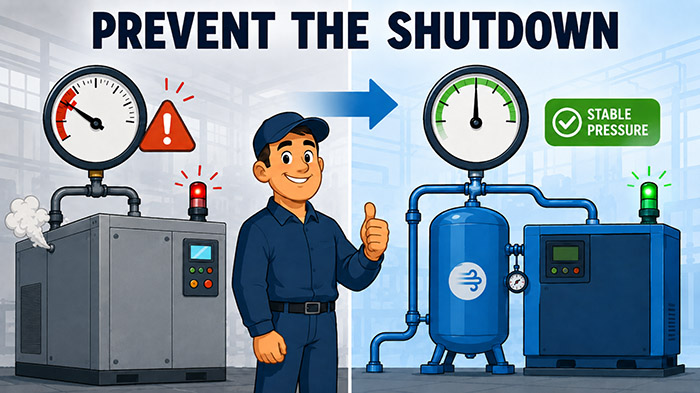
Fig. 1. Energy efficiency is not usually the primary benefit identified in a compressed air audit. Reliability is usually the most important aspect of a healthy compressed air system.
Ron Marshall/ai generated

During the audit, vibration measurements revealed another concern. One compressor showed signs of a developing mechanical problem that could eventually cause an unexpected shutdown. Instead of waiting for the compressor to fail, Mark scheduled repairs during a planned weekend outage. The work was completed without interrupting production.

The final report included familiar energy recommendations such as repairing leaks, improving compressor sequencing, and reducing unnecessary pressure. It also included a new section titled “Reliability Benefits.” That section explained how the improvements would stabilize pressure, reduce machine alarms, prevent emergency maintenance, improve product consistency, and lower the risk of production interruptions. It gave Mark a much stronger business case than energy savings alone.

The plant replaced the restrictive filter, improved the piping connection, added local storage, and adjusted the compressor controls. Within weeks, the nuisance alarms disappeared and the production line operated more consistently. Electricity use also fell, but that was not the result Mark valued most. He was more impressed by the reduction in emergency calls, operator complaints, and unexplained production delays.

For many years, compressed air audits were promoted mainly as energy-saving projects. That view is changing because compressed air is not simply another utility cost. It is a critical production service. Modern audits should still calculate kilowatt-hours and annual savings. They should also evaluate pressure stability, equipment condition, maintenance risk, production impact, and the consequences of system failure.

The best compressed air audit may not be the one that finds the largest energy savings. It may be the one that prevents the next shutdown.


Filed Under: Air Compressors, Air Preparation, Components, Compressed Air Technologies, Pneumatic Tips


About The Author

Paul Heney

Current Digital Issue

Fluid-Power-World-November-2026-issue-Cover-feature-image-template-copy

A note from the editor This issue takes a look at some of the practical challenges engineers face when designing, maintaining and troubleshooting fluid power systems. Our Design Notes feature explores the particularly harsh environment of tunnel boring machines, where moisture and contamination can quickly become reliability problems. Eaton’s filtration expert weighs in here on…

View Back Issues

Subscribe!

Fluid Power World is written by engineers for engineers engaged in designing machines and or equipment in Off-Highway, Oil & Gas, Mining, Packaging, Industrial Applications, Agriculture, Construction, Forestry, Medical and Material Handling. Fluid Power World covers pneumatics, mobile hydraulics and industrial hydraulics.

Fluid Power Design Guides

fluid
“fpw
EXPAND YOUR KNOWLEDGE AND STAY CONNECTED
Get the latest info on technologies, tools and strategies for Fluid Power Professionals.

RSS feed: Featured White Papers Featured White Papers

  • Moving fluid power forward
  • High-force linear motion: How to convert from hydraulic cylinders to electric actuators and why.
  • A technical comparison: Performance of pneumatic cylinders and electric rod actuators
Fluid Power World
  • Hose Assembly Tips
  • Mobile Hydraulic Tips
  • Pneumatic Tips
  • Sealing & Contamination Control Tips
  • About us
  • Contact Us

Copyright © 2026 Arrowfly LLC. All Rights Reserved. The material on this site may not be reproduced, distributed, transmitted, cached or otherwise used, except with the prior written permission of Arrowfly
Privacy Policy | Advertising | About Us

Search Fluid Power World

  • Home
  • Technologies
    • Hydraulics
      • Cylinders & Actuators
      • Filtration/Contamination Control
      • Fittings, Couplings & Adapters
      • Fluids
      • Fluid Conditioning
      • Hose & Tubing
      • Pumps & Motors
      • Related Technologies
      • Sealing
      • Sensors & Gauges
      • Valves & Manifolds
    • Pneumatics
      • Air Preparation & Regulation
      • Compressed Air Technologies
      • Cylinders & Actuators
      • End Effectors & Grippers
      • Fittings, Couplings & Adapters
      • Hose & Tubing
      • Sensors
      • Vacuum
      • Valves & Manifolds
  • Engineering Basics
  • Trending
  • Resources
    • Digital Issues
    • Pneumatics Tech Toolbox
    • Podcasts
    • Special Reports
    • Subscribe to Fluid Power World Print Magazine
    • Videos
    • Webinars / Digital Events
    • White Papers
  • Women in Engineering
    • Women in Fluid Power
    • Women in Engineering
  • Design Guides
  • Classrooms
    • Hydraulic Filtration
    • Hydraulic System Design
    • Pneumatics Classroom
  • Advertisers
    • Advertise
    • PR Submissions
    • Eblast Submissions
  • SUBSCRIBE