
By Josh Cosford, Contributing Editor
“With great power comes great responsibility,” could not be any truer of hydraulics. These wise words, first penned by Voltaire (and not Peter Parker’s uncle Ben), warn us fluid power professionals that the highest power density mechanical transmission method should be respected for its potential to cause harm.
High-pressure injection injuries are perhaps the most nefarious danger in hydraulics. Although not as immediately lethal as some other dangers, when a high-pressure jet of hydraulic oil penetrates your skin, the subsequent horror could disfigure you for life. Injection injuries occur when a pinhole leak creates a mini waterjet that can slice through or into your body with ease.
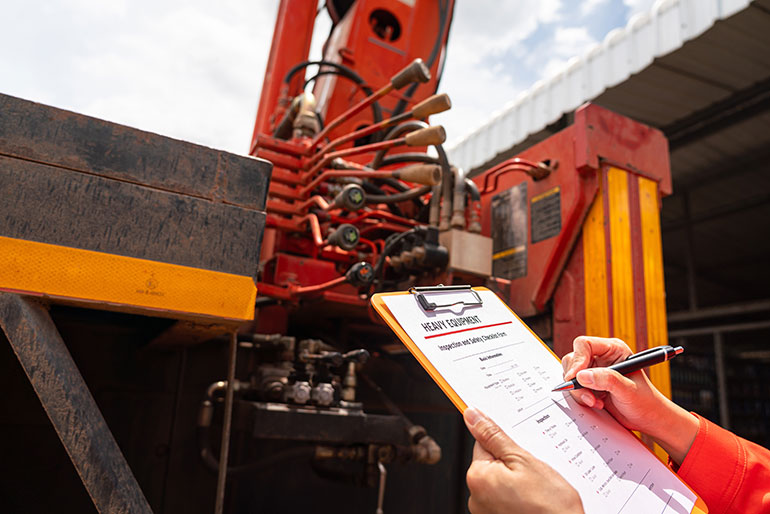
hydraulics operate at high pressures that if released accidentally, can cause serious harm. It is crucial to follow proper safety steps when dealing with pressure loss.
Hydraulic fluid injection injuries most frequently occur on the hand as mechanics and technicians touch or brush up against an unknown pinhole leak, which can be hard to see. Even gloves don’t stand a chance against a 3,000 psi liquid laser. If you’re feeling brave, search Google images for “hydraulic oil injection wound” to see why this is so dangerous (warning: not for the queasy). To prevent this, use visual inspection methods such as fluorescent dyes, and never touch the spray from a fitting, hose or other component.
A sudden and catastrophic failure of a hose or fitting poses a similar risk for injection but may also allow the sudden movement or drop of a load, such as a bucket, boom, or platform. Although modern machines will use counterbalance or check valves to prevent dropped loads, older machines may not be so equipped. Avoid operating under a hydraulically locked machine, and instead, use physical supports as support. And again, do not try to stop the escaping fluid with your hands. Just because it looks like a leaking garden hose doesn’t mean it won’t slice your hand in twain.
When working on machines, always eliminate stored or potential energy. Working under a machine supported only by hydraulics could result in the previous scenario, where loads may drop onto the mechanic. Even when locked out, a machine may still store potential energy simply by its mass, creating trapped pressure with the potential for harm. An elevated load creates a similar pressure profile as a hydropneumatic accumulator, and you must be sure to dump stored energy back to tank using the safety valves all accumulators should have installed.
Stored hydraulic energy can travel unpredictably through the hydraulic system, even backwards, where it can damage sensitive components or cause unintentional movement. Well-designed systems will have provisions and circuitry to prevent any drama, but again, you never know who designed or built an old machine. Always verify that sources of potential energy are neutralized.
And if you think a jet of hydraulic fluid is dangerous, you should see a hydraulic flame thrower. Hydraulic oil, being a hydrocarbon, is flammable, and especially so when it’s atomized, as when it’s spat out under high pressure from a leak. Despite the mostly metal construction of hydraulic machinery, they can quickly turn into enormous fireballs in the right conditions. Be sure to keep open flame away from machines using mineral oil-based fluid, especially while the machine is running. For machines operating near open flame or around molten metal, special fire-resistant hydraulic fluid must be used.
Because of the power potential of hydraulic machines and the unique nature in which they operate, you must take care to avoid dangerous designs and habits. Always keep in mind the potential dangers of a hydraulic machine so you never become complacent with safety.
Filed Under: Components, Engineering Basics, Fluids, Hose & Tubing
