Fluid Power World

  • Home
  • Technologies
    • Hydraulics
      • Cylinders & Actuators
      • Filtration/Contamination Control
      • Fittings, Couplings & Adapters
      • Fluids
      • Fluid Conditioning
      • Hose & Tubing
      • Pumps & Motors
      • Related Technologies
      • Sealing
      • Sensors & Gauges
      • Valves & Manifolds
    • Pneumatics
      • Air Preparation & Regulation
      • Compressed Air Technologies
      • Cylinders & Actuators
      • End Effectors & Grippers
      • Fittings, Couplings & Adapters
      • Hose & Tubing
      • Sensors
      • Vacuum
      • Valves & Manifolds
  • Engineering Basics
  • Trending
  • Resources
    • Digital Issues
    • Pneumatics Tech Toolbox
    • Podcasts
    • Special Reports
    • Subscribe to Fluid Power World Print Magazine
    • Videos
    • Webinars / Digital Events
    • White Papers
  • Women in Engineering
    • Women in Fluid Power
    • Women in Engineering
  • Design Guides
  • Classrooms
    • Hydraulic Filtration
    • Hydraulic System Design
    • Pneumatics Classroom
  • Advertise
  • SUBSCRIBE

The mystery of the vanishing pressure: A survival guide

By Paul Heney | June 5, 2026

Share

Joe stood in the middle of his plant, watching a critical machine sputter to a halt. His operator pointed at the gauge, which read 25 psi lower than the compressor’s display in the back room. To fix it, Joe did what most managers do: he bumped up the discharge pressure at the source. This boosted up the compressor room pressure, yet the machines were still struggling for air. Joe was battling an invisible thief known as pressure drop, and he was losing the fight.

Pressure drop is the reduction in air pressure from the compressor’s discharge to the actual point-of-use. In a perfect world, your system should lose much less than 10% of its pressure along the way. However, many plants suffer from overly high pressure where the compressors are forced to do extra work just to overcome internal friction.
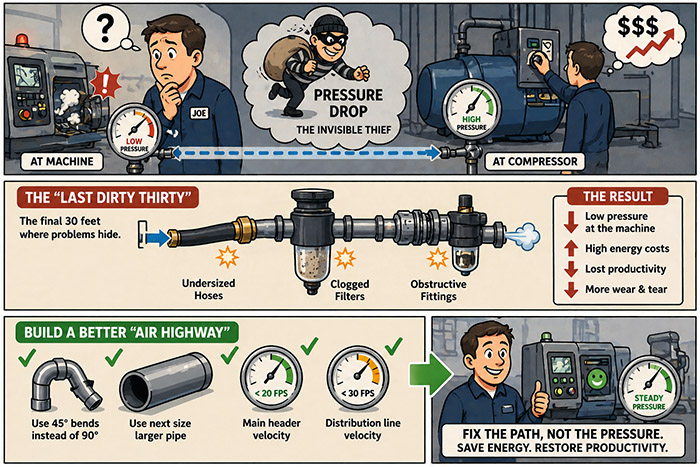
Fig. 1. These are important tips in keeping your compressed air energy costs low and your pressure free of fluctuations caused by changing flows. The highest pressure loss in a plant is usually within the last 30 feet of piping and feed components.

This is a costly mistake because, for every 2 psi increase in discharge pressure, your energy consumption climbs by approximately 1%. When you crank up the pressure to compensate for a drop, you aren’t just wasting power; you are also feeding every leak in the building even faster.

When Joe started investigating, he realized the problem wasn’t the large compressor, it was the “Last Dirty Thirty.” This term, popularized by compressed air industry experts, refers to the final 30 feet of piping, hoses, and filters before the air reaches the machine. This is where the most significant bottlenecks occur.

Common culprits causing significant pressure drop include:

  • Undersized hoses: Using a small-diameter hose for a high-flow tool chokes the supply.
  • Clogged filters: Dirty filter elements create high resistance that forces the compressor to work harder.
  • Obstructive fittings: Quick-disconnects and lubricators are often sized for average flow rather than peak demand, leading to unintended pressure loss.

Fixing pressure drop requires a shift in how we design the “air highway.” Think of your piping like a transit system; every sharp turn and narrow lane causes a traffic jam. Instead of using standard 90° elbows, the Compressed Air Challenge recommends using 45° angles and wide-radius curves to keep air moving smoothly.

Velocity control is also vital for efficiency. A well-designed system keeps air speed under 20 feet per second in the main header and under 30 feet per second in distribution lines. Investing in the next size larger pipe during installation might cost slightly more in materials, but the long-term energy savings are immense.

Joe eventually stopped fighting his compressor and started looking at his pipes and components. By replacing a few clogged filters and rightsizing his “Last Dirty Thirty,” he restored his plant’s productivity without spending a fortune on electricity.

Don’t let your profits vanish into thin air; a more efficient system is often just a few smart adjustments away. Next time your pressure fails, examine the path the air is taking before you reach for the control panel.


Filed Under: Air Compressors, Air Preparation, Components, Compressed Air Technologies, Engineering Basics, Pneumatic Tips


About The Author

Paul Heney

Current Digital Issue

Fluid-Power-World-October-2026-issue-Cover-feature-image-template-copy

  A note from the editor In our October issue of Fluid Power World, my commentary takes a look at the growing role of automation and sensors in mobile machinery, where OEMs are increasingly focused on automating specific functions and improving machine performance rather than chasing fully autonomous equipment. Josh Cosford gets cheeky comparing the auto…

View Back Issues

Subscribe!

Fluid Power World is written by engineers for engineers engaged in designing machines and or equipment in Off-Highway, Oil & Gas, Mining, Packaging, Industrial Applications, Agriculture, Construction, Forestry, Medical and Material Handling. Fluid Power World covers pneumatics, mobile hydraulics and industrial hydraulics.

Fluid Power Design Guides

fluid
“fpw
EXPAND YOUR KNOWLEDGE AND STAY CONNECTED
Get the latest info on technologies, tools and strategies for Fluid Power Professionals.

RSS feed: Featured White Papers Featured White Papers

  • Moving fluid power forward
  • High-force linear motion: How to convert from hydraulic cylinders to electric actuators and why.
  • A technical comparison: Performance of pneumatic cylinders and electric rod actuators
Fluid Power World
  • Hose Assembly Tips
  • Mobile Hydraulic Tips
  • Pneumatic Tips
  • Sealing & Contamination Control Tips
  • About us
  • Contact Us

Copyright © 2026 Arrowfly LLC. All Rights Reserved. The material on this site may not be reproduced, distributed, transmitted, cached or otherwise used, except with the prior written permission of Arrowfly
Privacy Policy | Advertising | About Us

Search Fluid Power World

  • Home
  • Technologies
    • Hydraulics
      • Cylinders & Actuators
      • Filtration/Contamination Control
      • Fittings, Couplings & Adapters
      • Fluids
      • Fluid Conditioning
      • Hose & Tubing
      • Pumps & Motors
      • Related Technologies
      • Sealing
      • Sensors & Gauges
      • Valves & Manifolds
    • Pneumatics
      • Air Preparation & Regulation
      • Compressed Air Technologies
      • Cylinders & Actuators
      • End Effectors & Grippers
      • Fittings, Couplings & Adapters
      • Hose & Tubing
      • Sensors
      • Vacuum
      • Valves & Manifolds
  • Engineering Basics
  • Trending
  • Resources
    • Digital Issues
    • Pneumatics Tech Toolbox
    • Podcasts
    • Special Reports
    • Subscribe to Fluid Power World Print Magazine
    • Videos
    • Webinars / Digital Events
    • White Papers
  • Women in Engineering
    • Women in Fluid Power
    • Women in Engineering
  • Design Guides
  • Classrooms
    • Hydraulic Filtration
    • Hydraulic System Design
    • Pneumatics Classroom
  • Advertise
  • SUBSCRIBE