
At the NFPA’s IEOC back in August, the association brought together leaders from OEMs and market intelligence for a panel discussion on what the future holds for mobile machinery and the part hydraulics will play. Integrated systems were a huge part of the discussion, but where this discussion led revealed that OEMs are not really looking to build a completely autonomous machine. It’s more about where they can automate functions and use sensors to ensure more reliable, efficient operations.
On stage were Ethan Roth, senior project engineer from Vermeer Corp.; Ryan Jenkins, hydraulics systems innovation engineer at CNH; and Alastair Hayfield, vice president, commercial vehicles with Interact Analysis. They discussed everything from labor dynamics to smart tech and automation to economic pressures impacting the market. But they kicked things off by discussing the driving forces behind many of the changes coming to machinery and how those changes — sometimes simple system designs — can ensure fluid power’s continued future in mobile machinery.
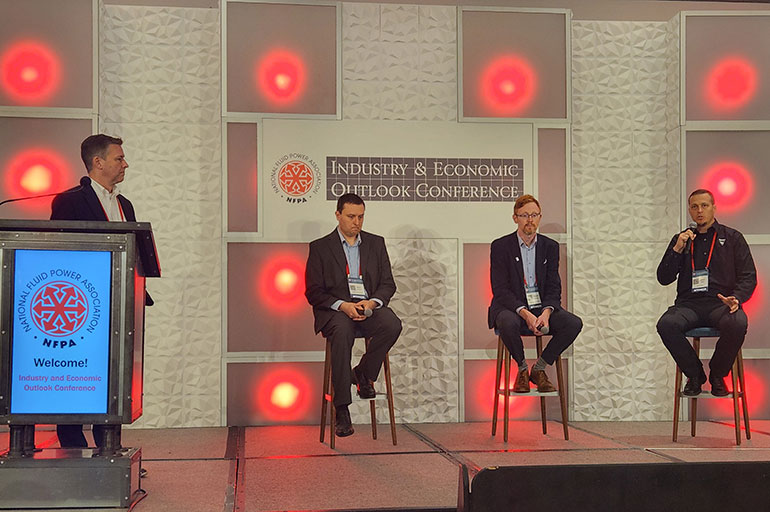
Ethan Roth, senior project engineer from Vermeer Corp.; Ryan Jenkins, hydraulics systems innovation engineer at CNH; and Alastair Hayfield, vice president, commercial vehicles with Interact Analysis, discussed the mobile hydraulics market, talking in-depth about autonomous machines, at the NFPA IEOC in August.
For example, practical automation is taking precedence over completely autonomous machines. Jenkins highlighted an application in agriculture where using sensors in a new way improved output and performance on a CNH combine. “Adding sensors to the header tells us what’s happening with the grain. At first glance, that might not necessarily be related to the hydraulic systems on the machine, but it is used to live-tune what we are doing in terms of the feeder’s real speeds, and how much you need to adjust your plates and all of the processes in the combine, the majority of which are controlled with fluid power,” Jenkins said.
Using these sensors, users can adjust processes, which in turn maximizes the quality of the grain that’s going through the machine. Using these sensors in conjunction with pressure and speed sensors helps operators to understand every aspect of the product coming through the machine.
Jenkins added that you can find similar examples in construction machinery as well. Integrating similar sensor systems into pumps, valves and cylinders gives users a better idea of how much load they may have in their bucket, for example. “It’s not just the hydraulic sensors, it’s other things working with the fluid power product,” he said.
Roth noted how important it is to know how your hydraulic system is performing. Guaranteeing accuracy, precision and repeatability in your hydraulic systems ensures all systems work together. “Automation, precision and accuracy is going to have to continue to rise with the speed and efficiency of whatever system you’re developing,” Roth said. “That systems engineering approach and understanding it through the entire system, that’s where hydraulics are still important. You can take the best control system you want, but if you don’t know what your hydraulics are doing — if you don’t know what your accuracy and precision are — you might as well throw the control system away.”
He described an application where sensors helped to automate just one operation on a four-directional horizontal drill from Vermeer. Here, they automated the process of drilling a hole and inserting a rod into the ground. The sensors and controls mean it’s much easier to train the operator on this function. As Roth noted, it’s easier to learn how to push one button than to understand how the entire process works.
Hayfield noted that there’s much hype about fully autonomous machines and replacing operators, but found both Roth’s and Jenkins’ machine examples eye-opening. “The reality is we’re a very long way from all that. It’s pleasing to hear that OEMs are focusing on actual customer-led solutions. It’s part of a machine process, a part of a task that can be automated. It’s a great win for the customer,” Hayfield said. “There needs to be more focus on that — the product development process is talking with customers, talking with end users, to determine what can be solved in an easy and step-by-step process, as opposed to trying to jump to a fully autonomous machine.”
I believe more than ever that we need to stop taking the human out of the equation, so this was a delightful reminder that we still matter.
What about you? Where do you see a need in your systems or machines for automation, and where are you happy to go without it?
Filed Under: Electrification, EV Engineering, News, Technologies, Trending
