
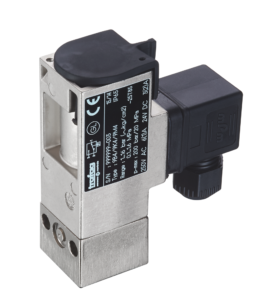
 Trafag highlights its Picostat family of mechanical pressure switches, which includes three models: the PST4B 9B4, PST4M 9M4 and PST4K 9K4. These switches are designed to provide repeatable switching performance in hydraulic applications. Each Picostat model uses a different mechanical sensing principle suited to specific pressure dynamics and media conditions, allowing hydraulic system designers to select the appropriate switch technology for return lines, supply circuits, pilot lines and high-pressure actuation stages.
The PST4B 9B4 uses a bellows measuring principle and is designed for vacuum, low and medium pressure ranges from −0.6…3.4 to 4…40 bar (−8…45 to 60…500 psi). It has an overpressure capability up to 50 bar, repeatability of ±0.5% FS typical, fixed switching differentials and an adjustable switch point range of 10…90% FS on request. The device supports media temperatures from −25…+125 °C, with options down to −40 °C for specific sensor versions, and can be used in tank lines, low-pressure circuits, auxiliary hydraulic functions and cooling or filtration loops.
The PST4M 9M4 uses a membrane measuring principle for pressure sensing in hydraulic and other media across medium to high pressure ranges from 1…10 to 10…100 bar (14…150 to 150…1500 psi). It has repeatability of ±2.0% FS typical, fixed switching differentials for each range and an adjustable switch point window of 10…90% FS on request. The device operates within a media and ambient temperature range of 0…+80 °C and has an anodized aluminum EN AW 6082 housing. It can be used in industrial and mobile hydraulic systems such as power packs, presses, clamping circuits, lifting equipment and general-purpose machinery.
The PST4K 9K4 uses a piston measuring principle with a 1.4035 piston and PTFE sealing for high-pressure and pulsating hydraulic media. It covers pressure ranges from 1…10 to 40…400 bar (14…150 to 580…5800 psi), with overpressure capability up to 600 bar (8700 psi), depending on the range. The device has repeatability of ±1.0% FS typical, fixed switching differentials for each range and an adjustable switch point range of 10…90% FS on request. It supports media temperatures from −25…+125 °C and ambient temperatures from −25…+85 °C, and can be used in applications such as injection molding machines, heavy mobile machinery and high-pressure actuator circuits.
All three Picostat switches share common installation and connectivity features. They provide an output signal through a floating changeover contact (SPDT), which allows integration into existing control circuits without additional interface relays. The switches use a standardized EN 175301-803 A (DIN 43650 A) plug connection and are specified for protection up to 95% relative humidity. Each model has a compact IP65-rated housing, vibration resistance up to 5 g, shock resistance of 50 g for 3 ms and can be installed in any mounting position. These features make them suitable for applications such as power units, manifolds and mobile hydraulic platforms.
The Picostat portfolio includes multiple pressure connection options and mounting accessories such as a flange with O-ring, fixing set, covering cap and lead seal for panel mounting and on-site installation. Depending on the model, available sensor options include bronze bellows with aluminum or brass housings and stainless steel bellows for the 9B4, FKM membrane sensors with anodized aluminum housings for the 9M4 and piston sensors with PTFE sealing for the 9K4. These options allow material selection based on media and corrosion requirements.
Across the range, approvals and conformity may include ABS, BV, CCS, DNV GL, KRS, LR or LRS, NKK where applicable, RINA and RMRS for the 9B4, as well as EN 60730-1 / 2-6 Type 2.B.H. These certifications support use in marine and safety-related applications, including shipbuilding and OEM projects. The Picostat models use different sensing mechanisms within a common interface and vibration-resistant design, allowing engineers to select a switch based on specific pressure dynamics while maintaining installation consistency across systems.
Trafag Inc.
www.trafag.com
Filed Under: Featured, Industry News, Pressure Sensing