
Danfoss Power Solutions recently released what it is calling its most advanced Vickers by Danfoss medium-pressure axial piston pump, engineered to deliver a new level of efficiency, performance, and system flexibility. Designed to meet the evolving needs of industrial machinery, the new PVMX pump offers substantial advancements over previous model series and competitive products. Initially available in a 28-cc displacement, the PVMX Axial Piston Pump combines high dynamic performance, low energy consumption, and a smart control architecture.
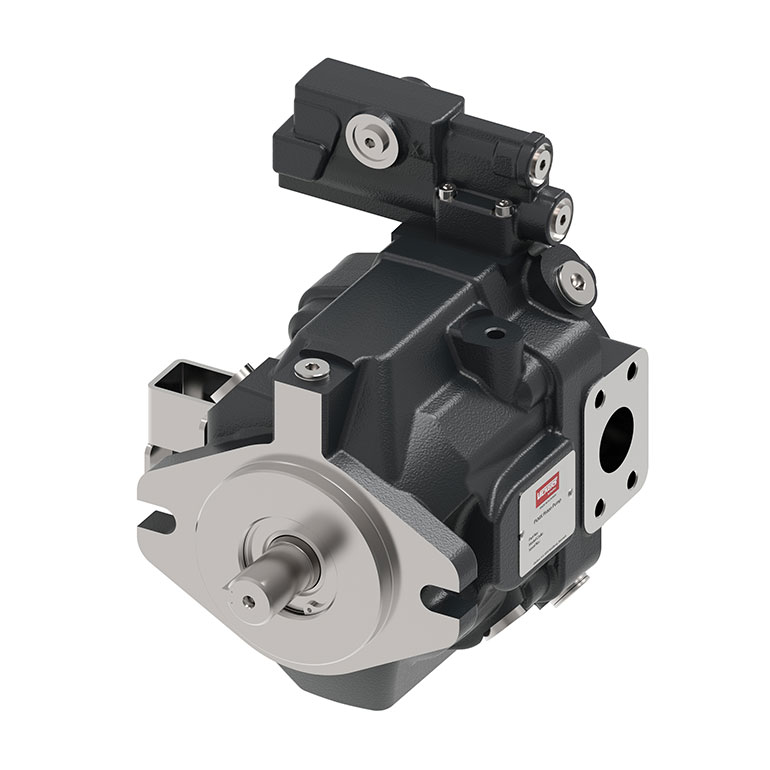
Vickers by Danfoss PVMX Axial Piston Pump 028cc (Front)
A range of high-performance ratings puts the PVMX pump at the top of its class, delivering significant efficiency and operational benefits. Danfoss says it features a continuous operating pressure of up to 350 bar, enabling greater power density, reduced actuator size, and minimized system stress. Its rated rotational speed of 3,800 rpm is matched for high-speed servo motor applications requiring fast response and frequent cycling. Furthermore, it operates with impressively low noise levels, achieving as low as 72 dB(A) (at 280 bar and 3,000 rpm), making it ideal for acoustically sensitive environments. These capabilities support quieter machines, faster response times, and compact hydraulic power units.
These high-performance specifications, combined with the pump’s ability to operate in two-quadrant mode, further expand the range of suitable applications. Designed for operating in reverse flow condition without complex valving, the pump allows the flow direction to be reversed by either reversing the direction of the servo motor or utilizing the pump’s over-center design. This simplifies system architecture while enabling advanced motion control functions such as fast actuator retraction, controlled deceleration, and pressure relief cycles.
In a discussion with Fluid Power World, Harshal Kokalekar – Product Manager – Industrial Piston Pumps and Motors, highlighted two applications which are anticipated to benefit from the flow reversing capability.
Injection Molding Machine – Fast Retraction & Cycle Time Reduction
Challenge:
Injection molding machines require fast retraction of the injection or clamping cylinder to minimize cycle time and increase productivity.
Solution:
By using an open circuit piston pump with over-center capability, the retraction phase can be greatly accelerated.
- When the cylinder needs to retract, the swashplate should be moved over center.
- The electric motor continues running in the same direction.
- The pump allows high flow at low pressure drop, enabling quick retraction without complex valving.
Benefits:
- Faster cycle times = higher production output
- Lower energy usage during retraction
- Simplified hydraulic circuit (no need for directional or dump valves)

Vickers by Danfoss PVMX Axial Piston Pump 028cc (Side)
Hydraulic Press – Gravity-Based Retraction with Energy Recuperation
Challenge:
Heavy-duty presses often have large rams that retract slowly or inefficiently. Energy is usually lost as fluid is dumped to tank.
Solution:
In a vertical hydraulic press with a gravity-retracting cylinder, the over-center pump provides a path for controlled flow and enables energy recovery:
- The weight of the press head pushes fluid back through the over-centered pump.
- The pump is now driven by the actuator and acts as a hydraulic motor.
- The connected electric motor becomes a generator, feeding energy back to the system.
Benefits:
- Energy recovery (KERS-style) from gravity-driven motion
- Reduced energy waste during retraction
- No need for a bidirectional electric motor — one direction is enough!
In servo-hydraulic applications such as injection molding, die casting, or vertical presses, the pump’s ability to facilitate energy recovery plays a transformative role. During operations like mold retraction or gravity-assisted movements, the actuator’s reverse flow is efficiently routed through the pump. In this mode, the actuator drives the pump mechanically; the pump, in turn, drives the motor, and the motor acts as a generator, feeding electrical energy back into the system. This process enables true regenerative braking and substantial energy savings, reducing the load on the main motor drive and minimizing system heat.
“In a conventional hydraulic power unit, a fixed-displacement axial piston pump is driven at a constant rotational speed, resulting in continuous energy consumption regardless of load demand. By contrast, a configuration incorporating a variable frequency drive (VFD) and a high-speed variable-displacement axial piston pump enables dynamic adjustment of pump speed and displacement to match real-time system requirements,” Kokalekar said. “This adaptive control strategy can reduce energy consumption by up to 80%, depending on the load profile and duty cycle of the application.”

Vickers by Danfoss PVMX Axial Piston Pump 028cc (Rear)
Compared to traditional fixed-speed pump systems, this servo-driven pump can achieve energy savings of up to 80%, depending on the duty cycle. Several factors drive this efficiency: the pump operates only when needed (eliminating idle losses), higher speeds enable the use of smaller electric motors, energy recuperation during deceleration offsets input power demands, and reduced cooling requirements lower heat generation. The result is a significant reduction in overall power consumption, leading to lower operating costs, a reduced carbon footprint, and improved compliance with energy efficiency directives.
“Industry trends show a growing shift toward VFD-controlled hydraulic systems, driven by the demand for higher energy efficiency and reduced environmental impact. In such systems, high-speed variable-displacement pumps allow both rotational speed and displacement to be precisely matched to real-time flow and pressure requirements. This control strategy enables the pump to operate within its optimal efficiency range across a wide spectrum of duty cycles, minimizing energy losses associated with overproduction of flow,” said Kokalekar. “The PVMX pump, rated for 350 bar and a maximum speed of 3,800 rpm, is engineered for these high-performance applications. By maintaining high operating efficiency, these systems lower overall power consumption, which in turn reduces factory CO₂ emissions and supports sustainability goals.”
Supporting speeds up to 3,800 rpm, a 35% increase over previous Vickers by Danfoss medium-pressure pumps, the PVMX is optimized for next-generation servo motor-driven architectures. This synergy allows for faster machine cycles and dynamic response, in addition to enabling the downsizing of motors and drive electronics and simplifying system layouts. This improved controllability leads to increased productivity and precision for high-precision applications in plastics, forming, test stands, and mobile machinery.
Kokalekar explained that increasing the pump’s operating speed directly increases the volumetric flow rate, thereby reducing cycle times. “Since flow rate Q is a function of pump displacement D and rotational speed N ((Q = D x N), the same flow requirement can be met by selecting a smaller‑displacement pump operating at higher speed, as opposed to a larger‑displacement pump running at lower speed. This approach can optimize system size, weight, and cost while maintaining the required hydraulic performance,” he said.
“Selecting a smaller‑displacement axial piston pump and operating it at higher speeds can also contribute to improved energy efficiency. When combined with variable speed control, the smaller pump can operate closer to its optimal efficiency range and reduce idle losses by matching output to real‑time demand,” Kokalekar said. “Energy savings are most significant in applications with variable load profiles, where the pump can slow down during periods of low demand. However, careful consideration must be given to permissible operating speed, mechanical wear, and hydraulic losses to ensure long‑term efficiency and reliability.”
Built in compliance with ISO and SAE interface standards, the PVMX offers a full range of control options, including pressure compensation, load sensing, and dual displacement, with more planned for future release. Multiple drive shaft and through-drive configurations, as well as various mounting flanges and porting arrangements, are also available. This flexibility enables OEMs to design or retrofit systems with minimal customization, accelerating time-to-market and simplifying inventory management.
“Compact, efficient, and smart, the PVMX contributes to smaller system footprints, lower cooling requirements, and reduced installed motor power. This innovative pump empowers OEMs and system designers to meet future sustainability targets while simultaneously increasing throughput and reducing the total cost of ownership,” said Yuanjin (Stein) Wang, Global Product Management Director, Pumps and Motors, Industrial division, Danfoss Power Solutions.
Danfoss Power Solutions
danfoss.com
Filed Under: Components, Pumps & Motors
