
By Josh Cosford, Contributing Editor
Hydraulic brakes are a specific fluid power application so well-suited to their purpose that I find it difficult to imagine being replaced by any other force transfer method. Hydraulic brake technology has been used in its current form for decades, and small changes in only the control method have changed over the years.
Let’s be clear that hydraulic brakes provide the preferred arresting method for machinery above and beyond that of vehicles, although it makes a great starting point for this discussion to cover how hydraulics are the number one choice for cars, trucks and self-powered machinery.
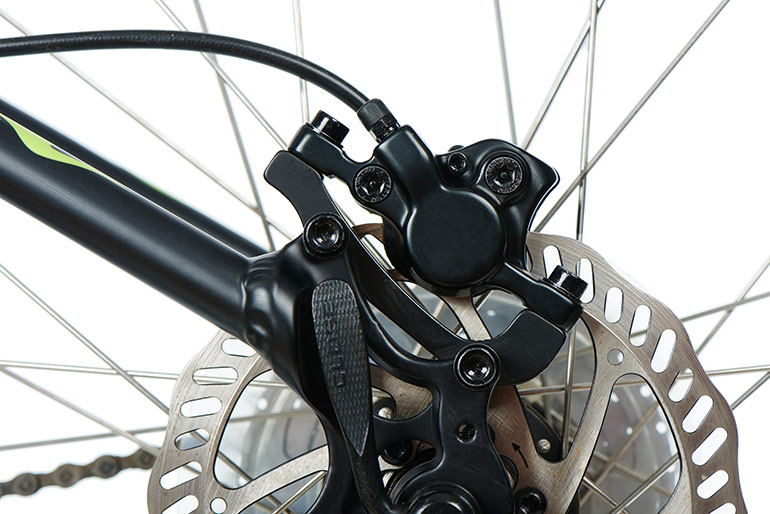
Hydraulic disk brakes are the preferred method on self-powered machinery like bicycles.
Compared to mechanical braking methods, the force multiplication effect of hydraulic brakes enables powerful braking capacity with less user input force. A mechanical braking method using cables or levers is only really possible with lightweight vehicles, such as go-karts. With added mass comes added inertia, and any combination of vehicle and human mass above a few hundred pounds can take advantage of hydraulic brakes.
In simple terms, hydraulic pumps and actuators act as force multiplication systems similar to gears or levers, as you trade distance for force. On a vehicle, this means a 2-in. pedal travel, for example, can increase pedal force 16 times when the brake pad only moves 1/8 of an inch. Twenty pounds of leg effort will translate into 320 lb of braking force. Modern vehicles are equipped with brake boosters that utilize vacuum to amplify output pressure further, working much like an air-over-hydraulic pump.
Such systems take advantage of the smooth and progressive nature of hydraulics, which provides progressive physical resistance for the operator based on braking effort. This “feel” is also why hydraulic braking systems are used exclusively in race cars. In fact, hydraulic brakes will pair with bias valves that allow racing drivers to direct braking effort fore and aft, thereby changing the overall balance for different tracks or even different corners.
Although rarely considered during your daily commute, hydraulic brakes also ensure even pressure at all four corners, which makes a vehicle reliable and controllable. Valves can “pump” the brake pedal in emergencies to prevent wheel lockup, and any brake pad wear is automatically compensated for, requiring no physical adjustments.
For industrial applications, hydraulic brakes remain the number one choice, especially where reliability and safety are the top priorities. Mine hoists, for example, are critical for moving persons and equipment down to extreme depths below the surface, some of which can be well over a mile deep, and hauling hundreds of thousands of pounds.

Standard and custom hydraulic brake packages from Twiflex are designed to meet the static holding and dynamic (emergency) stopping duty requirements of many types of applications, including elevators, ship loading gantry cranes, escalators, metal mill ladle cover hoists, amusement rides, conveyors,
When so much is at stake, the braking systems must be both powerful and reliable. It may require over a hundred tons of clamping force to ensure a mine hoist decelerates quickly and remains in position. Like many braking systems, mine hoist brakes are spring-applied and hydraulic release, which ensures the default condition is also the safest condition.
Compared to pneumatic brakes, hydraulic brakes are much more compact. The compact actuator sizes allow for more versatile installation options, as well as reduced power consumption when comparing a hydraulic power unit to an air compressor of equal braking capacity. Hydraulic brakes also offer precise and instantaneous pressure adjustments. Frequent partial application and feathering is accurate and in real-time using measurements of back pressure, hoist velocity and deceleration rate, ensuring target deceleration is precise regardless of load, direction of travel and even partial system failures.
With so many benefits and so few downsides, it’s unlikely that hydraulic brakes will be replaced by any emerging technology soon, including electric actuation. A technology’s life cycle can be judged by how quickly it’s replaced with modern technology in everyday items. Consider that hydraulic brakes have only recently permeated the bicycle industry, and you’ll quickly understand that this technology is nowhere near its peak.
Filed Under: Components, Related Technologies
