
When I first got my start in hydraulics some twenty years ago, I thought the priority-type flow control was the bee’s knees. It’s pressure-compensated on the priority port and can dump any remaining unused fluid to tank or to an auxiliary hydraulic function through the bypass port. Priority-type flow controls are sometimes referred to as flow dividers, as they can crudely split incoming pump flow in nearly any ratio.
Priority-type flow control valves are perfect for machinery with variable pump flow, such as with tractors, transmission-mounted pumps, or small engines. So long as pump flow exceeds the priority setting, downstream flow remains steady despite fluctuations in either load pressure or engine RPM.
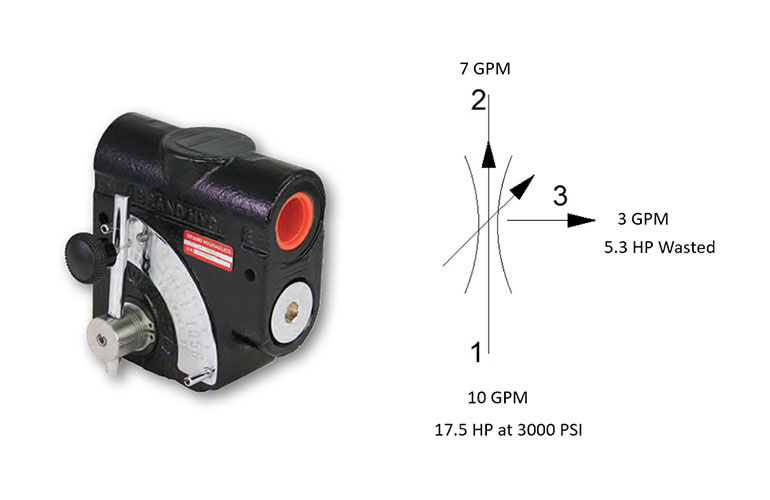
Figure 2. Priority type flow control
The valve uses a compensator to maintain a constant pressure drop across a variable orifice, ensuring the flow rate remains stable despite load or flow fluctuations. The compensator is often a spool that senses pressure before and after the orifice. Should downstream pressure rise, the pressure drop across the orifice decreases, so the spool shifts to open the flow path, stabilizing the pressure drop. If downstream pressure drops, instead of the increased pressure drop allowing more flow, the compensator spool closes, once again reducing the pressure differential to the factory setting.
Some cartridge valve manufacturers allow you to select the spring pressure value of their compensators to achieve the desired pressure drops and flow rates for your system. The type of lever-operated valve you see most, however, has a fixed spring value.
Nevertheless, it’s important to know that if you rely on the secondary (bypass) port, it only provides flow when the pump input exceeds the priority setting. You can choke back the priority flow or simply get a larger pump, but be sure to select the valve with the lowest flow rating suitable for your application. Selecting the 30 gpm valve when you only need 8 gpm leaves you with a massive deadband on the valve, where only 20-30° of lever rotation has any effect on the controlled flow.
Also remember that the controlled flow port may be pressure compensated, but the secondary port is not. The 3rd port simply receives the leftover fluid. In fact, you may even see unstable flow from the secondary port while the priority port enjoys the benefits of pressure compensation. Be careful not to use actuators that require constant flow or that operate at higher pressure than the priority port, as this could reduce controlled-flow performance.
Ideally, a priority flow control valve should send bypass flow directly to tank if you wish to maintain the most stable, pressure-compensated flow rate. But therein lies the biggest problem with priority flow control valves … the excess flow isn’t just a harmless byproduct that helps you mimic a variable displacement pump. All incoming flow counts, and it counts at the same pressure seen downstream of the priority port. Anything not being used to achieve useful work is wasted as pure heat.
You can see in Figure 1 that if we’re sending 10 gpm from the pump at 3,000 psi while only using 7 gpm downstream, you still have to “create” 17.5 hp from your prime mover, despite only using 12.3 hp at your actuator. The remaining 3 gpm is wasted as 5.3 hp of pure heat.
So, do I still love priority-type flow-control valves? You bet I do. You just have to use them correctly and be aware of their heat-generating potential. You can’t get something for nothing, so don’t waste any of that precious hydraulic oil you’re sending into it. When used properly, a priority-type flow control is a highly precise, finely tuned flow control valve.
Filed Under: News
