Fluid Power World

  • Home
  • Technologies
    • Hydraulics
      • Cylinders & Actuators
      • Filtration/Contamination Control
      • Fittings, Couplings & Adapters
      • Fluids
      • Fluid Conditioning
      • Hose & Tubing
      • Pumps & Motors
      • Related Technologies
      • Sealing
      • Sensors & Gauges
      • Valves & Manifolds
    • Pneumatics
      • Air Preparation & Regulation
      • Compressed Air Technologies
      • Cylinders & Actuators
      • End Effectors & Grippers
      • Fittings, Couplings & Adapters
      • Hose & Tubing
      • Sensors
      • Vacuum
      • Valves & Manifolds
  • Engineering Basics
  • Trending
  • Resources
    • Digital Issues
    • Pneumatics Tech Toolbox
    • Podcasts
    • Special Reports
    • Subscribe to Fluid Power World Print Magazine
    • Videos
    • Webinars / Digital Events
    • White Papers
  • Women in Engineering
    • Women in Fluid Power
    • Women in Engineering
  • Design Guides
  • Classrooms
    • Hydraulic Filtration
    • Hydraulic System Design
    • Pneumatics Classroom
  • Advertise
  • SUBSCRIBE

When should you use plastic fitting materials?

By Mary Gannon | August 1, 2025

Share

Editor’s Note: This is the fourth and final in a multi-part series on materials used in fluid power hose fittings. We will cover carbon steel, stainless steel, and brass.

By Josh Cosford, Contributing Editor

It’s hard to overstate the relevance of one of the most important inventions of all time – plastic. As you read this, you’re likely touching plastic right now: your smartphone, your office chair, your computer mouse or the synthetic clothing on your skin. Fluid power has not been immune to the disruption created by plastics, especially in pneumatics.
plastic-fitting-materials-AdobeStock_481814303

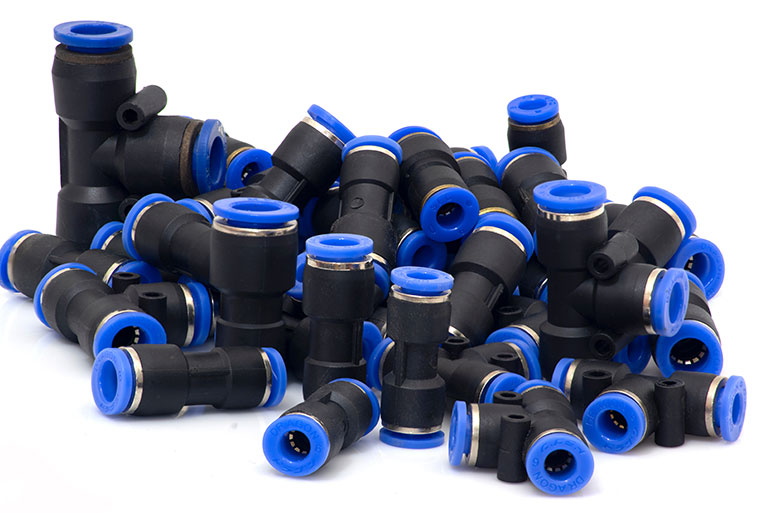
You’re going to see two types of polymers most often used for plastic fittings — nylon and PBT (polybutylene terephthalate). Although, depending on the fitting construction and application, some designs may use Delrin or polypropylene, these are less common than the push-to-connect fittings that dominate the market.

Nylon is easy to manufacture and easy to machine. High-volume nylon fittings are injection molded, and that mold will include any thread used in bushings, adapters and hose barbs. However, nylon is also very easy to machine from billets, making it suitable for custom designs or configurations, such as oddly sized ports.

Nylon is also highly economical, and even large fittings are reasonably priced. However, cost is often associated with quality, so you can only expect so much from nylon in this case. Bring relatively soft, nylon is prone to damage easily or it can develop leaks when removed and replaced frequently. For this reason, you often see nylon only used in residential or commercial applications, while less so in industrial environments.

Industrial fittings must be durable and reliable, so harder plastics and stable polymers are preferred for pneumatic push-to-connect fittings. PBT plastic is the body material of choice for all the major players in the pneumatic fitting game, as it exhibits excellent impact resistance, a wide operating temperature range and is easy to mold. Although brass and stainless steel are commonly used in pneumatic fittings, the popular on-touch fittings that connect simply by pushing a fresh, squarely cut tube into place are the hybrid model, providing the best combination of cost and functionality.

Although the body of such one-touch fittings is manufactured using PBT or polypropylene, the stud, chuck, and guide could be stainless steel or a combination of brass and nickel plating. Popular designs for the release button utilize POM (polyoxymethylene) due to its excellent balance of strength and low friction.

Plastic pneumatic fittings are an inexpensive, versatile and durable upgrade from the previous generation of brass-only fittings that required a ferrule. They’re available in all common pneumatic thread forms, from NPT to G, and most fluid power distributors will stock a variety of shapes, thread forms, and tube diameters in both imperial and metric units.

In this series on fitting materials, we’ve covered steel, stainless steel, brass and plastic, which combined, constitute the vast majority of possible fitting materials. Although pressure and application make up the primary two factors when selecting the appropriate material, ambient environment and cost also play a role. Regardless of your application, always choose the material that best suits your requirements.


Filed Under: Components, Featured, Fittings, Couplings & Adapters, Hose Assembly Tips


About The Author

Mary Gannon

Mary Gannon is editor of Fluid Power World. She has been a technical writer and editor for more than 13 years, having covered fluid power, motion control and interconnect technologies.

Current Digital Issue

Fluid-Power-World-October-2026-issue-Cover-feature-image-template-copy

  A note from the editor In our October issue of Fluid Power World, my commentary takes a look at the growing role of automation and sensors in mobile machinery, where OEMs are increasingly focused on automating specific functions and improving machine performance rather than chasing fully autonomous equipment. Josh Cosford gets cheeky comparing the auto…

View Back Issues

Subscribe!

Fluid Power World is written by engineers for engineers engaged in designing machines and or equipment in Off-Highway, Oil & Gas, Mining, Packaging, Industrial Applications, Agriculture, Construction, Forestry, Medical and Material Handling. Fluid Power World covers pneumatics, mobile hydraulics and industrial hydraulics.

Fluid Power Design Guides

fluid
“fpw
EXPAND YOUR KNOWLEDGE AND STAY CONNECTED
Get the latest info on technologies, tools and strategies for Fluid Power Professionals.

RSS feed: Featured White Papers Featured White Papers

  • Moving fluid power forward
  • High-force linear motion: How to convert from hydraulic cylinders to electric actuators and why.
  • A technical comparison: Performance of pneumatic cylinders and electric rod actuators
Fluid Power World
  • Hose Assembly Tips
  • Mobile Hydraulic Tips
  • Pneumatic Tips
  • Sealing & Contamination Control Tips
  • About us
  • Contact Us

Copyright © 2026 Arrowfly LLC. All Rights Reserved. The material on this site may not be reproduced, distributed, transmitted, cached or otherwise used, except with the prior written permission of Arrowfly
Privacy Policy | Advertising | About Us

Search Fluid Power World

  • Home
  • Technologies
    • Hydraulics
      • Cylinders & Actuators
      • Filtration/Contamination Control
      • Fittings, Couplings & Adapters
      • Fluids
      • Fluid Conditioning
      • Hose & Tubing
      • Pumps & Motors
      • Related Technologies
      • Sealing
      • Sensors & Gauges
      • Valves & Manifolds
    • Pneumatics
      • Air Preparation & Regulation
      • Compressed Air Technologies
      • Cylinders & Actuators
      • End Effectors & Grippers
      • Fittings, Couplings & Adapters
      • Hose & Tubing
      • Sensors
      • Vacuum
      • Valves & Manifolds
  • Engineering Basics
  • Trending
  • Resources
    • Digital Issues
    • Pneumatics Tech Toolbox
    • Podcasts
    • Special Reports
    • Subscribe to Fluid Power World Print Magazine
    • Videos
    • Webinars / Digital Events
    • White Papers
  • Women in Engineering
    • Women in Fluid Power
    • Women in Engineering
  • Design Guides
  • Classrooms
    • Hydraulic Filtration
    • Hydraulic System Design
    • Pneumatics Classroom
  • Advertise
  • SUBSCRIBE