Fluid Power World

  • Home
  • Technologies
    • Hydraulics
      • Cylinders & Actuators
      • Filtration/Contamination Control
      • Fittings, Couplings & Adapters
      • Fluids
      • Fluid Conditioning
      • Hose & Tubing
      • Pumps & Motors
      • Related Technologies
      • Sealing
      • Sensors & Gauges
      • Valves & Manifolds
    • Pneumatics
      • Air Preparation & Regulation
      • Compressed Air Technologies
      • Cylinders & Actuators
      • End Effectors & Grippers
      • Fittings, Couplings & Adapters
      • Hose & Tubing
      • Sensors
      • Vacuum
      • Valves & Manifolds
  • Engineering Basics
  • Trending
  • Resources
    • Digital Issues
    • Pneumatics Tech Toolbox
    • Podcasts
    • Special Reports
    • Subscribe to Fluid Power World Print Magazine
    • Videos
    • Webinars / Digital Events
    • White Papers
  • Women in Engineering
    • Women in Fluid Power
    • Women in Engineering
  • Design Guides
  • Classrooms
    • Hydraulic Filtration
    • Hydraulic System Design
    • Pneumatics Classroom
  • Advertise
  • SUBSCRIBE

When should you use stainless steel fittings?

By Mary Gannon | July 16, 2025

Share

Editor’s Note: This is the third in a multi-part series on materials used in fluid power hose fittings. We will cover carbon steel, stainless steel, brass and plastic.

By Josh Cosford, Contributing Editor

In this third installment of our four-part series on fitting materials, I discuss stainless steel. Stainless steel offers a level of corrosion resistance and reliability above and beyond carbon steel while offering strength advantages over brass. As you’d imagine, the extra benefits of stainless steel come at a cost, and that cost is cost. But let’s delve into why stainless could be worth using in your hydraulic or pneumatic machine.

When people think of products designed to resist corrosion, what’s likely to come to mind is rusting adaptors that were exposed to water, salt, and caustic chemicals. To be sure, you definitely want to mitigate the result of such harmful exposure, and that’s where stainless steel fittings make the top of the list for engineers and technicians to select. Continuous exposure to ambient conditions will surely cause carbon steel fittings to rust, corrode and pit over time, but you can expect reliable performance from their stainless counterparts.
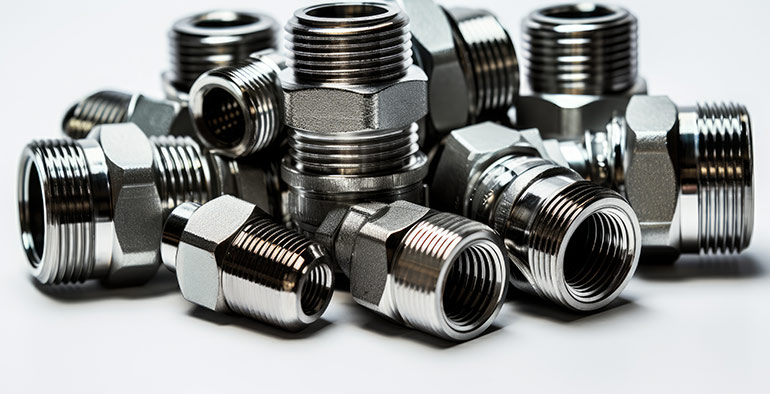
Stainless steel fittings AdobeStock_654624010

However, what’s often forgotten is the potential for harm is much worse than some flakey rust on your elbows, tees and branches. A corroded fitting may simply leak or break entirely, causing expensive loss of fluid or pump dry running at worst. But when the internal surfaces of your fittings begin to corrode, you will have no idea it’s occurring and for how long, but you can bet that iron oxide particles circulating through your hydraulic or pneumatic system will eventually cause damage to expensive pumps, valves and actuators.

It’s clear that stainless steel provides a benefit to fluid power systems exposed to moisture and chemicals, whether internally or externally, so your next step is to choose the alloy appropriate for your application. Stainless steel starts with an iron and carbon base, like most steels, which also uses various elements like manganese and silicon. The primary driver of SS magic is chromium, which must be at least 10.5% concentration by weight. Chromium provides the steel with a surface layer that prevents oxidation, and even despite dents and scratches, it will “self-heal” to ensure an oxidation-resistant surface.

The most common specific alloy used for fluid power is 316, which uses 10-14% nickel to improve corrosion resistance and toughness. As well, 316 alloy uses molybdenum to improve resistance to pitting and crevicing. The 316L variant is a lower carbon recipe that offers superior weldability, making it perfect for larger or custom fittings not produced from machining or forging.

For pneumatic applications where pressure and corrosion demands are more subdued, 303 or 304 alloys may be more suitable. 304 stainless uses a higher content of chromium and carbon but lower nickel, while 303 drops the chromium slightly in favor of increased carbon, sulfur and phosphorus. Both alloys are similar, although 303 comes with increased machinability with a slightly reduced corrosion resistance. Extreme applications may call for alloys such as 17-4 or 2205, although they tend to have specific requirements for aerospace or offshore applications.

316 will usually cost more to manufacture than 303/304, but the performance is commensurate with cost. If your application has a low pressure and corrosion resistance requirement, select 304 alloy. If the same application is produced through a machine tool, then 303 will be more suitable. When in doubt, 316 should handle all but the most extreme fluid power fitting applications.


Filed Under: Components, Engineering Basics, Featured, Fittings, Couplings & Adapters, Hose Assembly Tips


About The Author

Mary Gannon

Mary Gannon is editor of Fluid Power World. She has been a technical writer and editor for more than 13 years, having covered fluid power, motion control and interconnect technologies.

Current Digital Issue

Fluid-Power-World-October-2026-issue-Cover-feature-image-template-copy

  A note from the editor In our October issue of Fluid Power World, my commentary takes a look at the growing role of automation and sensors in mobile machinery, where OEMs are increasingly focused on automating specific functions and improving machine performance rather than chasing fully autonomous equipment. Josh Cosford gets cheeky comparing the auto…

View Back Issues

Subscribe!

Fluid Power World is written by engineers for engineers engaged in designing machines and or equipment in Off-Highway, Oil & Gas, Mining, Packaging, Industrial Applications, Agriculture, Construction, Forestry, Medical and Material Handling. Fluid Power World covers pneumatics, mobile hydraulics and industrial hydraulics.

Fluid Power Design Guides

fluid
“fpw
EXPAND YOUR KNOWLEDGE AND STAY CONNECTED
Get the latest info on technologies, tools and strategies for Fluid Power Professionals.

RSS feed: Featured White Papers Featured White Papers

  • Moving fluid power forward
  • High-force linear motion: How to convert from hydraulic cylinders to electric actuators and why.
  • A technical comparison: Performance of pneumatic cylinders and electric rod actuators
Fluid Power World
  • Hose Assembly Tips
  • Mobile Hydraulic Tips
  • Pneumatic Tips
  • Sealing & Contamination Control Tips
  • About us
  • Contact Us

Copyright © 2026 Arrowfly LLC. All Rights Reserved. The material on this site may not be reproduced, distributed, transmitted, cached or otherwise used, except with the prior written permission of Arrowfly
Privacy Policy | Advertising | About Us

Search Fluid Power World

  • Home
  • Technologies
    • Hydraulics
      • Cylinders & Actuators
      • Filtration/Contamination Control
      • Fittings, Couplings & Adapters
      • Fluids
      • Fluid Conditioning
      • Hose & Tubing
      • Pumps & Motors
      • Related Technologies
      • Sealing
      • Sensors & Gauges
      • Valves & Manifolds
    • Pneumatics
      • Air Preparation & Regulation
      • Compressed Air Technologies
      • Cylinders & Actuators
      • End Effectors & Grippers
      • Fittings, Couplings & Adapters
      • Hose & Tubing
      • Sensors
      • Vacuum
      • Valves & Manifolds
  • Engineering Basics
  • Trending
  • Resources
    • Digital Issues
    • Pneumatics Tech Toolbox
    • Podcasts
    • Special Reports
    • Subscribe to Fluid Power World Print Magazine
    • Videos
    • Webinars / Digital Events
    • White Papers
  • Women in Engineering
    • Women in Fluid Power
    • Women in Engineering
  • Design Guides
  • Classrooms
    • Hydraulic Filtration
    • Hydraulic System Design
    • Pneumatics Classroom
  • Advertise
  • SUBSCRIBE